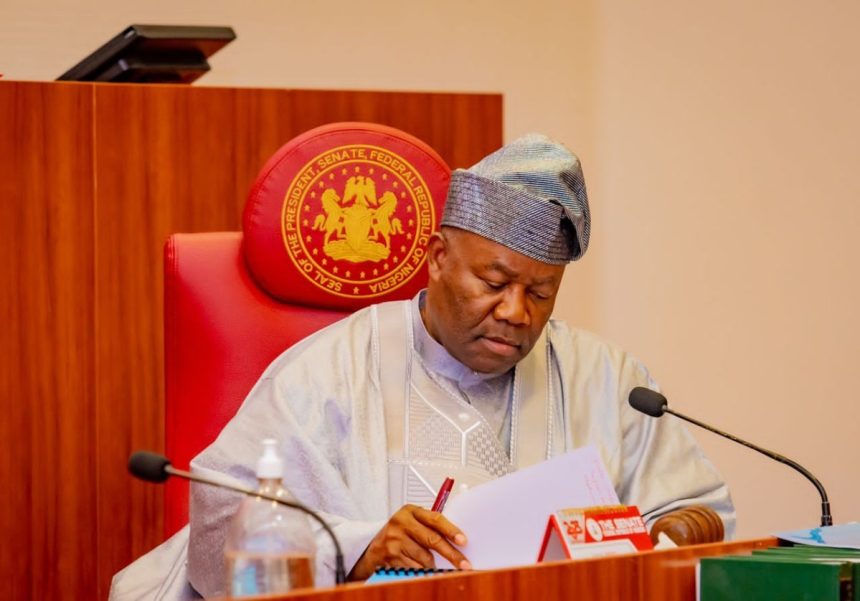
- The African Democratic Congress (ADC) has slammed Senate President Godswill Akpabio, accusing him of lowering Nigeria’s ethical standards through the controversial Electoral Act 2026.
- The party specifically condemned the removal of certificate forgery as a ground for challenging election results, calling it a move to protect the ruling party.
- Akpabio dismissed the opposition’s outcry, claiming that if the opposition is “frowning” at the new laws, it is proof the Senate has done the right thing.
The African Democratic Congress (ADC) has issued a stinging rebuke to Senate President Godswill Akpabio, characterizing his leadership of the National Assembly as “spineless” and “compromised.”
Eko Hot Blog reports that the outcry follows the passage of the Electoral Act 2026, which has introduced significant changes to how elections are contested in Nigeria.
EDITOR’S PICK
- 540 Candidates Cleared as Lagos APC Moves to Elect LGA Executives
- Court Sentences Pastor to Death for Killing UniUyo Student
- Lagos Teacher Questions Lack of Recognition for One-Day Governor Mentors
In a statement released on Sunday by National Publicity Secretary Bolaji Abdullahi, the ADC targeted a specific provision in Section 138 of the new Act.
According to the party, the law now prevents the election of an individual from being challenged on the grounds of certificate forgery.
The ADC argued that this directly contradicts the Nigerian Constitution, which disqualifies any candidate who presents forged documents to INEC from holding public office.
“It is difficult to imagine a more damaging message to send to Nigerians, particularly to our young people, than the suggestion that certificate forgery should no longer have serious consequences,” the statement read.
The verbal exchange began on Saturday when Akpabio, speaking in Uyo, Akwa Ibom State, openly mocked the opposition.
He suggested that their threats to boycott future elections were a sign of unpreparedness rather than principled protest.

Akpabio took aim at the internal crises within the Labour Party and the PDP, suggesting that the opposition was too “distressed” and “confused” to offer any real challenge for 2027.
“Each time we make a law and the opposition frowns, I get excited that I’ve made the right law,” Akpabio said, adding that while the ruling party was busy consulting, the opposition was still struggling to register or find leaders to sign their forms.
The ADC countered this by stating that amendments to laws should advance national interests, not protect individual dishonesty.
They warned that history would judge the current legislature harshly for creating a “rogue democracy” where ethical standards are systematically lowered to favor the elite.
As the political atmosphere heats up ahead of the 2027 cycle, this clash over the Electoral Act 2026 highlights a deep-seated divide over the integrity of the nation’s democratic framework and the moral qualifications required for leadership in Nigeria.