- EDITOR’S PICK
- Politics Has Become a Survival Language
- Social Media Turned Nigerians Into Full-Time Political Commentators
- The Rise of Political Dynasties and “Nepo Politicians”
- The “Obidient” Movement Changed Political Participation Forever
- Nigerian Politics Is Becoming Entertainment
- Children Are Growing Up Inside Political Warfare
- Tribalism Continues To Fuel Political Identity
- Politicians Also Encourage This Culture
- Nigeria Risks Becoming Permanently Politicized
- But Perhaps Nigerians Have No Choice
- Conclusion: Nigeria Is A Nation Constantly Campaigning
- FURTHER READING
Political arguments belonged mostly to party loyalists, journalists, activists, and a handful of older men who gathered under mango trees discussing military governments and failed promises.
EDITOR’S PICK
- Fresh Details Emerge on Death of Odomola Monarch, Oba Adebowale Adeshina
- Sanwo-Olu Applauds LASU’s Academic Excellence After JAMB Ranking
- NRC Moves 176,820 Tonnes Of Cargo Through Lagos Ports In Q1
Today, however, politics has escaped every formal boundary that once contained it. It now lives inside TikTok videos, church WhatsApp groups, Instagram captions, barber shops, podcasts, football conversations, music lyrics, family dinners, and even nursery school jokes.
Nigeria has become a country where virtually everybody is politically charged, not necessarily informed, not always ideological, but emotionally invested.
The mechanic has a manifesto. The influencer has a preferred candidate. The market woman has an economic theory. The comedian has become a political analyst.
The musician subtly endorses parties through coded language. Even children now repeat political slogans they barely understand, sometimes defending politicians with the same emotional aggression adults reserve for football clubs.
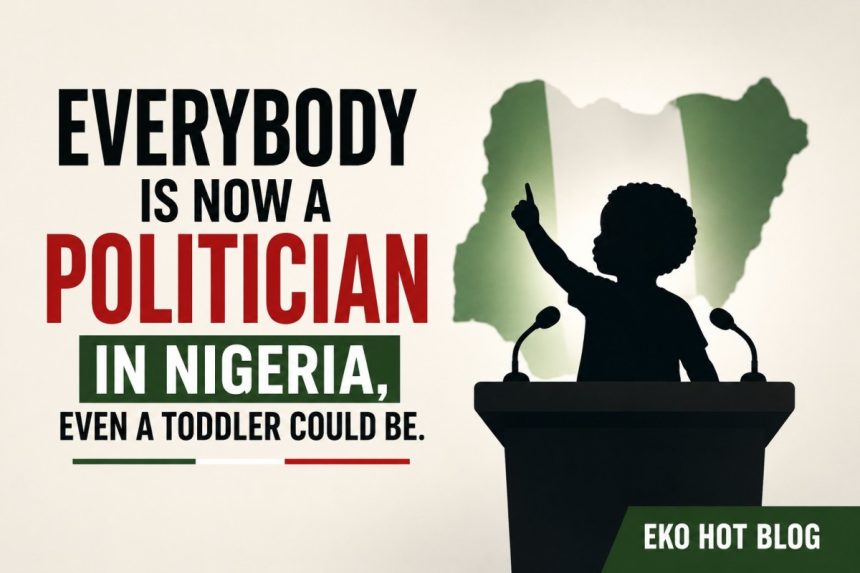
In modern Nigeria, everybody is now a politician. Even a toddler could be.
And perhaps, that says more about the country than Nigerians realize.
Politics Has Become a Survival Language
In many developed societies, politics can feel distant, almost ceremonial. Citizens debate taxation, healthcare, immigration, or foreign policy from a position of relative institutional stability.
In Nigeria, however, politics feels deeply personal because governance affects survival almost immediately and often brutally. A government policy in Abuja can alter the economic rhythm of an ordinary household before sunset.
Fuel prices rise and transport fares double overnight. The naira weakens and food prices become unrecognizable by the following week.
Electricity tariffs increase and small businesses begin shutting down silently. School fees climb beyond reach while salaries remain stagnant.
Under these conditions, political discussion naturally stops being intellectual entertainment and becomes a daily survival language.
This is why political conversations in Nigeria no longer belong exclusively to politicians.
Under the administration of Bola Ahmed Tinubu, economic reforms such as subsidy removal, currency liberalization, and tax restructuring have dominated national debate.
Reuters recently reported that Nigeria’s debt servicing burden could consume nearly half of government revenue, while the government continues defending difficult reforms as necessary long-term adjustments.
To supporters, these reforms represent painful surgery required to rescue a collapsing economy.
To critics, they represent economic shock therapy imposed on already exhausted citizens. Either way, Nigerians cannot escape politics because politics now directly controls daily existence with frightening immediacy.
A bag of rice is political. Electricity is political. Tuition fees are political. Dollar exchange rates are political. Even pure water has become political
When governance enters every aspect of ordinary life, everybody eventually becomes politically vocal, whether they want to or not.
Social Media Turned Nigerians Into Full-Time Political Commentators
The rise of social media transformed political participation in Nigeria more radically than many democratic institutions ever managed to achieve.
Platforms like X, Facebook, TikTok, Instagram, and WhatsApp erased the traditional gatekeepers of political discourse almost overnight. A university student in Akure can now debate national policy directly with a senator in Abuja.
A TikTok creator can shape public opinion faster than an editorial board. A random Twitter thread can dominate national headlines for days.
The result is a country that now appears permanently online and permanently arguing.
Research examining Nigerian online behavior between 2020 and 2025 found that social media significantly intensified political polarization and ideological clustering among users.
Another study on digital discourse observed how online platforms increasingly amplify emotional political conflict rather than nuanced debate.
Nigeria’s political culture is no longer confined to party offices or newspaper interviews. It has become algorithmic.
The more controversial the statement, the more engagement it receives.
The angrier the opinion, the faster it spreads.
This explains why every national issue rapidly transforms into political warfare online. A celebrity comments on fuel prices and immediately becomes either “anti-government” or “a patriot.”
A musician posts a cryptic message and political camps begin decoding hidden endorsements. A footballer likes a politician’s tweet and social media detectives start investigations worthy of intelligence agencies.
Everybody now performs politics publicly, whether intentionally or not.
The Rise of Political Dynasties and “Nepo Politicians”
Another striking feature of modern Nigerian politics is how children of powerful individuals are increasingly stepping into political spaces themselves, sometimes officially, sometimes informally, but almost always visibly. Politics in Nigeria is beginning to resemble inheritance.
Seyi Tinubu has become one of the clearest examples of this evolving reality. Though he does not currently occupy elected office, his public appearances, youth mobilization campaigns, political advocacy, and influence within pro-government circles have made him one of the most recognizable political figures among Nigeria’s younger elite.
According to recent reports, children of prominent politicians increasingly defend their fathers publicly and actively shape political narratives online.
Similarly, discussions around Nigeria’s emerging “political nepo babies” have intensified in recent years.
Eko Hot Blog recently explored how children of influential politicians are becoming deeply embedded within the political machinery surrounding their parents.
What makes this phenomenon fascinating is that these younger figures are not merely inheriting surnames; they are inheriting political audiences, online influence, and emotional loyalty structures already built by their families.
Even outside traditional politics, celebrity children and wealthy heirs increasingly flirt with political relevance.
DJ Cuppy, for instance, has openly expressed ambitions that touch governance, leadership, and youth influence, while using her social visibility to engage civic conversations.
Nigeria is slowly producing a generation raised inside political privilege, where governance is no longer just a public institution but family ecosystem.
The “Obidient” Movement Changed Political Participation Forever
One of the clearest examples of Nigeria’s political transformation emerged during and after the 2023 elections through the rise of the “Obidient” movement surrounding Peter Obi.
For many young Nigerians, the movement became more than electoral support.
It evolved into identity, culture, online community, and emotional resistance against an older political establishment many considered deeply corrupt and disconnected.
Political engagement suddenly became fashionable among demographics previously dismissed as apathetic.
Young Nigerians who once ignored elections started learning voter registration procedures, analyzing economic statistics, fact-checking interviews, attending rallies, and debating governance online with surprising intensity.
But the movement also revealed something deeper about modern Nigerian politics: support for politicians increasingly resembles fan culture.
Political loyalty now behaves like football fandom.
Politics has become emotionally consumable content, and that transformation carries dangerous implications for democratic reasoning.
Nigerian Politics Is Becoming Entertainment
The line between governance and entertainment continues disappearing at alarming speed. Political interviews trend like reality television clips. Campaign slogans become memes.
Senate drama becomes comedy material before sunset. Governors dance publicly to maintain relatability. National crises are processed first through humor before seriousness enters the conversation.
When citizens lose trust in institutions, satire becomes coping mechanism. But there is a consequence.
When politics becomes entertainment, substance often dies quietly beneath spectacle.
Many Nigerians now consume politics through snippets, insults, edited clips, propaganda videos, and emotionally manipulative content rather than policy analysis or institutional literacy.
Complex economic reforms are reduced to hashtags. Security failures become tribal debates. Everything becomes binary.
A person with accurate information may receive less attention than somebody confidently spreading conspiracy theories inside a thirty-second video clip. That is partly why misinformation spreads rapidly during elections and national controversies.
Children Are Growing Up Inside Political Warfare
Perhaps the most disturbing development is how deeply politics has entered childhood spaces.
Nigerian children now repeat political insults heard from parents. Teenagers inherit political enemies before understanding governance itself. Primary school pupils recognize party symbols faster than historical figures.
A toddler dancing to campaign songs may appear harmless or amusing, but it reflects how saturated the national atmosphere has become.
Digital exposure accelerated this process dramatically. Research examining adolescent internet behavior in Nigeria found that young people are increasingly immersed in online ecosystems shaped by algorithms, trends, outrage culture, and political exposure.
Many Nigerian children are growing up in homes where politics is no longer occasional discussion but constant emotional climate.
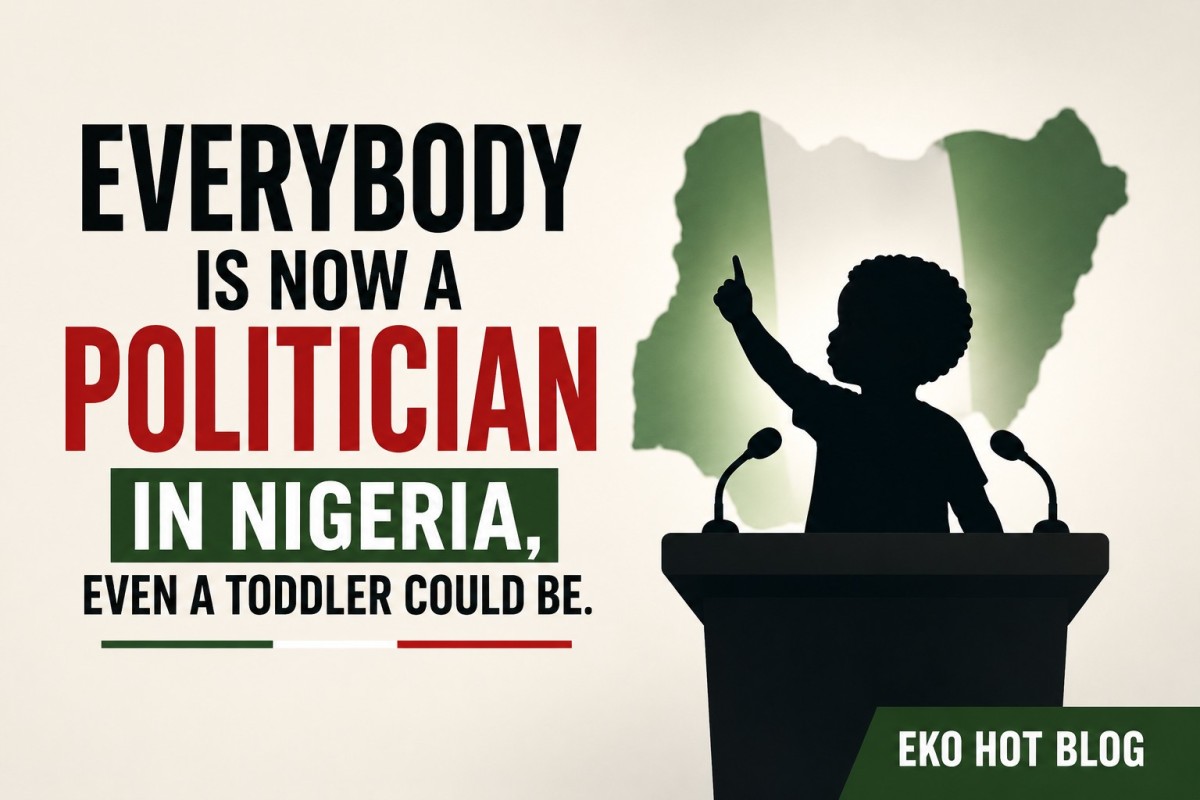
This creates future citizens who may inherit polarization before developing independent reasoning or civic maturity.
Tribalism Continues To Fuel Political Identity
Nigeria’s politics has always carried ethnic and regional tensions, but social media intensified them dramatically. Political disagreements that should center on policy frequently collapse into ethnic suspicion and identity warfare.
A person criticizes government policy and immediately gets accused of tribal hatred.
Another praises a political figure and becomes labeled ethnically compromised.
This pattern has damaged rational national conversation profoundly.
Studies examining Nigerian online electoral discourse describe how political “othering” increasingly shapes interactions across party and ethnic lines. The result is exhausting political paranoia where Nigerians spend enormous emotional energy defending politicians who may never know they exist.
Politicians Also Encourage This Culture
Nigerian politicians understand the emotional economy of modern politics extremely well. They know outrage keeps them relevant.
They know controversy drives engagement. They understand that emotionally loyal supporters will defend almost anything online.
This explains why political communication increasingly targets emotion rather than policy.
Supporters defend their leaders with religious intensity. Critics respond with equal aggression. Online communities amplify both extremes until facts disappear beneath emotional warfare.
Reddit discussions among Nigerians increasingly reflect this frustration, with many users describing Nigerian politics as permanently polarized and emotionally exhausting.
This cycle benefits politicians because emotionally divided citizens are easier to mobilize, easier to distract, and easier to manipulate.
Nigeria Risks Becoming Permanently Politicized
Political awareness itself is not dangerous. In fact, citizen participation remains essential for democratic survival. The danger begins when politics consumes everything else.
Nigeria risks becoming a nation where every conversation transforms into ideological battle.
Already, many Nigerians no longer ask whether an opinion is intelligent. They first ask what political camp the speaker belongs to.
That is unhealthy for democracy because democracy requires disagreement without dehumanization.
But Perhaps Nigerians Have No Choice
Still, blaming Nigerians entirely would be intellectually dishonest. People become politically obsessed when systems fail repeatedly and leadership disappoints consistently.
Citizens become emotionally reactive when insecurity persists, inflation rises, unemployment deepens, and corruption scandals continue endlessly. Under such conditions, politics stops feeling theoretical and becomes survival psychology.
The average Nigerian is not discussing politics merely for entertainment.
Many are discussing rent, school fees, food, transportation, healthcare, migration, hope.
That is why politics now dominates the national bloodstream so aggressively, because Nigerians are desperately attempting to negotiate their future in real time.
Conclusion: Nigeria Is A Nation Constantly Campaigning
Nigeria today feels like a country permanently campaigning, permanently arguing, permanently defending, permanently reacting. Everybody has become a political commentator, an analyst, a propagandist, or an opposition spokesperson.
And yes, even toddlers now absorb the language of political conflict before they fully understand arithmetic.
But beneath all the noise lies an uncomfortable truth:
- Nigerians are not obsessed with politics because they simply love politics.
- They are obsessed with politics because politics determines whether they survive comfortably or struggle endlessly.
Until governance becomes less painful and institutions become more trustworthy, politics will continue invading every Nigerian conversation, every Nigerian household, every Nigerian timeline, every celebrity space, every family structure, and every Nigerian childhood.