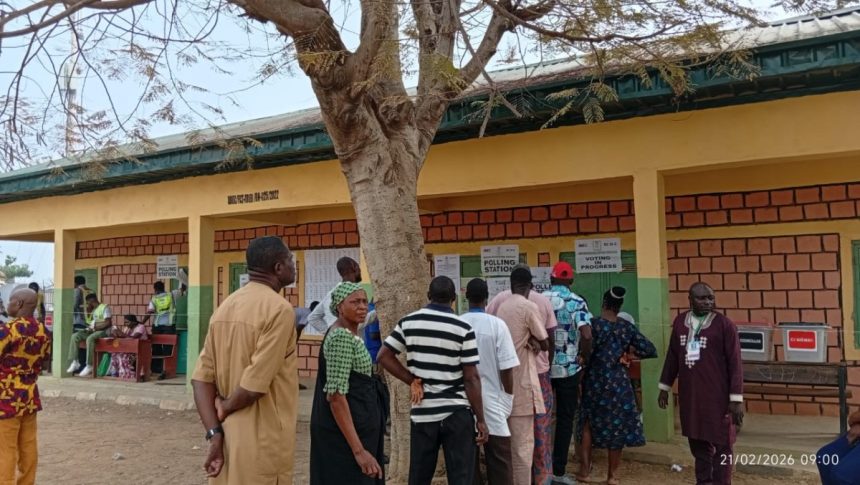
When the results of Saturday’s Federal Capital Territory area council elections trickled in, they told a story the opposition can no longer afford to ignore.
The All Progressives Congress (APC) swept five of six chairmanship seats, leaving the Peoples Democratic Party with just one — Gwagwalada — and the African Democratic Congress (ADC), a coalition many had billed as the future of opposition politics, without a single win.
EDITOR’S PICKS
For a country where the ruling party’s governance has drawn widespread criticism, the outcome was striking. It was also instructive. EKO HOT BLOG explores what the opposition should learn from the disappointing outing.
Numbers That Should Worry the Opposition
The APC’s victory was not merely symbolic. In the Abuja Municipal Area Council, incumbent Christopher Maikalangu won with 40,295 votes — more than three times the votes of his nearest rival. In Kuje, the margin was razor-thin: 17,269 votes to the PDP’s 15,824. But even that close result went to the APC. Only in Gwagwalada did the opposition break through, with the PDP’s Mohammed Kasim polling 22,165 votes against the APC’s 17,788.
For the ADC — which has positioned itself as the big-tent alternative ahead of 2027 — the results were particularly sobering. Zero seats. Not one. This is a coalition that includes seasoned political figures and commands significant media attention. Yet on election day, it could not convert visibility into votes. That gap between noise and results is perhaps the most urgent lesson the opposition must confront.
Unpopularity Is Not Enough
There is a tempting argument circulating in opposition circles: that the APC is so unpopular across much of Nigeria that 2027 will be its reckoning.
Fuel prices remain punishing. The cost of food has pushed millions closer to the edge. Hundreds of Nigerians are being killed or kidnapped every week in different parts of the country, yet the government’s response often feels inadequate. Surely, the argument goes, voters will rise up and throw the incumbents out.
The FCT results suggest otherwise. Unpopularity does not automatically translate into electoral defeat, particularly when the opposition has not done the hard work of convincing voters that it is a credible, competent alternative. People do not vote against a government simply because they are suffering. They vote for something or someone they believe in. If the opposition cannot make that case clearly and convincingly, many voters will stay home, or worse, stick with the devil they know.
Low voter turnout, which characterised these FCT polls, is not a neutral outcome. It tends to favour incumbents with established structures, loyal foot soldiers, and the machinery to mobilise their base. An opposition that relies on public anger to do the campaigning for it will find that anger alone does not queue up at polling units.
What 2027 Demands
The road to 2027 requires more than a coalition announcement and a press conference. It demands a strategy built on three foundations: a compelling vision, earned trust, and aggressive mobilisation.
Opposition parties must articulate, in plain and specific language, what they would do differently — on security, on the economy, on governance — and take that message directly to voters in markets, motor parks, places of worship, and town halls. Nigerians need to hear more than complaints about the APC; they need to believe, genuinely, that the alternative is better.
Trust, once lost, is rebuilt slowly. The PDP governed Nigeria for 16 years and left behind a complex legacy. The ADC is still finding its footing. Neither can afford vague promises. Voters in 2027 will be watching not just for what candidates say, but whether their parties have the discipline and seriousness to govern.
Finally, the opposition must invest in voter mobilisation as seriously as it invests in litigation and media relations. The FCT polls showed what happens when turnout is low: structures win. Building those structures — ward by ward, local government by local government — is unglamorous work. But it is the only work that counts on election day.
FURTHER READING
The APC’s FCT victory is not proof that it cannot be beaten. It is proof that beating it will require far more than waiting for it to fail.
Philip Ibitoye is a Special Correspondent with EKO HOT BLOG. Click here to find daily analysis and critical insight on trending issues in Lagos and other parts of Nigeria.
Click to watch the video of the week below: