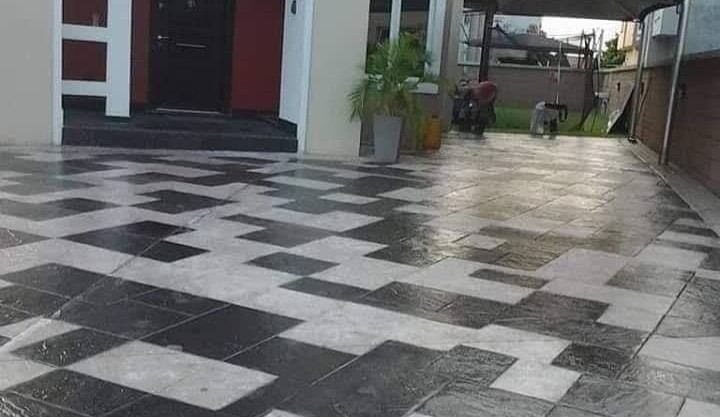
An exchange on X between a Lagos resident and the state’s Commissioner for Environment and Water Resources, Tokunbo Wahab, on Tuesday, has brought attention to an overlooked contributor to the city’s persistent flooding problem: the widespread practice of paving entire residential compounds with concrete and tiles.
The resident suggested that when homeowners cement or tile their compounds completely, it prevents rainwater from soaking into the ground, forcing every drop into drainage system. Wahab agreed, stating that the Lagos State Building Control Agency (LASBCA) would address the issue, adding that “Lagos cannot be turned to concrete jungle.”
You are right. And the State Building Control Agency (LASBCA) will address that. Lagos cannot be turned to concrete jungle. https://t.co/HLlWBmmBGz
— Tokunbo Wahab (@tokunbo_wahab) February 10, 2026
EDITOR’S PICKS
EKO HOT BLOG explores all the angles, including whether restrictions on concrete floors are a complete solution.
The Science Behind the Concern
When rain falls on natural soil or grass, much of it infiltrates the ground, replenishing underground water and reducing surface runoff. Trees and vegetation also absorb water through their roots. However, when surfaces are paved with concrete or tiles, water has nowhere to go but into drains.
During heavy rainfall, this creates a surge of water entering drainage systems simultaneously from thousands of compounds across the city. Even well-maintained drains can become overwhelmed when they must handle water that would otherwise have been absorbed by soil and plants.
Research from urban planning studies worldwide shows that cities with high percentages of impermeable surfaces — concrete, asphalt, tiles — experience more frequent and severe flooding than those that preserve green spaces and natural drainage.
Is This the Main Problem?
Whilst the contribution of paved compounds to flooding is real, it would be misleading to present this as the primary cause of Lagos’s flooding challenges. The city faces multiple, interconnected drainage problems.
Lagos’s drainage infrastructure is often inadequate for the city’s population and rainfall patterns. Many drains are poorly maintained, blocked with refuse, or simply too small for the volume of water they must carry. Some areas lack proper drainage systems entirely.
Unplanned development, particularly building on wetlands and natural water channels, has also reduced the city’s capacity to manage heavy rainfall. When natural floodplains are built upon, water that once spread harmlessly across open land is forced into residential areas.
Climate change is intensifying rainfall patterns, with shorter but more intense downpours that test even well-designed drainage systems.
Shared Responsibility
The exchange between the resident and Wahab highlights an important truth: addressing Lagos’s flooding requires action from both government and residents.

Government responsibilities include building and maintaining adequate drainage infrastructure, enforcing planning regulations to prevent building on floodplains, ensuring regular clearing of drains and channels, and investing in large-scale flood management systems.
However, individual choices also matter. When millions of homeowners independently decide to pave their entire compounds, the cumulative effect on the city’s water management is significant. A single paved compound may contribute only slightly to neighbourhood flooding, but thousands of them together create measurable impact.
What Could Regulation Look Like?
If LASBCA does introduce guidelines on permeable surfaces, several approaches are possible. Building regulations could require that a minimum percentage of each compound remains unpaved to allow water infiltration. Approval processes for new buildings could include drainage plans showing how rainwater will be managed on the property.
Enforcement presents challenges. Lagos has millions of existing homes with fully paved compounds. Retrospectively requiring changes would be both politically difficult and practically complex. New buildings offer a more realistic starting point for regulation.
Public education may prove as important as regulation. Many homeowners are unaware that their paving choices contribute to neighbourhood flooding. If residents understand the connection, some may voluntarily maintain green spaces.
The Bigger Picture
Reducing flooding in Lagos will require coordinated effort across multiple fronts: improved drainage infrastructure, better urban planning, climate adaptation measures, and yes, reconsidering how residential compounds are designed.
The question is not whether restricting concrete floors alone will solve Lagos’s flooding problem— it will not. The question is whether it can be one useful component of a broader strategy. The evidence suggests it can, provided it is accompanied by the government meeting its own responsibilities to build and maintain the public infrastructure the city desperately needs.
FURTHER READING
Whether Wahab’s promise translates into actual policy remains to be seen. However, it is clear that both government and residents have roles to play in making Lagos more resilient to the rains that will keep coming.
Philip Ibitoye is a Special Correspondent with EKO HOT BLOG. Click here to find daily analysis and critical insight on trending issues in Lagos and other parts of Nigeria.
Click to watch the video of the week below: