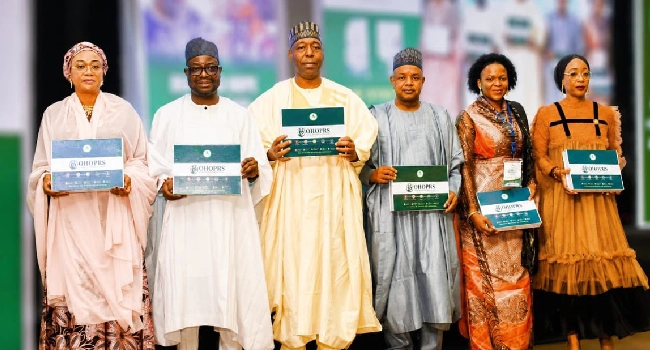
The Federal Government, on Wednesday, launched a $1 billion social protection scheme, the Household Prosperity and Economic Social Protection Project (HOPE-SP), targeting 7.6 million vulnerable households across Nigeria.
Unveiled at the State House, Abuja, by First Lady Oluremi Tinubu, the programme is billed as a shift “from palliatives to pathways,” moving households from one-off cash handouts to a structured route out of poverty.
EDITOR’S PICKS
Under HOPE-SP, eligible households will get a one-off digital transfer of ₦40,000, provided they are on the National Social Register and their identity checks out with their National Identification Number.
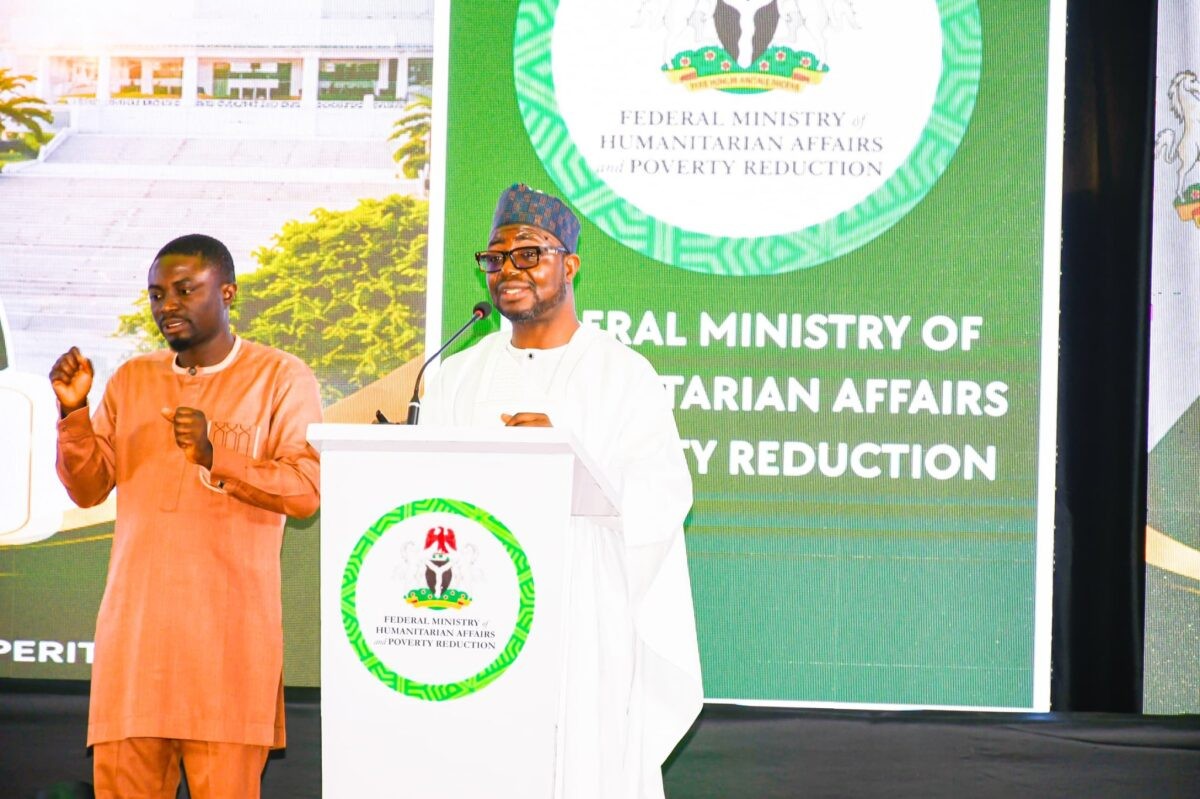
The launch came on the same day the Minister of Humanitarian Affairs and Poverty Reduction, Bernard Doro, claims in an interview on Politics Today, a Channels Television programme, that over ₦600 billion has already been paid to more than 10 million households in the last three years.
Doro says the new scheme will link identification, needs assessment, protection, empowerment and “poverty graduation” into one coordinated system, called OHOPRS.
A Familiar Promise, A New Name
Nigeria has tried cash-based poverty interventions before, and the results have been mixed at best. The National Social Register itself, which HOPE-SP will draw from, already holds 20 million households, meaning the new scheme covers well under half of those officially classified as vulnerable.
That gap alone raises the first hard question: what happens to the other 12.4 million households not captured this round?
There is also a naming and coordination problem. HOPE-SP now sits alongside HoPE-CT, an existing $800 million World Bank-backed cash transfer scheme reportedly targeting up to 15 million households, and separate World Bank-funded programmes like HOPE-GOV and HOPE-PHC.
The government has not clearly explained how HOPE-SP differs from HoPE-CT, or whether the two overlap. For a public already sceptical of shifting acronyms and rebranded schemes, this is important.
Doro’s own justification for OHOPRS was to end “fragmentation, duplication and multiple uncoordinated registries,” an admission that past interventions suffered exactly the confusion HOPE-SP now risks repeating under a new name.
What “Pathways” Actually Means Is Still Unclear
The government has been specific about what a palliative is: a single cash payment during a shock. It has been far less specific about what a “pathway” actually looks like in practice.
The humanitarian affairs ministry describes a sequence — identification, needs assessment, empowerment, graduation — but has not said what tools will move a household from one stage to the next. Will there be skills training? Business grants? Microloans? Job placement? None of these have been named.
Other countries offer a template.
Rwanda’s Imibereho registry links social protection to skills programmes and health insurance, reaching 13.8 million people through insurance alone. Brazil’s Cadastro Único connects 94.5 million people to more than 60 federal programmes covering housing and vocational training.
Both systems work because the “pathway” beyond cash is concrete and measurable. HOPE-SP has announced the destination — self-reliance — without yet showing the road.
Promise Versus Proof
None of this means HOPE-SP is destined to fail. A shift toward tracking households over time, rather than simply disbursing one-off payments, is a reasonable response to years of criticism that palliatives change nothing structurally. The involvement of the World Bank and EU as observers, and the government’s own acknowledgment of past coordination failures, suggest some lessons have been absorbed.
But a $1 billion price tag and a hopeful slogan are not, on their own, evidence of a working system. The real test will be whether OHOPRS delivers a genuinely unified registry, whether “empowerment” translates into specific, fundable interventions, and whether households that receive the ₦40,000 transfer are still being tracked — and supported — a year or two from now.
FURTHER READING
Until those details are public, HOPE-SP remains a promising framework rather than a proven solution. Nigeria has heard versions of this pitch before. What is different this time is something only implementation, not the launch ceremony, can prove.
Philip Ibitoye is a Special Correspondent with EKO HOT BLOG. Click here to find daily analysis and critical insight on trending issues in Lagos and other parts of Nigeria.
Click to watch the video of the week below: