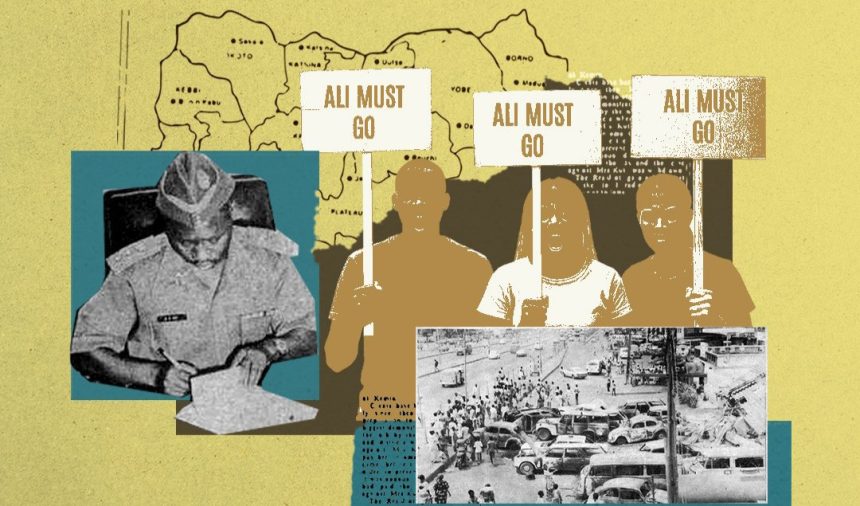
In April 1978, a storm of youthful defiance rolled through Nigeria’s universities. What began as a policy announcement from the National Universities Commission (NUC) quickly ignited into one of the most dramatic student uprisings in the nation’s history — the “Ali Must Go” protests.
A DRUM Magazine report from 1978, archived by Archivi.ng and obtained by EKO HOT BLOG, NUC had declared an increase in boarding fees for university students across the country.
EDITOR’S PICKS
Under the new policy, undergraduates were required to pay ₦378 for feeding and ₦90 for lodging per academic session — a sharp rise that the Commission said was necessary to rescue the universities from financial hardship.
But for students already struggling under economic strain, the decision felt like a betrayal. The National Union of Nigerian Students (NUNS), led by the charismatic Segun Okeowo, swiftly called for a nationwide boycott of lectures and a coordinated protest.
Soon, campuses from Lagos to Ibadan, Ife, Zaria, Benin, and Jos erupted with chants of “Ali Must Go!” — a direct rebuke to the Federal Commissioner for Education, Colonel Ahmadu Ali, whom students blamed for the hike despite claiming that the Supreme Military Council (SMC) made the decision.
From Protest to Tragedy
The demonstrations started peacefully but escalated rapidly. On the second day, police stormed several campuses in an attempt to “restore order.” The ensuing chaos turned deadly.
At the University of Lagos (UNILAG), Akintunde Ojo, a third-year student in the Faculty of Environmental Design, was shot dead. In Zaria, Amuda Nuhu, Najib Jibrin, Nuhu Yusuf, and Alhassan Sule — all students of Ahmadu Bello University — were killed as bullets tore through the protesting crowds.
The week became one of the darkest in Nigeria’s student history. Streets emptied, campuses shut down, and the air thickened with grief and fear.
Government’s Iron Response
The Federal Government, under the military regime of General Olusegun Obasanjo, reacted with characteristic force. All universities were ordered closed. The National Union of Nigerian Students (NUNS) was banned, its accounts frozen, and its leader, Segun Okeowo, was rusticated from UNILAG.
In a tone that reflected the hardline posture of the era, the target of the protests, Colonel Ali, issued a blunt statement of triumph.
“I warned them to desist from that path, since they would be the loser. It is now common knowledge that they did not heed my warning,” Ali said.
A Costly Victory
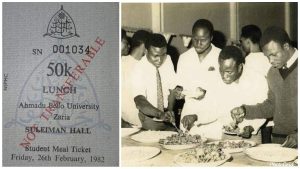
After the bloodshed and nationwide condemnation, the government quietly reversed the decision that had sparked the crisis. Students were told to pay 50 kobo per meal instead of the proposed ₦1.50, reducing total feeding costs for a session of 36 weeks to ₦126 instead of ₦378.
FURTHER READING
Yet, while the students “won” the argument, the price was devastatingly high. Lives were lost, dreams were shattered, and the voice of organized student activism was silenced for years to come.
Philip Ibitoye is a Special Correspondent with EKO HOT BLOG. Click here to find daily analysis and critical insight on trending issues in Lagos and other parts of Nigeria.
Click here to watch the video of the week below: