- Scientists say a massive glacier collapse likely triggered devastating floods in Nepal and Tibet.
- More than 160 people have reportedly been killed, while hundreds remain missing.
- Experts warn that rising temperatures may be increasing instability in the Himalayas.
The scientists have linked the devastating flash floods that swept through parts of Nepal and Tibet to the collapse of a glacier in the Himalayas.
Eko Hot Blog reports that the disaster, which has left more than 160 people dead and hundreds of others missing, struck after a huge mass of ice and rock reportedly broke away from a glacier near Langtang Lirung in Nepal.
EDITOR’S PICK
- How Lagos Achieved 57.4% Exclusive Breastfeeding Rate
- Shaibu Lists Nigeria’s Biggest Security Challenges
- Vote, Protect Your Mandate, Governor Adeleke Urges Residents Ahead of August 15 Polls.
Experts examining satellite imagery believe the collapsed ice and debris plunged into a valley from a high altitude, triggering a powerful surge that rushed into the Lhende Khola river.
The resulting flood carried enormous volumes of water, mud, rocks and other debris downstream, destroying communities and damaging major infrastructure, including roads, bridges and hydropower facilities near the Nepal-China border.
Initial reports had suggested that an earthquake may have triggered a landslide in the area.
However, the United States Geological Survey later clarified that the seismic activity recorded during the disaster was caused by the collapse of glacial ice and rock and the massive debris flow that followed, rather than a conventional earthquake.
Scientists studying the incident said the collapse may have started on the slopes of Langtang Lirung, about 15 kilometres from the areas most severely affected by the flooding.
The force generated by the falling mass of ice and rock was reportedly so powerful that it produced seismic energy equivalent to a magnitude 5.2 event.
While investigators have yet to determine the exact cause of the glacier collapse, experts say rising temperatures could be contributing to growing instability across the Himalayan region.
Climate change has been linked to the shrinking of glaciers and the thawing of permafrost, permanently frozen ground that helps support steep mountain slopes.
Scientists say the weakening of glaciers and mountain terrain can increase the risk of glacier collapses, landslides and other disasters that can trigger devastating floods downstream.
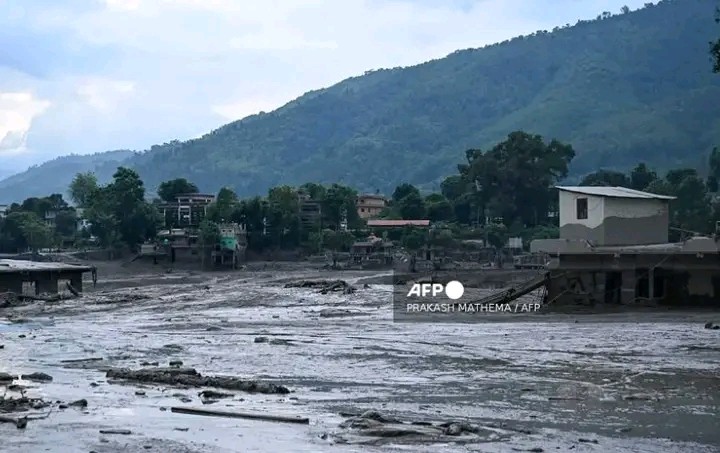
However, experts have cautioned against directly attributing Wednesday’s disaster solely to climate change.
They said warming temperatures may instead have created conditions that made the glacier and surrounding terrain more unstable and vulnerable to collapse.
The tragedy has renewed concerns over the growing dangers faced by communities living in the Himalayas, where rapidly changing ice and snow conditions, steep mountain landscapes and powerful rivers can combine to produce sudden and difficult-to-predict disasters.
Rescue operations are continuing in affected areas on both sides of the Nepal-China border as authorities search for survivors and work to determine the full extent of the destruction.
FURTHER READING