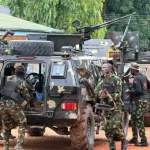
- The United Nations has confirmed that a significant cache of weaponry looted during the 2011 Libyan conflict has successfully crossed regional borders into the hands of extremist groups operating within Nigeria.
- UN Under-Secretary-General and High Representative for Disarmament Affairs, Izumi Nakamitsu, noted that weapons from concluded wars continue to circulate illegally, undermining peacebuilding long after headlines fade.
- International disarmament investigators are facing severe tracking hurdles due to the rise of sophisticated trafficking networks, 3D-printed firearms, and untraceable “ghost guns”.
A high-level briefing at the United Nations Headquarters in New York has exposed a direct operational link between the 2011 Libyan conflict and the ongoing security challenges in Nigeria.
Eko Hot Blog reports that the UN Under-Secretary-General and High Representative for Disarmament Affairs, Izumi Nakamitsu, revealed that weapons systematically looted or diverted during the civil war that ended Muammar Gaddafi’s regime have effectively cascaded across the wider Sahel region.
EDITOR’S PICK
- Fresh Details Emerge on Death of Odomola Monarch, Oba Adebowale Adeshina
- Sanwo-Olu Applauds LASU’s Academic Excellence After JAMB Ranking
- NRC Moves 176,820 Tonnes Of Cargo Through Lagos Ports In Q1
Nakamitsu stated that these illicit arms have surfaced in Niger, Burkina Faso, and Nigeria, with a substantial portion subsequently recovered from extremist groups, illustrating how a singular historical conflict can destabilize an entire continent over a decade later.
While the international body did not provide the exact volume of arms and ammunition that crossed Nigerian borders, officials stressed that the cessation of a war never guarantees the containment of its weaponry.
Throughout sub-Saharan Africa, the unmonitored proliferation of small arms continues to compromise fragile peace building efforts.
When armed groups, localized militias, or civil communities retain firearms under the guise of self-protection, it routinely triggers a cyclical renewal of violence and instability.
The UN explicitly tied the circulation of these illicit weapons to systemic human rights abuses, domestic terrorism, and spikes in sexual and gender-based violence.
Compounding these traditional security threats is the rapid modernization of illegal weapon manufacturing.
Disarmament experts expressed profound concern over the emergence of 3D-printed firearms and disassembled weapon parts designed specifically to bypass international tracing systems.
To counter these sophisticated trafficking rings, the UN is urging member states to aggressively enforce the global frameworks established under the 2001 program of action and the 2005 International Tracing Instrument.
These frameworks provide standard markers for tracking how illegal armaments enter black markets, and the UN continues to offer technical assistance and border-control capacity building to help sovereign governments secure their sovereign territory.