- Nigeria and Cameroon have formalised a milestone Memorandum of Understanding on bilateral defence cooperation, focusing directly on securing their shared terrestrial southern border and expanding maritime safety.
- Signed in Yaoundé, the new operational protocol establishes a modernized framework for real-time intelligence sharing, coordinated cross-border joint operations, tactical military training, and logistics synchronization.
- Beyond border patrol, the pact opens collaborative pathways for indigenous military hardware production, with Nigeria offering its Defence Industries Corporation framework for joint regional technology transfers.
The federal governments of Nigeria and Cameroon have taken a decisive step toward stabilizing the West and Central African sub-regions by signing a comprehensive Memorandum of Understanding to deepen bilateral defence cooperation.
Eko Hot Blog reports the high-profile signing ceremony occurred on Wednesday in Yaoundé, the Cameroonian capital, marking the successful conclusion of two days of intensive, closed-door strategic deliberations by top-tier defence, intelligence, and border security experts from both sovereign nations.
EDITOR’S PICK
- Hamzat Appoints Obanikoro as Campaign DG Ahead of 2027 Lagos Governorship Race
- Tinubu’s State Police Plan Gains Momentum as Amendment Looms
- Residents Raise Alarm After Two Bodies Found in Lagos Waterway
The pact addresses longstanding security concerns along the shared terrestrial corridors and responds directly to the shifting landscape of transnational crime across their borders.
According to an official statement released by Leah Katung-Babatunde, the media aide to Nigeria’s Minister of Defence, the newly activated agreement modernizes and structures how both armed forces interact across territorial and maritime spaces.
Under this institutionalized framework, both nations are legally and operationally bound to step up intelligence sharing, align tactical operational coordination, provide mutual logistics support, and establish robust personnel exchange programs.
Crucially, the agreement lays down a formalized, swift collective response mechanism designed to tackle sudden, emerging security challenges before they escalate into diplomatic or territorial crises.
A central piece of the bilateral discussions was the immediate operationalisation of the Combined Maritime Joint Task Force.
Defence chiefs from both countries described the naval platform as a highly strategic tool for protecting critical economic assets and curbing piracy within the wider Gulf of Guinea, an area where both Nigeria and Cameroon function as dominant maritime stakeholders.
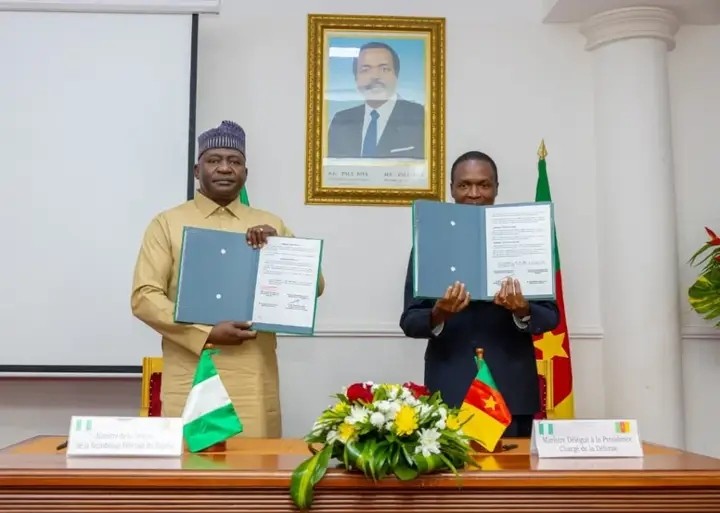
Striking a note on long-term self-reliance, Nigeria’s Minister of Defence, General Christopher Musa (retd), highlighted that a historical weakness in African defense has been an over-reliance on foreign military hardware.
He strongly urged regional industrial partnerships, positioning the repositioned Defence Industries Corporation of Nigeria as an open launchpad for shared military manufacturing, research, and technical innovation.
In his response, Cameroon’s Minister Delegate at the Presidency in Charge of Defence, Mr. Joseph Assomo, welcomed the defense technology partnership, confirming that his ministry is finalizing a structured proposal to bring the technical manufacturing collaboration to life.
This diplomatic breakthrough arrives at a critical moment for local border communities; just days prior, reports of alleged incursions by Cameroonian forces into the Danare community within Cross River State’s Boki Local Government Area had triggered significant public anxiety.
By establishing clear lines of communication, the newly signed pact is expected to defuse such localized border frictions, ensuring absolute respect for national sovereignty while maintaining a unified front against shared security threats.