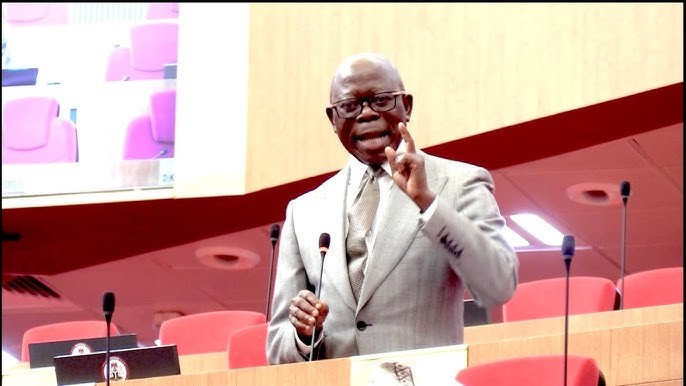
Senator Adams Oshiomhole did not come to the Senate floor on Tuesday to mourn.
“I don’t want this senate to be shedding tears to sympathise with those who have died,” the Edo North senator said, as legislators debated the latest wave of xenophobic attacks against Nigerians in South Africa.
EDITOR’S PICKS
“If you hit me, I hit you.”
His prescription was: revoke the operating licences of South African companies in Nigeria — MTN and MultiChoice, operators of DStv, specifically named.
The Senate declined to adopt that position. But the argument — that economic pain is the only language Pretoria will understand — has not gone away. The House of Representatives went further, recommending a temporary suspension of business permits for South African companies and a review of trade and aviation treaties between both countries.
The question is whether any of this would actually work.
The Case For Economic Pressure
The frustration behind Oshiomhole’s position is legitimate and grounded in hard facts. Two Nigerians — Ekpenyong Andrew and Amaramiro Emmanuel — were killed in separate incidents in April 2026, both involving South African security personnel.
These were not mob attacks by civilians. They were killings by agents of the South African state. At that point, the argument that Nigeria should respond only with diplomatic notes and fact-finding visits becomes difficult to sustain.
The economic leverage is also real. MTN and MultiChoice are not peripheral players in Nigeria — they are among the most profitable foreign businesses operating on Nigerian soil. Oshiomhole’s logic is straightforward: if South Africa’s government will not protect Nigerians from its own security forces, Nigeria should make the cost of that inaction visible in Johannesburg’s boardrooms.
The House of Representatives reinforced this, recommending a review of bilateral relations including trade and aviation treaties, targeted economic measures, and a review of tax incentives enjoyed by existing South African firms in Nigeria, pending demonstrable steps by South Africa to halt the attacks, prosecute perpetrators, and compensate victims.
Why the Debate Is Bigger Than MTN and DStv
The counterargument — offered by Senate President Godswill Akpabio, who underscored the importance of diplomatic engagement and said economic retaliation against businesses would not be the preferred course of action [Anti-Apartheid Movement Archives](https://www.aamarchives.org/history/front-line-states.html) — is not wrong on principle. But it is weakened by the record. Xenophobic violence against Nigerians in South Africa is not new. Major outbreaks occurred in 2008, 2015, and 2019. Each time, Nigeria summoned envoys, issued condemnations, and recalled ambassadors. Each time, the attacks returned.
Nigeria’s Minister of Foreign Affairs, Bianca Odumegwu-Ojukwu, is already in South Africa for diplomatic talks, with the government also considering the possible evacuation of affected citizens. [ResearchGate](https://www.researchgate.net/publication/382819138_Nigeria_Zimbabwe_and_the_Struggle_for_Black_Majority_Rule_in_South_Africa/fulltext/66ad4ea92361f42f23af2705/Nigeria-Zimbabwe-and-the-Struggle-for-Black-Majority-Rule-in-South-Africa.pdf) The Senate has resolved to send a joint National Assembly delegation to Pretoria. These are the familiar instruments of a familiar response to a recurring crisis.
The deeper problem is that economic retaliation, however satisfying in principle, carries its own risks. Revoking MTN’s licence does not protect a Nigerian standing in a Durban street. It could, however, cost thousands of Nigerians their jobs, trigger legal disputes that drag through international arbitration for years, and hand Pretoria a grievance that distracts from its own accountability.
FURTHER READING
Oshiomhole is right that Nigeria needs leverage. The question is whether blunt economic punishment is the most effective form of it, or whether targeted measures — suspending new business permits, freezing bilateral trade negotiations, grounding South African Airways routes — apply pressure more precisely without Nigeria bearing the collateral damage.
Philip Ibitoye is a Special Correspondent with EKO HOT BLOG. Click here to find daily analysis and critical insight on trending issues in Lagos and other parts of Nigeria.
Click to watch the video of the week below: