BY RILWAN BALOGUN
What do we know as charity? Is it in our case, the practical failure of governance?
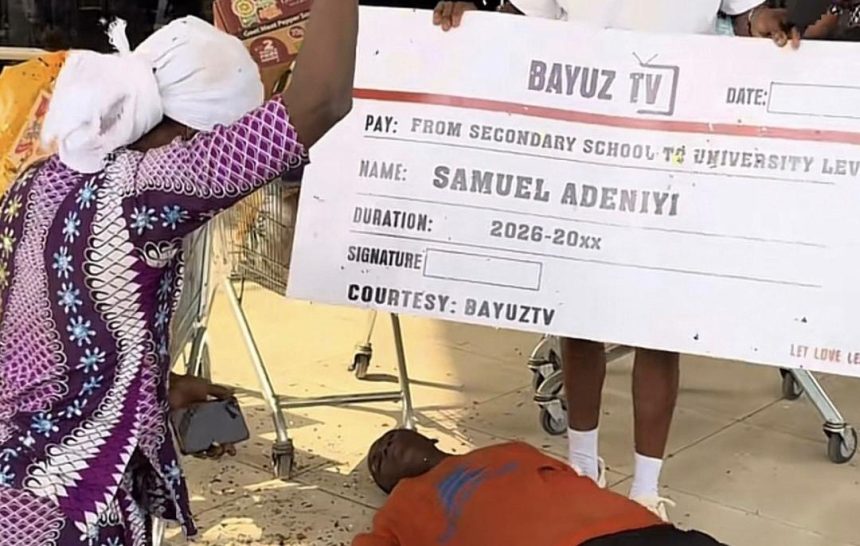
About a fortnight ago, a video made the rounds showing a 19-year-old young man rolling on the floor in ecstasy. It was a moment that spurred reactions from Nigerians of almost every class.
EDITOR’S PICKS
The boy, a trained tiler, was found on the streets of Lagos carrying a sack of torn cartons. He looked unkempt and tired and would surely use a helping hand. When asked about his state, he spoke in a tone that would court pity on most days. His frustrations were visible. He was doing this without the knowledge of his mother.
During the course of the interview—read: content—he revealed he made ₦2,000 ($1.43) whenever he managed to get a sack of cartons. When quizzed about why he started the ‘trade’, he said, “because I need money to buy my work tools.”
Beyond my comprehension God😭 Best video ever #bayuztv pic.twitter.com/0r6hXqOScH
— BayuzTv (@BayuzTv) January 26, 2026
Everything just turn around for Samuel the tiller in just 24hrs🥹 #bayuztv pic.twitter.com/KjNM1BxdpK
— BayuzTv (@BayuzTv) January 29, 2026
That interaction was the beginning of a story that changed his outlook on life, improved his conditions, and gave him genuine aspirations. Nigerians, an emotional people, were moved to tears on social media as he narrated his story. When he was taken to get the tools he needed for his tiling work, his reaction would remain an example of what Nigerians often deem to be gratitude.
As he rolled on that floor and shed tears uncontrollably, more Nigerians were encouraged to lend a hand to his cause. That was how Samuel and his family’s story changed for the better.
In Nigeria, this isn’t new. It’s a country that has thousands of leaders with little to no vision or interest in improving the lives of the hundreds of millions of people they lead. The one institution capable of touching most lives at a time—the government has failed in its most important responsibility. Nigerians are poor and tired.
The absence of good governance has led to a massive gap in social structures. The government has failed to meet its terms of the social contract it signed with Nigerians, and the people have taken decisions into their hands by offering giveaways to as many people who are in need. But that isn’t coming for free. Those people are not the government.
Samuel has now OFFICIALLY Received 8 million Naira cash , food stuffs worth 650k and Scholarship to study from secondary to university level .
His mother who was washing dresses for people , begging food to feed her children and selling pure water received 1 million Naira https://t.co/PLf5C3xgsa pic.twitter.com/gUznF51tTp
— DukeOfOsun (@DukeOfOsun) January 29, 2026
Like the Nigerians they help, this group of people beg for support somewhere too, and need to hit certain expectations to keep getting the resources that enable them to lend a hand. They are content creators, and have found a huge market in Nigeria’s woes.
When Infrastructure Collapses, Cameras Fill the Void
Nigeria has no roads, no jobs, no functional medical systems. In each of these gaps, there are opportunities taken by ordinary people who have found a place to invest their time and creativity to build a name for themselves, even if it comes at the expense of the pride of the recipients.
The social media age has made content king, and there are clear opportunities for individuals’ growth and popularity through philanthropic content. Very eminent Nigerians have built cult followings on tokenism. They do giveaways on social media and are worshipped by the people who benefit from this. What this culture has bred is a system that always expects a lending hand from those who have been blessed with resources.
Nigeria’s failure to build a social system that accommodates everyone has led to a dependency pipeline where mutual aid has become extremely important—but viralized and curated for public acceptance and brand sponsorships.
Do the recipients care?
There’s so little to consider when one has been stripped of honour as a result of lack. Their images are out there in the public and the world knows they are beneficiaries of public sympathy. They become props in someone else’s narrative of generosity.
Osun state tillers interior and exterior decorators osogbo zone support Samuel with all the freedom requirements whenever he's ready.
Everybody shout Grace https://t.co/Kuts6aIiag pic.twitter.com/DGtJFTf7Zz
— DukeOfOsun (@DukeOfOsun) January 30, 2026
Poverty has been commodified through content. Whether this is intentional is another subject entirely, but there’s an algorithmic incentive that comes with putting people’s faces in the public, sometimes for help, but mostly for reactions.
The Economics of Compassion: Who Actually Benefits?
There are more than a hundred million Nigerians living in poverty and there’s no help in sight. Only the government, through human development-centered policies, has the power to bring this incredibly high number down. That government has failed at its responsibility time and again.
For a young man like Asherkine who is working hard and has built a worthy life for himself, his compassion can be curated for content. He loses nothing (at least publicly) but gains everything. What Asherkine does is interesting to many businesses in Nigeria, especially producers of Fast Moving Consumer Goods (FMCGs) whose major markets are still poor people.
What he does is give hope to the masses through instant liquidity and build a chain of interested promoters of his services. The more sponsors he gets, the stronger his helping hand becomes. That’s how the business of giveaways is conducted.
The recipients stand the chance of gaining even more sympathy when their reactions to receiving support are vulnerable. It’s the vulnerability that sells. It’s giving agency to one’s helper—after all, there may be none if theirs never came in.
But who else benefits?
The brands get access to millions of eyeballs and association with goodwill. Their products appear in videos watched by the exact demographic they’re trying to reach; poor Nigerians who will remember which company or people helped Samuel get his tools.
The content creators gain followers, monetisation, brand deals, and influence, all derived from other people’s suffering. Even when the help is real, there’s an extractive dimension that can’t be ignored.
The viewers get entertainment and the emotional satisfaction of witnessing transformation without having to give anything themselves. They consume poverty, feel something, and scroll on.
The recipients get real help that changes their lives. Medical bills paid. School fees covered. Tools purchased. This cannot be dismissed.
The government gets the most valuable thing of all: absolution. As more Nigerians help one another, the already underperforming layers and levels of Nigerian government become empowered in their bid to continuously breach their social contract with Nigerians. The sight of Nigerians helping one another is just perfect for them.
‘So, who help epp?’
This new social media culture of giving helps everyone in the transaction. But at the depth of it, ordinary Nigerians are still the losers. The system that created their poverty remains untouched, yet there is a shift in the psychological landscape of the ordinary person.
Creating a Performing Underclass
For most content creators lending a helping hand to the needy, virality accompanies the good feeling of giving, if it’s genuine. The algorithm is moved by reactions, and if there’s enough passion in the response to receiving, there’s a high chance such a person will receive more help.
We’re seeing a Pavlovian conditioning in real time where the sight of a face like Asherkine and others naturally triggers performance regardless of the feeling. Even during times the person doesn’t know the content creator, people gather around to tell about who they are and what they do.
What this leads to is many poor others who know they have to be raw in their emotions should a mic ever be placed before them. They’re charged to recall what the benefits of performance or fully expressed reaction could mean to their lives. As it has turned the life of some persons around, theirs may not be different.
This affects how people see themselves. It also means many genuinely needy people may not get help because they are naturally reticent. To shed tears to the camera brings a sharper lens, and those who lack the capacity to show emotions in that state may never stand a chance.
What does it do to someone’s sense of self to know their tears, gratitude, or desperation needs to be camera-ready? Does it breed performative helplessness? If you’ve learned that crying gets you fed, what happens to your relationship with your own emotions?
The algorithm essentially decides who deserves rescue. Not everyone’s poverty is camera-friendly, even to their neighbours.
Help Thy Neighbor… But Hold a Camera
As content’s reign as king continues, community bonds are also gently eroding. Everyone has a phone and those devices have cameras. It means many people film reactions that may have otherwise not been filmed a decade ago. It may not be an intentional pose to bring the other person to public attention, but just an unthought-of action that gives some satisfaction.
When help becomes public performance, it can change the nature of community support. It also changes how much people are willing to reveal in protection of their value and agency. But to the giver, sometimes there’s an end game. Why help your neighbor quietly when you could film it and get recognition? Does it make non-filmed generosity feel unrewarded?
When help is filmed, it becomes less of a community action but more of a spectator game.
Again, the needy don’t care, or perhaps they can’t afford to care. Many Nigerians lie today on hospital beds, waiting and praying fervently for the good hearts of others to come to their rescue. With often astronomical medical bills, their names, sometimes images, are sent out as proof of their current conditions. There should be no shame for a person fighting for a second chance at life.
There are many families who eventually get this help, and their helpers often require they make videos to show the public. This is sometimes to prove that they have a good heart and can probably lead you rightly in the future, should they come demanding your votes and political support later.
When the demand is popular and the content is viral, even governments latch on to it for narrative. For example, some of the people who enjoy this public sympathy go on to see politicians from their home states. That government may be owing thousands of workers salaries. Should the failure of government be met with a content that fails to go viral, what happens?
When the Helper Turns Their Back
Nigerians have gradually and increasingly transferred expectations to the public givers. They demand from them. They try to influence what they should do and who they should give. “The woman in that video should be helped too” is a comment that is not uncommon.
Nigerians are tired. With the rise of the compassion creators’ market, there’s a real chance that the people may not be as demanding of their governments. People now look towards individual benefactors for salvation. Many people ask Asherkine to come to their states or city just for them to benefit from his kindness.
They’re tired of asking their governors to answer to them, especially as their responses won’t provide instant liquidity anyway. They’re tired of writing to charity organisations who mostly look after their pockets than deliver on the services they get paid thousands of dollars for. They’re tired of the corruption and the lack of fairness that comes with waiting for systems that have increasingly disappointed them.
To those people, Asherkine is their governor.
But individual benefactors can withdraw help anytime, unlike rights-based state services. What happens when brands become aware that their public strategies no longer work and stop funding the compassion creator economy? What happens when the content gets stale and the algorithm moves on to the next trend?
These are the issues. Nigeria has continued to outsource welfare to influencers. The people are in their hands and it’s increasingly difficult to differentiate genuine help from algorithmic demands.
The Social Business of Giving and the Loss of Agency
The current content market of compassionate giving is a business model where poverty is the product, emotion is the currency, and algorithms determine value.
What you gain in money, you lose in agency. MummyZee on X is still reminded of how she was raised by social media sympathy every time she decides to lend her own opinions. While she fights back now, perhaps she’d have preferred that her financial uptick wasn’t publicly magnified. That’s the loss that comes with being a public recipient of mutual aid benefaction. Every future argument she makes, every position she takes, will be met with “But we saw as they helped you.” Her poverty became public record, archived forever, callable at any moment to discredit her voice.
It’s a social business at the end of the day, and business comes with its undersides. It’s a feature, not a bug.
The stripped dignity experienced by some beneficiaries of social handouts isn’t an accidental byproduct, it’s what makes the content work. The emotional display is the value proposition. The vulnerability is the asset being monetised. You can’t have the business without the extraction, because the extraction is the business.
More brands will latch on to this. More Nigerians will expect a handout. The lines of the social contract between them and their governments will get increasingly blurred. Yet, that new social contract can only go so far.
There are unspoken dangers.
The Insecurity and Expectation Angle
The consequences of public compassion don’t end on social media. It leaves dangers that exist beyond it. A man or woman seen on camera as they receive wads of naira notes courts attention. To the neighbours, there’s an expectation of extending a hand. To friends and family, it means the needs they once came with can now be met.
If they live in an environment where there are street urchins, they’d need even greater protection. How much do they have to pay to feel safe? Do we ask these questions? What becomes of the money they receive?
Also, this culture of public giveaways and crowdfunding feeds into Nigeria’s rising insecurity, especially as it now extends to the ordinary people. Before now, the rich were often targets of kidnappers, but all of that has changed. People now crowdfund to pay kidnappers’ ransom. They know if they kidnap the ordinary people who have no security, they have the public to beg for support. Every Nigerian is now a target—rich and poor. The poor have the public, the rich have themselves. It’s sad.
Again, do we think of the effects of this compassion content market?
The Impossible Bargain
Here is the uncomfortable truth that no one wants to say out loud: this system is extractive, undignified, and deeply problematic and it’s still better than nothing.
When you’ve watched someone get surgery they couldn’t afford, when you’ve seen a child go to school because a stranger’s viral video paid their fees, when you’ve witnessed real transformation happen in hours rather than the years it would take for broken systems to work—if they ever would—the philosophical concerns about dignity start to feel like luxuries that hungry people can’t afford.
The real critique isn’t of individuals trying to survive or even those trying to help. The real critique is of a system that makes this bargain necessary in the first place. In a functioning state, people wouldn’t have to choose between dignity and survival. The fact that social business has rushed to fill the gap reveals how catastrophic the infrastructure failure is.
This shouldn’t exist. But it does. And it works better than waiting for a government that isn’t coming.
So Nigerians continue to make impossible choices. Recipients trade their privacy and agency for survival. Givers navigate the uncomfortable space between genuine compassion and personal benefit. Viewers consume and scroll as they get entertained. Brands calculate return on investment. And the government that created this entire economy of desperation continues to collect taxes and fail its people.
Beneficiaries also have their poverty documented. How they became is open to all, how they cried and wailed, how they rolled on the floor but what matters more to them? To feed or have their reactions get fed on?
They prioritise survival over dignity. They care less about the emotional labour they have to undergo to receive support publicly. The attention economy is one that thrives on manipulation of the algorithm and beneficiaries have to contribute to the systems that shine on them. It’s the way of the game.
It’s a give and take system where little is given but a great deal is taken. The majority of the public who are not an active part of that system enjoy the entertainment that is the digital display of poverty. The Nigerian government which is capable of making a massive difference will rather be a spectator too. When the numbers are good, it engages in its usual spurious reactions.
The social contract is broken. What we’re watching now is Nigerians writing a new one: messy, imperfect, extractive, and necessary.
Until the state returns to its responsibilities, this is what mutual aid looks like in the algorithm age. It’s a help that costs everything and solves problems anyway, while taking some pride as collateral. Cameras are now god-like. They are answered prayers as the governments continue to ghost and hide from their responsibilities. Who bears the brunt?
FURTHER READING
Nigeria’s poor are at the receiving end of everyone’s gains. But they’re also receiving what they desperately need. Both things are true. Help for a few. Entertainment for many. Both things matter. And that’s the impossible bargain we’re all living with. How long can Nigerians feed one another with the crumbs that’s left to us? This is a system that will struggle to scale, yet we can’t deny it serves a purpose for now.
Opinions expressed in this article are solely the writer’s and do not represent the views of EKO HOT BLOG.
Click to watch the video of the week below: