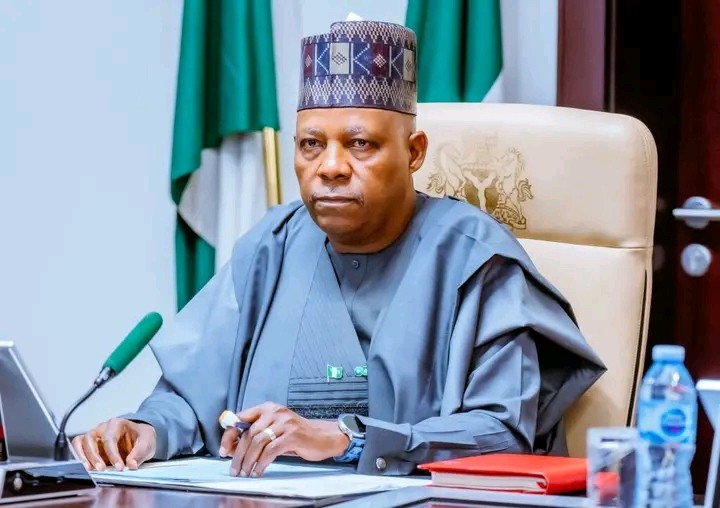
- Vice President Kashim Shettima has defended the decision to hike the 2026 fiscal budget by ₦10 trillion, bringing the total to ₦68 trillion, arguing that Nigeria needs an ambitious budget to drive growth and reduce poverty.
- Ben Akabueze, former Director-General of the Budget Office, has sounded an alarm over Nigeria’s 56,000 abandoned projects, citing a historic disconnect between national planning and actual budget execution.
- The Federal Government has announced the removal of duties on pharmaceuticals, machinery, and fabrics to stimulate local productivity and ease the economic burden on citizens.
Vice President Kashim Shettima has rejected calls for a leaner national budget, insisting that President Bola Tinubu’s vision for Nigeria requires a massive financial commitment to move the needle on poverty and per capita income.
Eko Hot Blog reports that speaking at a National Policy Dialogue in Abuja on Tuesday, April 14, 2026, Shettima explained that the recent ₦10 trillion adjustment to the 2026 budget, now sitting at ₦68 trillion, is a deliberate strategy to fund development rather than just sustain government expenditure.
EDITOR’S PICKS
- JAMB Delists 23 CBT Centres, Warns 89 After Mock UTME Review
- NASA Astronauts Return to Earth After First Human Trip to the Moon in 50 Years
- INEC Shifts Nationwide Voter Revalidation Until After 2027 General Election
Represented by Tope Fasua, Special Adviser to the President on Economic Matters, the Vice President emphasized that the administration is prioritizing data-driven planning over rigid, outdated economic models.
He highlighted that the government has already begun slashing tariffs on essential raw materials and removing duties on critical items like drugs and manufacturing equipment to jumpstart the economy.
According to Shettima, these moves signal that the Renewed Hope agenda is focused on tangible improvements in the standard of living for every Nigerian.
However, the dialogue also heard a sobering assessment from Ben Akabueze, who painted a grim picture of Nigeria’s fiscal discipline.
Akabueze pointed out that the country is currently littered with over 56,000 abandoned projects, a direct consequence of decades of weak coordination between development plans and annual budgets.
He argued that for the ₦68 trillion budget to be effective, it must serve as a “compass” for development outcomes rather than a mere list of political spending.
Nigeria’s budgeting process has long been criticized for being incremental and heavily politicized, with recurrent spending often swallowing the funds meant for infrastructure.
Akabueze stressed that without an “organic budget law” to enforce timelines and hold officials accountable, the gap between planning and implementation will continue to widen, regardless of the budget size.
The dialogue, themed around the imperatives of national development for sustainable growth, comes at a time when the Tinubu administration is pushing for far-reaching reforms in the tax and fiscal sectors.
Shettima maintained that the current budget is guided by the Medium-Term Expenditure Framework (MTEF) and aims to hit the United Nations Sustainable Development Goals, specifically focusing on food security, health, and education.
As the National Assembly and the Executive look to harmonize the 2026-2030 Renewable Medium-Term Plan, the focus remains on whether this record-breaking budget can actually be implemented to prevent further project abandonment.
For now, the government’s message is clear: Nigeria will not “budget small” in its quest for economic recovery.