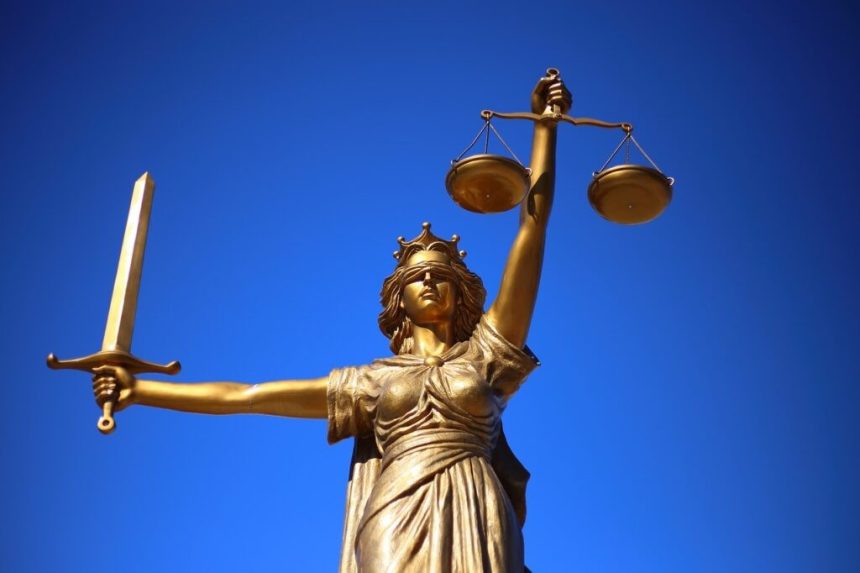
Justice is one of the promises on which every constitutional democracy rests. In Nigeria, that promise is reflected in the courts, the constitution, the legal profession and the institutions established to protect the rights of citizens.
The country’s judicial structure is extensive, stretching from magistrates’ and customary courts to the Supreme Court, with specialised courts created to determine election disputes, labour matters and commercial conflicts.
EDITOR’S PICKS
- FG Partners With Chinese Investors To Secure Land For 10,000-Home Mass Housing Project
- Intelligence Materials Were Shared With US, Not Seized – DHQ
- Man Arraigned in Adamawa Over Alleged Abuse Involving Daughter
Yet for many Nigerians, the justice system remains more written in theory than in practice.
Every year, thousands of disputes are resolved without ever reaching a courtroom. Some end around dining tables during family meetings. Others are settled by traditional rulers, religious leaders, community associations or private mediators. Many are abandoned altogether.
This is not because Nigerians do not experience legal disputes. Rather, it reflects a difficult reality: for many citizens, the journey to court is often viewed as too expensive, too slow or simply too uncertain.
The result is a growing gap between the rights guaranteed by law and the ability of ordinary people to enforce them.
Justice Exists But Access Does Not Always Follow
Legal scholars often distinguish between the existence of rights and access to justice.
The first depends on legislation.
The second depends on whether citizens can realistically use the institutions created to enforce those rights.
A worker may know an employer has breached a contract. A widow may believe she has been unlawfully denied her inheritance. A business owner may have evidence that an agreement has been violated.
Having a legal claim, however, is only the beginning.
The more difficult question is whether pursuing that claim is financially, procedurally and practically possible.
That comes to an ever ending and increasingly important discussions about judicial reform, not only in Nigeria but across Africa.
Fewer than half believed they could afford court costs if they needed to pursue legal action, while concerns over delays, unequal treatment and the cost of legal representation remained widespread.
When Litigation Becomes an Economic Decision
Justice is often described as blind. It is rarely described as expensive.
Civil litigation carries financial obligations long before a judge hears evidence. Filing fees, legal representation, documentation, transportation, certified copies of court records and repeated appearances all carry costs that increase as proceedings continue.
For individuals and small businesses, those expenses can become part of the dispute itself.
The issue is not simply whether lawyers charge professional fees. Legal practice requires expertise and preparation. The larger question is whether the average Nigerian can afford to remain in litigation for months or, in some cases, years.
Recognising this challenge, the Legal Aid Council of Nigeria provides legal assistance to eligible citizens who cannot afford representation. Yet awareness of those services remains limited, and available resources cannot meet every request for assistance.
For many Nigerians, the calculation becomes practical rather than legal.
Will the value of the judgment outweigh the cost of obtaining it?
If the answer is no, the dispute often ends before a claim is ever filed.
The Weight of Time
Cost is only one barrier, time may be an even greater one.
The Nigerian judiciary has, for years, acknowledged the challenge of delays in civil and criminal proceedings.
Adjournments, congested court dockets, procedural applications, appeals and shortages of judicial personnel all contribute to cases remaining in the system for extended periods.
Delay carries consequences beyond inconvenience, businesses postpone investment while commercial disputes remain unresolved.
Families continue living with uncertainty in inheritance and land matters.
Employment disputes affect livelihoods long before judgments are delivered.
Justice delayed is not simply a legal concern. It is an economic one.
The Rise of Informal Justice
The assumption that every dispute belongs in court has never reflected Nigerian reality.
Long before the modern judicial system, communities developed their own methods of resolving disagreements. Traditional institutions, religious bodies and community leaders continue to mediate conflicts involving land, marriage, inheritance and neighbourhood disputes.
In recent decades, Alternative Dispute Resolution (ADR) has become an increasingly recognised part of the legal landscape.
Mediation and arbitration now play significant roles in commercial disputes because they are often faster, less adversarial and less expensive than litigation.
The growth of ADR does not suggest courts have become irrelevant.
It reflects an acknowledgement that different disputes require different pathways to justice.
Confidence Matters
A justice system depends not only on laws but also on public confidence.
People are more likely to seek legal remedies when they believe institutions are independent, accessible and capable of delivering decisions within a reasonable time.
The World Justice Project argues that access to justice is fundamental to the rule of law because it enables people to resolve everyday legal problems through fair and effective institutions.
A latest findings suggest many Africans remain unconvinced that courts consistently meet those expectations. Respondents cited concerns about affordability, timeliness, integrity and equal treatment under the law as significant barriers to justice.
For Nigeria, these findings are not merely statistical observations.
They raise broader questions about institutional legitimacy.
If citizens increasingly believe that formal justice is beyond their reach, they are more likely to seek alternative methods of resolving disputes or abandon legitimate claims entirely.
The Reform Question
Improving access to justice is not solely a matter of appointing more judges or constructing additional courtrooms.
Legal experts have consistently argued that reform must address procedure as much as infrastructure.
Simplifying court processes, expanding legal aid, strengthening case management, embracing technology, reducing unnecessary adjournments and improving public legal education are all part of the discussion.
Some jurisdictions have introduced electronic filing systems and expanded mediation through Multi-Door Courthouses in an effort to reduce delays and improve efficiency.
Whether those reforms produce lasting change will depend on implementation as much as policy.
More Than a Legal Issue
The conversation about justice is often confined to courtrooms and law reports. It is, in reality, much broader.
Access to justice influences economic activity, investor confidence, labour relations, family stability and public trust in government institutions.
A legal right that cannot be enforced at a reasonable cost or within a reasonable time risks becoming symbolic rather than practical.
Nigeria’s Constitution guarantees access to justice.
The continuing challenge is ensuring that the promise contained in law is matched by the experience of those who depend on it.
Because in every society governed by the rule of law, justice is measured not only by the quality of its judgments, but by whether ordinary people can realistically reach the courtroom in the first place.