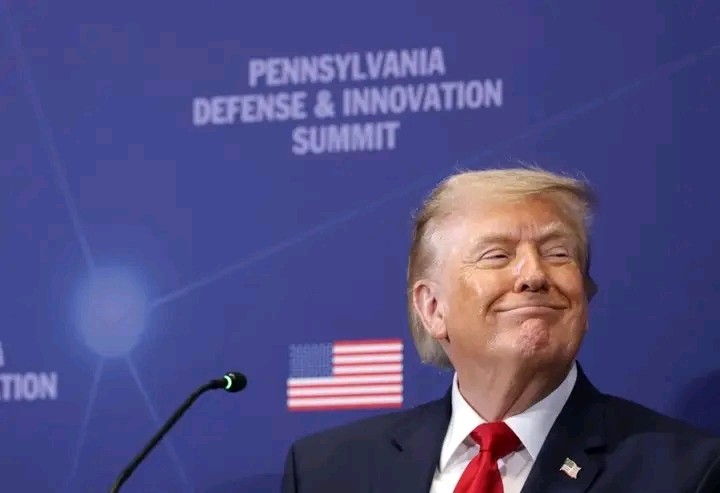
- United States President Donald Trump sparked wide public reactions after humorously declaring his intention to seek a “fourth term” in office during an address at the rescheduled White House Correspondents’ Association dinner in Washington, D.C.
- The American leader donned a bright red cap emblazoned with “Trump 2028” on stage while declaring before a gathering of media professionals and dignitaries that he was getting “very good at running for president.”
- The lighthearted declaration comes despite clear provisions under the Twenty-second Amendment to the United States Constitution, which explicitly prohibits any individual from being elected to the presidential office more than twice.
United States President Donald Trump generated widespread media attention and online debate after jokingly hinting at a prospective presidential run in 2028 during a lighthearted address at the annual White House Correspondents’ Association dinner held at the Waldorf Astoria in Washington, D.C.
Eko Hot Blog reports that addressing an audience comprising journalists, government officials, and high-profile dignitaries, the president presented his remarks as an exclusive piece of news, telling the room that he intended to make an official announcement regarding another campaign for the nation’s highest office.
EDITOR’S PICKS
- FG Partners With Chinese Investors To Secure Land For 10,000-Home Mass Housing Project
- Intelligence Materials Were Shared With US, Not Seized – DHQ
- Man Arraigned in Adamawa Over Alleged Abuse Involving Daughter
Shortly after delivering the statement, President Trump produced and put on a bright red baseball hat reading “Trump 2028,” mirroring the iconic political merchandise that defined his prior campaign cycles.
The moment was captured in a video clip shared widely across digital platforms by the RapidResponse47 account, quickly accumulating millions of views and triggering intense discussion among political analysts and observers.
The gala marked President Trump’s first personal attendance at the White House Correspondents’ Association dinner during his presidency, having skipped the traditional annual gathering throughout his previous administration and the initial period of his second term.
The event had been rescheduled to July following a security disruption in April when gunfire near a security checkpoint forced an immediate evacuation of guests, including First Lady Melania Trump.
Moving the venue from its traditional long-standing location at the Washington Hilton to the Waldorf Astoria, organizers implemented heightened security measures alongside the Secret Service and local law enforcement agencies.
Outgoing association president Weijia Jiang opened the rescheduled program by emphasizing the resilience of the press corps, asserting that journalists would not be deterred by security challenges.
During his wide-ranging address, which spanned over an hour, President Trump mixed typical humor with sharp criticisms directed at media houses and political adversaries.
He reflected on the venue change and security enhancements, quipping that the second iteration of the dinner was vastly superior, drawing a parallel to his own return to the executive office.
Despite the enthusiasm generated among his supporters by the “Trump 2028” display, legal experts and constitutional scholars immediately noted that a third term remains constitutionally impossible.
The Twenty-second Amendment to the United States Constitution, which was formally ratified in 1951 following the four-term presidency of Franklin D. Roosevelt, strictly mandates that no individual shall be elected to the office of the President more than twice.
While political opponents criticized the remarks as an unnecessary challenge to democratic norms, prominent administration allies dismissed the outrage, characterizing the speech as classic observational humor tailored for the traditional roasts associated with press correspondents’ dinners.
Political commentators noted that while the statements were clearly delivered in jest, Trump’s frequent references to future electoral cycles continue to shape public discourse and maintain his central position within contemporary global political narratives.