- The United Nations has reported that up to 6.76 million individuals, including nearly two million residents in the capital city of Caracas alone, may be suffering from the immediate aftermath of the catastrophic natural disaster.
- The official national death toll has climbed to 920 fatalities, while the UN humanitarian aid department warns that an estimated 50,000 citizens remain missing or trapped beneath collapsed infrastructure.
- Advanced satellite mapping assessments conducted in cooperation with technology firms indicate extreme localized devastation, with over 31 per cent of all residential and commercial buildings completely destroyed in the hard-hit coastal town of Catia La Mar.
An unfolding humanitarian catastrophe of unprecedented proportions has gripped South America as the United Nations officially estimated on Saturday, June 27, 2026, that close to seven million citizens have been affected by the powerful twin earthquakes that tore through Venezuela earlier in the week.
Eko Hot Blog reports that the harrowing projections, compiled through data tracking and field reports by the International Organisation for Migration (IOM), indicate that up to 6.76 million people are currently facing displacement, severe structural loss, or lack of access to basic life support networks following the disaster that struck on Wednesday, June 24.
EDITOR’S PICK
- Hamzat Appoints Obanikoro as Campaign DG Ahead of 2027 Lagos Governorship Race
- Tinubu’s State Police Plan Gains Momentum as Amendment Looms
- Residents Raise Alarm After Two Bodies Found in Lagos Waterway
The core of the devastation is centered around the capital city of Caracas and its adjacent coastal regions, where entire blocks of multi-story buildings have collapsed into mountains of concrete rubble.
According to the IOM’s urgent situational statement, the current vulnerability mapping includes an estimated two million impacted individuals within Caracas alone, illuminating the massive scale of emergency aid required to prevent further loss of life.
In the coastal city of La Guaira, located just north of the capital, the structural damage is total, following the consecutive historic tremors that registered massive magnitudes of 7.2 and 7.5 on the Richter scale.
Emergency operations have entered a critical, desperate phase as local emergency teams and international volunteers dig through fractured concrete slabs with bare hands and specialized acoustic tools.
The national death toll has officially been verified at 920 individuals, but officials warn this metric represents a minor fraction of the eventual reality.
Speaking on the ground, UN Aid Chief Tom Fletcher disclosed that more than 50,000 people are currently documented as missing, with thousands believed to be trapped inside subterranean voids beneath collapsed residential buildings across several coastal municipalities.
To expedite rescue coordinates, the IOM partnered with the Microsoft AI for Good Lab to deploy rapid satellite mapping and aerial data analysis over the worst-hit impact zones.
Initial data models have revealed a terrifying reality, confirming that approximately 31.5 per cent of all buildings and infrastructure in the dense metropolitan town of Catia La Mar have been entirely flattened or structurally compromised beyond repair.
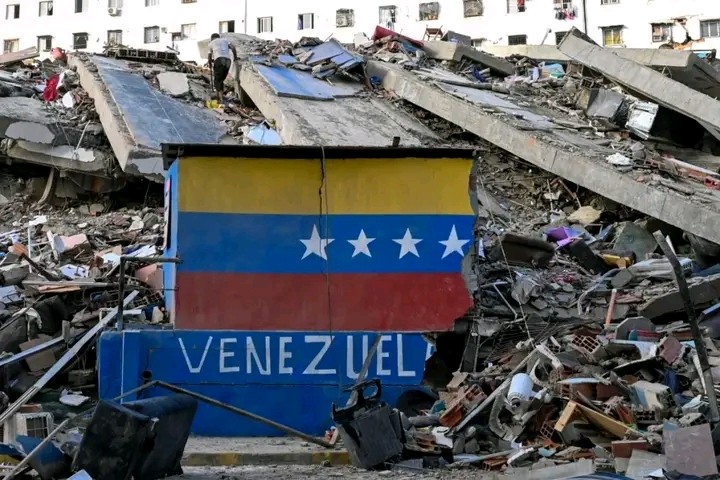
These real-time digital maps are being channeled directly to frontline emergency dispatch centers to help tactical teams identify buried communities and prioritize where to allocate life-saving medical resources and heavy earth-moving equipment.
The head of the UN migration agency, Amy Pope, issued a global call to action, emphasizing that the initial hours and days following a seismic shock are completely decisive in determining the survival rates of trapped populations.
She noted that the organization is rapidly scaling up its operations by distributing pre-positioned emergency relief materials, including medical field tents, clean water sanitation kits, and security protection structures.
The official warned that internal displacement is bound to skyrocket rapidly in a nation that was already navigating a delicate economic and social climate before the subterranean shifting occurred, requiring sustained international financial and logistic intervention for the long recovery ahead.