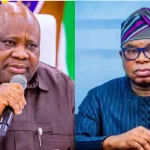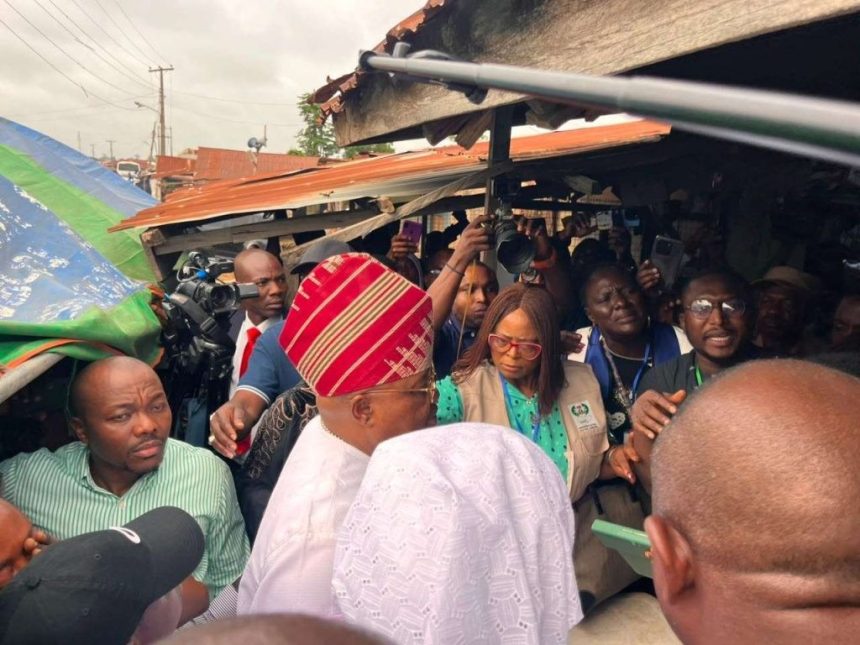
Governor Ademola Adeleke appears on course to win a second term in Osun State, with results from the Independent National Electoral Commission (INEC) showing him commanding a decent majority of the vote as collation nears completion. But the story of Saturday’s election is not just who won. It is how the vote was conducted and what that says about the road to 2027.
Voting was marked by thuggery in multiple local government areas.
EDITOR’S PICKS
Suspected thugs disrupted polling at former governor Rauf Aregbesola’s unit in Ilesa. In Ejigbo, a notorious thug disrupted voting and damaged a vehicle, while the African Democratic Congress (ADC) candidate Najeem Salaam was whisked away by security after violence broke out at his own polling unit, forcing officials to suspend voting there.
Police also reportedly arrested 52 people at a lawmaker’s residence, and multiple videos circulated showing alleged vote-buying. Afrobeats star Davido, a nephew of the governor, claimed soldiers tried to block his entry into the state, a claim security-adjacent voices dismissed as routine election-day movement restrictions rather than targeted obstruction. Just a day before the poll, PDP figures withdrew and threw their weight behind Adeleke, reshaping the field at the last minute.
Put together, this was less a clean contest than a stress test, one with direct lessons for the parties already positioning for 2027.
Incumbency still wins, but it doesn’t win clean
Adeleke’s apparent victory confirms a pattern Nigerian politics keeps repeating: sitting governors are hard to dislodge, even against a federal government determined to unseat them. Oyebamiji had the backing of the ruling APC at the center — the party that controls the police and military deployed for the poll — yet Adeleke still appears to have won comfortably. That points to the strength of state-level incumbency: control of the state’s own bureaucracy, local government structure, and the ability to absorb defectors like the PDP bloc that folded into his camp, all of which mattered more on the ground than who Abuja was backing.
For 2027, this should worry the APC as much as it worries the opposition. If federal firepower and security deployment cannot reliably tip a governorship race against an incumbent, the party may need a different playbook for states where it doesn’t already hold the government house.
At the same time, the margin of victory — with the top three candidates taking nearly 99 percent of the vote — shows Nigeria’s fragmented multi-party ballot (fifteen parties contested) still funnels down to a two- or three-horse race in practice. Smaller parties remain spoilers, not contenders, a trend the major parties will factor into their 2027 primary calculations.
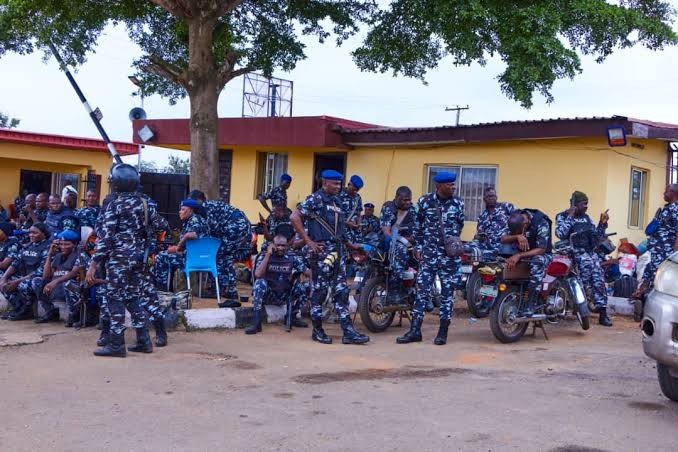
Federal backing didn’t seal it for Oyebamiji
The ruling APC at the center threw its weight behind Oyebamiji, controlled the police and soldiers deployed for the poll, and still could not deliver Osun. Everything played out under a federal government backing the opposition candidate. None of it changed the outcome on the ground.
That may tell us something about 2027. The APC’s national machinery is often treated as a decisive advantage in any race it enters. Osun suggests otherwise. State governors still control the ground game that actually decides elections: local government structure, traditional rulers, party agents at the polling unit, and the ability to absorb rival parties’ voters, as Adeleke did with the PDP defectors just a day before the vote.
For APC strategists, the lesson is that winning hostile states in 2027 will take more than federal muscle. It will take rebuilding structure at the state level, the very thing incumbents like Adeleke already have.
Thuggery is not going away, it is adapting
The disruptions in Ilesa and Ejigbo were not isolated. They fit a pattern flagged well before election day, when a pre-election risk assessment recorded dozens of violent incidents and deaths linked to the Osun race in the months leading up to the vote. That thugs could still shut down polling at a former governor’s own unit, and at a leading opposition candidate’s unit, shows that security deployment on the day itself is not solving the underlying problem; political actors financing local enforcers to intimidate rivals.
For 2027, this suggests the fight will not just be at the ballot box but in the weeks before it, in the LGAs identified as flashpoints. Parties that invest early in local-level security and community buy-in — rather than relying on police presence on voting day alone — will have an edge. It also strengthens the case for civil society and journalists to track pre-election violence data as a predictive tool, not just an afterthought.
FURTHER READING
Osun was a dress rehearsal. If its lessons on incumbency, security trust, and grassroots thuggery go unaddressed, 2027 will inherit the same problems at a much larger scale.
Philip Ibitoye is a Special Correspondent with EKO HOT BLOG. Click here to find daily analysis and critical insight on trending issues in Lagos and other parts of Nigeria.
Click to watch the video of the week below: