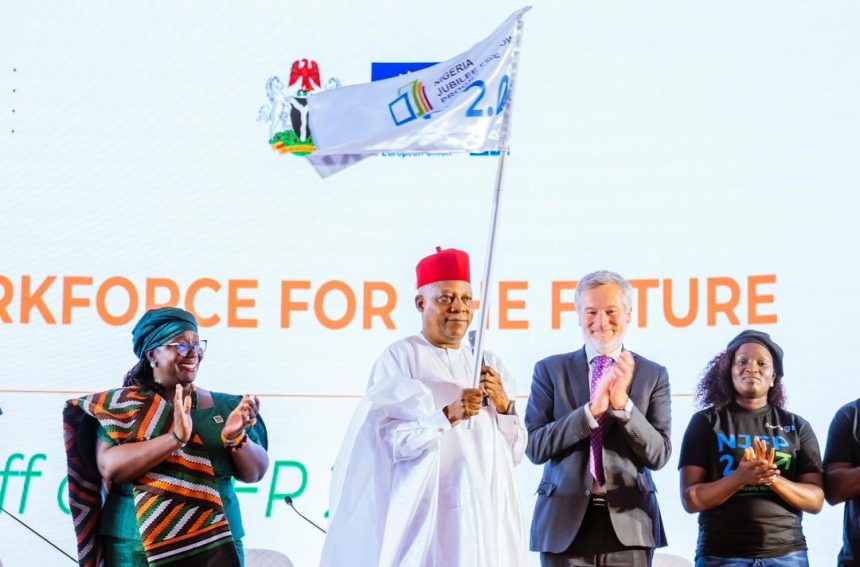
When Vice-President Kashim Shettima announced a $220 million investment in the second phase of the Nigeria Jubilee Fellows Programme (NJFP) 2.0 on Wednesday, it may have rekindled hope for thousands of young Nigerians seeking pathways into decent employment.
Launched in partnership with the European Union (EU) and the United Nations Development Programme (UNDP), the initiative aims to equip high-potential graduates with work experience, training, and mentorship, particularly in fast-growing sectors such as technology, energy, agriculture, and the creative industries.
EDITOR’S PICKS
According to Shettima, the programme is designed to “bridge the transition gap between learning and earning,” aligning graduate skills with real market needs and transforming Nigeria’s demographic strength into “productive economic power.”
Promise of a New Direction
The government’s pledge to embed NJFP 2.0 into Nigeria’s national planning and budgeting framework signals an intention to institutionalise youth employability, ensuring it outlives donor cycles and political transitions.
The Nigerian government has concluded plans to invest $220 million in creating employment opportunities for young Nigerians.
The initiative is to be spearheaded in collaboration with the European Union (@EUinNigeria) and the United Nations Development Programme (@UNDPNigeria)… pic.twitter.com/sBvY2n9xv3
— Senator Kashim Shettima (@officialSKSM) October 22, 2025
This marks a potential shift from the short-lived nature of previous youth initiatives such as N-Power or YouWin!, which were often hampered by inconsistent funding, poor monitoring, or political interference. If fully realised, NJFP 2.0 could provide a structured, sustainable model for connecting graduates to work placements and career growth opportunities.
However, beyond the rhetoric, the real question is whether this renewed effort can create long-term employment, not just one-year internships. Nigeria’s unemployment rate, which dropped from 5.3% in Q1 2024 to 4.3% in Q2, according to the National Bureau of Statistics (NBS), still hides deep underemployment and informal labour realities.
Private Sector at the Core
A key innovation in this new phase is the drive to engage the private sector more deeply. The vice-president’s call for collaboration with businesses highlights a recognition that government alone cannot absorb Nigeria’s ballooning youth population.
By incentivising private companies to host fellows and build skills pipelines, NJFP 2.0 could serve as a bridge between academia and industry, preparing graduates for the evolving demands of the global economy. But that will only succeed if firms are encouraged to retain participants beyond the internship year through incentives such as tax breaks or wage support.
Without such mechanisms, private sector involvement risks being symbolic rather than strategic, repeating past patterns where programmes created temporary opportunities but no lasting career impact.
Between Promise and Proof
With more than 60% of Nigerians under 25, the country’s youth population remains a potential goldmine of innovation and enterprise or a ticking time bomb of frustration if left untapped.
The $220 million NJFP 2.0 could indeed be a game changer if it delivers measurable outcomes: jobs created, fellows retained, and industries strengthened. But for now, the optimism must be tempered with scrutiny.
FURTHER READING
Success will depend not on the scale of funding, but on the political will, transparency, and accountability that ensure promises translate into livelihoods.
Philip Ibitoye is a Special Correspondent with EKO HOT BLOG. Click here to find daily analysis and critical insight on trending issues in Lagos and other parts of Nigeria.
Click here to watch the video of the week below: