- Nigeria Lost 60 Years of Rail Development to Government Neglect – Dr. Opeifa
- Six States Set to Launch Metro Rail Plans
- NRC boss says Tinubu’s rail policy offers new hope
Nigeria lost a critical sixty years of rail development due to prolonged government neglect, the Managing Director of the Nigerian Railway Corporation, Dr Kayode Opeifa, has revealed.
Eko Hot Blog reports that in an interview on The Exchange Podcast hosted by Femi Soneye, Dr Opeifa gave a stark assessment of Nigeria’s rail history, comparing the country’s stagnant four thousand kilometre network with South Africa’s thirty five thousand kilometres.
EDITOR’S PICK
- FCT Court Rejects EFCC Witnesses in Emefiele Trial
- Tems Reveals Alternate Career Path Before Music Fame
- Lamido Holds Emergency PDP Stakeholders Meeting Amid Party Crisis
He traced the decline to a long period in which nothing substantial was done to expand rail infrastructure. He said Nigeria made no meaningful progress after 1912. According to him, for sixty years after that period, no new rail development took place.
He added that between 1962 and 2000, there was no significant investment in rail transport, while other nations moved from narrow gauge to standard gauge, high speed rail and eventually modern magnetic levitation technology.
Dr Opeifa credited the Obasanjo administration for reviving national interest in rail modernisation in 2002. He noted that the idea had earlier been proposed by Chief Obafemi Awolowo in the 1970s.
He explained that although the effort started well, it later lost momentum until more recent administrations placed renewed attention on the sector.
He described the 2023 constitutional amendment that moved rail transport from the Exclusive Legislative List to the Concurrent List as the most important policy breakthrough.
The amendment allows state governments, local governments and private investors to participate directly in rail development. He said this marked the end of the long standing federal monopoly that had slowed progress.
He cited Lagos State as an example, recalling how the federal government previously obstructed its attempts to develop intra city rail systems such as the Red Line, the Blue Line, the Green Line and the Purple Line. Dr Opeifa said the amendment now gives every state full freedom to develop its own rail network.
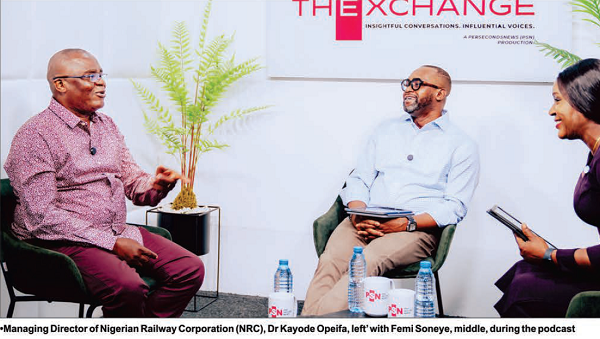
The NRC chief outlined three essential pillars for successful rail development. These include the right legal framework, strong institutions, and clear operational processes.
With the new law in place, he said the next priority is for both federal and state governments to establish effective structures and transparent processes for rail administration.
He confirmed that at least six states including Lagos, Kaduna, Kano and Borno are already working on their own metro rail plans under the new legal framework. He said this decentralised approach will speed up rail development across the country.
The Federal Government is also finalising a new National Rail Master Plan. Dr Opeifa said the plan is ready for launch. It aims to connect all states with efficient national rail lines. He described this as essential for economic growth and national integration.
Dr Opeifa expressed optimism that with the right policies in place, many states will be able to commence rail construction before the year 2026.
FURTHER READING
- Olubadan Predicts Rapid Economic Growth for Ibadan
- Group Raises Alarm Over Nigeria’s High Malaria Deaths
- Over 160,000 Lagos Residents Living with HIV
Click here to watch video of the week