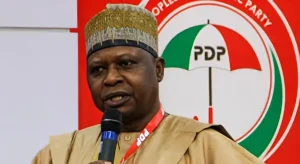
When the spokesperson of the Peoples Democratic Party (PDP), Ini Ememobong, accused the Independent National Electoral Commission (INEC) of “hypocrisy”, “bias” and a deliberate attempt to “kill the PDP and truncate democracy” on Tuesday, he gave voice to a familiar charge Nigerian political actors deploy whenever institutions refuse to validate their preferred outcomes.
According to Ememobong, INEC’s refusal to recognise the Kabiru Turaki–led national working committee (NWC) is not neutrality but partisan interference.
EDITOR’S PICKS
But beyond the rhetoric lies a harder question: is INEC truly acting with bias, or is the PDP’s internal crisis largely self-inflicted exacerbated by desperation, legal brinkmanship and an unhealthy reliance on contradictory court orders? EKO HOT BLOG explores these questions
At stake is not only the fate of the former ruling party, but the institutional independence of INEC itself, increasingly dragged into factional political wars it neither created nor is empowered to resolve.
A party at war with itself
The immediate trigger of the controversy is INEC’s refusal to update its records to recognise the Turaki-led NWC, citing multiple court judgements and the fact that the matter remains sub judice. The commission’s position is procedurally conservative: it cannot take administrative action that could pre-empt ongoing judicial processes challenging the PDP’s Ibadan convention.
From the Turaki faction’s perspective, this caution looks selective and even hostile. They argue that INEC monitored the PDP’s NEC meetings that fixed the date and venue of the convention, received formal notice of the exercise, and even monitored party primaries in Ekiti and Osun conducted under Turaki’s leadership. They further cite Supreme Court precedents, most recently involving the SDP, which bar INEC from interfering in the internal affairs of political parties.
On the other side are party members opposed to the Ibadan convention, led by Federal Capital Territory minister Nyesom Wike, who insist that the process violated the PDP constitution and electoral laws. Their resistance culminated in the formation of a parallel NWC, NEC and board of trustees, an extraordinary escalation that highlights how far internal cohesion has collapsed.
Yet it is difficult to ignore a central fact: the Ibadan convention went ahead in defiance of existing federal high court orders halting the exercise.
Instead of approaching an appellate court to challenge those rulings, the PDP leadership secured a contrary judgement from an Oyo State high court clearing the convention and directing INEC to monitor it. Whether legally defensible or not, the optics are troubling. To critics, it smacks of forum shopping, a tactical search for a favourable ruling rather than a principled pursuit of judicial clarity.
That decision deepened, rather than resolved, the crisis. It produced a convention whose legitimacy is now tied up in litigation and placed INEC in an impossible position: recognise one faction and risk contempt of court, or stand aside and be accused of bias.
Courts, contradictions and institutional strain
The PDP’s turmoil cannot be separated from a broader and more corrosive problem in Nigeria’s democracy: the proliferation of conflicting court orders on political matters. In this case, federal high courts in Abuja halted the convention, while a state high court in Ibadan authorised it. Each side now clings to the judgement that favours its cause, weaponising the judiciary in a political contest.
INEC’s letter rejecting recognition of the Turaki-led NWC reflects an institutional instinct for self-preservation. Faced with contradictory rulings, the commission opted to freeze its records until the courts speak with finality. That caution may frustrate politicians, but it is arguably the only posture that preserves the commission’s credibility.
The danger arises when political actors, driven by desperation, seek to compel INEC to take sides. Accusations of bias, threats of delegitimisation and public pressure campaigns are not just about internal party advantage; they risk turning INEC into an arena of partisan struggle rather than an impartial referee.
This pressure is compounded by inconsistency. The same politicians who cite Supreme Court judgements limiting INEC’s role in party affairs often demand decisive administrative action when it suits them. Conversely, factions that benefit from INEC’s restraint celebrate institutional independence, only to denounce it as cowardice or collusion when the tide turns.
The result is a corrosive cycle in which institutions are damned for acting and damned for refusing to act.
The real threat to INEC’s independence
The PDP crisis illustrates how political desperation, not administrative overreach, poses the greatest threat to INEC’s independence. By ignoring court orders, shopping for favourable judgements and escalating disputes into parallel party structures, politicians create legal and moral ambiguity and then insist that INEC resolve it in their favour.
This is not unique to the PDP. But the scale and intensity of the dispute within Nigeria’s leading opposition party magnify the stakes. If INEC is forced, bullied or shamed into recognising one faction while litigation rages, it sets a precedent that electoral administration is subordinate to political pressure.
FURTHER READING
Neutrality, in such circumstances, is easily misrepresented as bias. Yet neutrality is often the only defensible option.
Philip Ibitoye is a Special Correspondent with EKO HOT BLOG. Click here to find daily analysis and critical insight on trending issues in Lagos and other parts of Nigeria.
Click here to watch the video of the week below: