- Nigeria, EU Reaffirm Commitment to Multilateralism and Stronger Bilateral Ties
- Ambassador Ahmed reiterated the long-standing and mutually beneficial partnership between Nigeria and the European Union
- Gautier Mignot commended the strong alignment between Nigeria’s national priorities and the EU’s strategic objectives
Nigeria and the European Union (EU) have reaffirmed their shared commitment to multilateralism, the rule of law, and the principles of the United Nations Charter, while expressing optimism over the continued strengthening of Nigeria–EU relations.
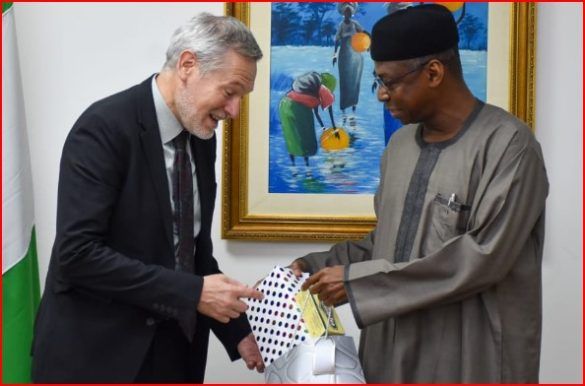
Eko Hot Blog reports that the renewed commitment followed a high-level meeting between the Permanent Secretary of the Ministry of Foreign Affairs, Ambassador Dunoma Umar Ahmed, and the European Union Ambassador to Nigeria and ECOWAS, Mr Gautier Mignot, held at the Ministry of Foreign Affairs in Abuja.
EDITOR’S PICK
- Court Remands Portable Over Assault, Theft Charges
- Uganda Orders Internet Shutdown Ahead of Election
- Truck Crash into Church: Epe LG Chairman Calls for Calm, Assures Community Support
Speaking during the meeting, Ambassador Ahmed reiterated the long-standing and mutually beneficial partnership between Nigeria and the European Union, describing the EU as one of Nigeria’s most important development partners.
He outlined the wide scope of cooperation between both parties, covering trade and investment, peace and security, governance, climate action, digital economy, agriculture, education, health, humanitarian assistance, and people-to-people exchanges.
Ambassador Ahmed expressed satisfaction with the positive trajectory of bilateral relations and reaffirmed the Federal Government’s commitment to economic diversification. He disclosed that Nigeria is gradually reducing its dependence on oil revenues and shifting focus to priority sectors such as agriculture, the digital economy, climate-smart development, and innovation.
He encouraged increased European investment and collaboration in these sectors, noting their importance to sustainable growth and job creation.
The Permanent Secretary also highlighted Nigeria’s strategic role in promoting regional peace and stability, particularly in West Africa, and welcomed continued EU cooperation in counter-terrorism, the prevention of violent extremism, maritime security in the Gulf of Guinea, and post-conflict recovery initiatives.
He stressed the need to address the root causes of insecurity, including poverty and youth unemployment.
On climate change, Ambassador Ahmed reaffirmed Nigeria’s commitment to climate action and sustainable development, calling for enhanced EU support in climate adaptation, energy transition, access to climate finance, and the transfer of green technologies.
He further advocated a balanced, humane, and cooperative approach to migration, emphasising the importance of legal mobility pathways, skills partnerships, and youth empowerment programmes.
In his remarks, EU Ambassador Gautier Mignot commended the strong alignment between Nigeria’s national priorities and the EU’s strategic objectives. He described 2026 as a pivotal year for scaling up the partnership through structured dialogue and high-level engagements.
Mignot disclosed that preparations are underway for a Nigeria–EU Ministerial Meeting proposed for March 2026 in Abuja, aimed at advancing cooperation across key sectors.
He highlighted the EU’s Global Gateway Strategy, which seeks to leverage development assistance to attract private investment, noting significant EU-backed investments in infrastructure, digital connectivity, clean energy, water transportation, agriculture, and youth-focused initiatives.
The EU Ambassador also reaffirmed the bloc’s growing support for Nigeria’s peace and security architecture, economic development, and efforts towards regional stabilisation.