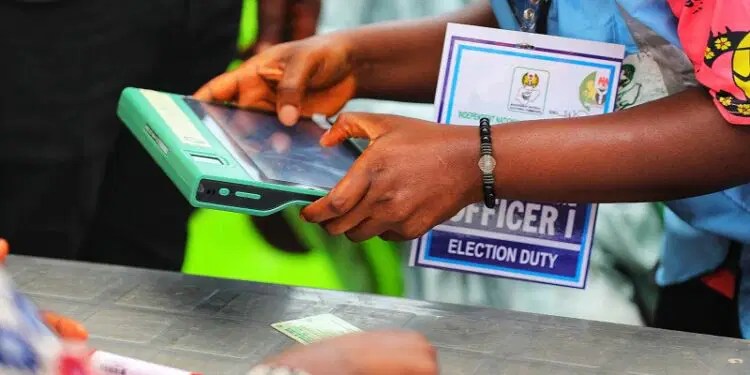
Senate Leader Opeyemi Bamidele on Sunday boldly declared that Nigeria is not prepared for mandatory real-time electronic transmission of election results.
He cited broadband coverage at 70 per cent, internet penetration at 44.53 per cent, and mobile network speeds ranking Nigeria 85th out of 105 countries globally.
EDITOR’S PICKS
His conclusion? The nation’s infrastructure cannot support real-time upload of results nationwide. The Senate amended the Electoral Bill 2026, retaining electronic transmission but with Form EC8A as backup when internet fails.

Yet this isn’t the first time lawmakers have wrestled with this question. A deeper look by EKO HOT BLOG reveals a troubling pattern of contradictory claims and technical reports that seem to change with the political wind.
What the 2018 Joint Committee Actually Found
Seven years ago, the Independent National Electoral Commission (INEC) and the Nigerian Communications Commission (NCC) formed a joint technical committee to evaluate electronic transmission. The committee, co-chaired by NCC Commissioner Ubale Maska and INEC National Electoral Commissioner Mustapha Lecky, analysed 118,302 polling units.
According to the committee’s findings, 59,523 polling units were covered by 3G and 2G services, 50,038 were covered by only 2G, whilst 8,741 units had no coverage at all. That translates to roughly 50 per cent with 3G/2G and 49 per cent with only 2G or below.
Yet crucially, the committee still recommended proceeding with electronic transmission. After evaluating three options — national roaming, multi-SIM, and traditional data communication — they chose the last: traditional data service from mobile operators using Access Point Names (APN) and Virtual Private Networks (VPN).
The cost? N395 million for SIM cards, system configuration, support, and data bundles. Mobile operators confirmed capacity, citing similar solutions deployed for JAMB examinations nationwide.
INEC’s Critical Position: We Have Capacity
Here’s where the story becomes revealing. In a September 2021 position paper, INEC stated that the joint committee “found that mobile networks adequately covered 93 per cent of INEC polling units with capacity to cover the outstanding seven per cent”.
This wasn’t INEC inventing figures. The committee had allocated polling units to four mobile operators — MTN, Airtel, Glo, and 9Mobile — specifically for transmitting results. The N395 million budgeted covered services with one-year validity.
When NCC’s Executive Commissioner (Stakeholder Management), Adeleke Adewolu, testified before the House of Representatives in July 2021 that only 50 per cent of the country has 3G coverage required for transmission, INEC pushed back forcefully.
Then Director of Publicity and Voter Education of the electoral umpire, Nick Dazang declared that the commission had the capacity to transmit election results from any part of the country, no matter the terrain.
In its position paper two months later, INEC said, “To suggest that 2G cannot transmit election data is simply incorrect. In any case, the MNOs and the NCC were well aware that only 2G network existed in some places in the country when in 2018 they concluded that electronic transmission of results was possible.”
When politics trumps technology
The timing wasn’t coincidental. It came during heated debates over the Electoral Act Amendment Bill, with voting splitting along party lines. APC members generally opposed giving INEC full control, while PDP members favoured it.
The compromise required NCC to certify adequate coverage before INEC could transmit results electronically, effectively handing politicians a veto over a technical decision.
The real question
Today’s debate mirrors 2021’s. Bamidele cites 70 per cent broadband coverage as inadequate. Yet in 2018, despite raw coverage figures showing only half of polling units with 3G, the joint committee still found it feasible and INEC declared capacity to proceed.
The difference? INEC’s 93 per cent assessment factored in operator assurances, alternative solutions for gap areas, and proven capacity from JAMB’s nationwide operations. In November 2025, INEC uploaded over 99 per cent of Anambra’s results using 6,879 devices.
So the question isn’t really about infrastructure — 2G networks can transmit simple numerical data and images. The question is about interpretation. Does 70 per cent broadband coverage mean Nigeria cannot transmit election results? Or does it mean we need backup systems for the 30 per cent, as INEC has repeatedly stated it can provide?
FURTHER READING
In 2018, technical experts said it could be done. In 2025, it has been done successfully. Yet lawmakers keep finding reasons why it cannot become mandatory. Perhaps the real question is: who benefits from keeping electronic transmission optional?
Philip Ibitoye is a Special Correspondent with EKO HOT BLOG. Click here to find daily analysis and critical insight on trending issues in Lagos and other parts of Nigeria.
Click to watch the video of the week below: