
- the 2026 rainy season will begin around the final week of March and continue until the first week of December
- These climate conditions suggest that Lagos, as well as neighbouring Ogun State, may experience rainfall levels that are higher than usual
- In addition, temperatures across most parts of the state may remain above average between March and May
The Lagos State Government has projected that the 2026 rainy season will begin around the final week of March and continue until the first week of December.
According to the state authorities, Eko Hot Blog gathered that total rainfall for the year is expected to range between 1,650mm and 3,030mm.
EDITOR’S PICK
- “Pay Her Transport Fare Too”, Pete Edochie Stirs Debate on Dating Expenses
- Epe Students Parliament Declares Executive Seats Vacant Over Inauguration Dispute
- Osimhen Warns Galatasaray Ahead of Liverpool Match
The announcement was made by the Commissioner for Environment and Water Resources, Tokunbo Wahab, during a press briefing held in Alausa, Ikeja.

Wahab explained that the forecast is based on the presence of a weak La Niña and a neutral phase of the El Niño Southern Oscillation (ENSO).
These climate conditions suggest that Lagos, as well as neighbouring Ogun State, may experience rainfall levels that are higher than usual.
He noted that the rainy season is likely to start early or at the normal time, while its end may occur slightly later than usual.
Overall rainfall levels are also expected to range from normal to above normal. In addition, temperatures across most parts of the state may remain above average between March and May.
The commissioner further explained that the year began with a weak La Niña in January, while the neutral ENSO phase is expected to continue for the first six to eight months of the year.
These conditions could result in an early start to the rainy season, a longer duration of rainfall, and a delayed end.
Specific forecasts were also given for several parts of the state:
- Ikeja: Rainfall expected to start around March 31 and end by December 2, with an estimated annual rainfall of about 1,932mm.
- Badagry: Expected onset on March 28, ending December 3, with about 2,010mm of rainfall.
- Ikorodu: Predicted to begin March 31 and end December 2, with approximately 1,935mm.
- Lagos Island: Likely to start March 30 and end December 2, with around 1,968mm.
- Epe: Expected onset on March 29 and cessation on December 3, with about 1,984mm.
Across the state’s 20 Local Government Areas, the average rainfall expected for the year is estimated at 1,965mm.
Wahab warned that areas receiving heavy rainfall could experience occasional flash floods, while strong winds may occur at both the beginning and the end of the rainy season, potentially posing risks to lives and property.
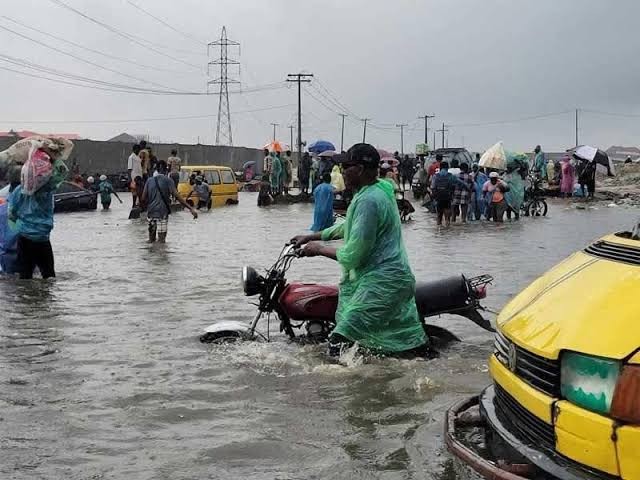
To manage these risks, the Lagos State Government said it has installed a network of weather monitoring stations and river gauge systems to track weather patterns and water levels.
The Ministry also continues to run its year-round drainage maintenance programme aimed at improving flood control, alongside measures to strengthen waste management across the state.
The government will also maintain collaboration with the Ogun-Oshun River Basin Development Authority to regulate water releases from the Oyan Dam.
This coordination helps control water flow and reduce the risk of flooding in communities along the downstream sections of the Ogun River.
Residents living in low-lying communities such as Agiliti, Agboyi, Itowolo, and Ajegunle have been advised to consider relocating to safer, higher areas as a precaution. Authorities also said they are closely monitoring the possibility of flooding along the Ogun River and other river systems in the state.
In addition, the Lagos State Signage and Advertisement Agency has been placed on alert to ensure that billboards and telecommunication masts are properly secured.
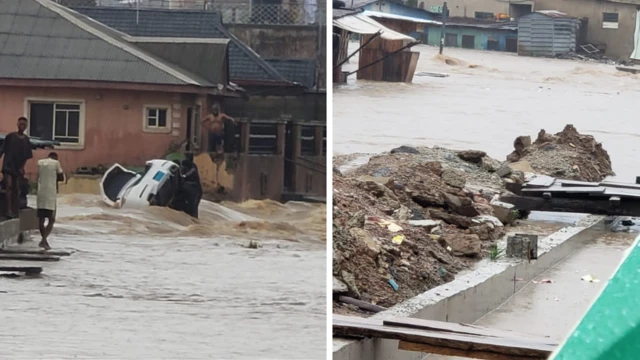
This is to prevent possible structural failures caused by strong winds that often accompany the start and end of the rainy season.
Emergency services and traffic management agencies across the state have also been put on standby to respond quickly to any weather-related incidents.
Wahab added that short-term flash flooding during heavy rainfall is sometimes unavoidable but usually clears quickly once water drains away.
He urged media organisations to avoid sensational reporting that may cause unnecessary panic, explaining that flooding should only be considered severe when water remains on roads for several hours.
The commissioner also pointed out that rising water levels in the lagoon can sometimes block drainage outlets during periods of high tide. When this happens, stormwater may temporarily back up and cause flooding until the water level drops and normal drainage resumes.
Residents living along floodplains and drainage corridors, including areas such as Owode, Iwaya, Makoko, Badia, Ijora, Isaalu, Pota, and Shibiri, were advised to remain vigilant and be prepared to relocate if necessary.
Authorities said they will notify affected communities whenever relocation becomes necessary.
FURTHER READING