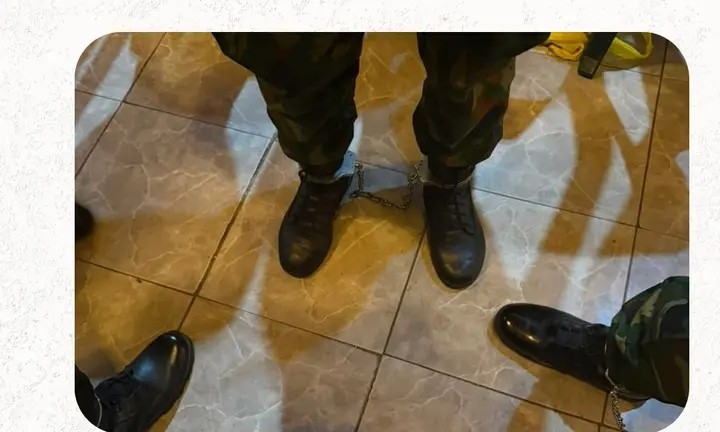
- At least 35 Nigerian military personnel standing trial for an alleged plot to overthrow the government of President Bola Ahmed Tinubu are being brought to court in heavy shackles, sparking intense debates over constitutional rights and fair trial standards.
- Legal experts and human rights advocates have raised serious concerns, noting that keeping the defendants bound inside the courtroom directly violates the Administration of Criminal Justice Act (ACJA) 2015 and the constitutional presumption of innocence.
- Reports indicate that the strict security protocols have begun taking a physical toll on the accused personnel, with at least one high-ranking officer collapsing during recent secret proceedings due to prior sustained injuries.
A serious constitutional and human rights controversy has hit the ongoing secret trial of at least 35 Nigerian military personnel accused of plotting a coup against President Bola Ahmed Tinubu, as the defendants continue to appear before the tribunal in handcuffs and leg chains.
Eko Hot Blog reports that despite repeated formal objections and passionate appeals from their legal representatives, the authorities have persisted in keeping the officers and soldiers tightly shackled throughout the court proceedings.
EDITOR’S PICK
- Hamzat Appoints Obanikoro as Campaign DG Ahead of 2027 Lagos Governorship Race
- Tinubu’s State Police Plan Gains Momentum as Amendment Looms
- Residents Raise Alarm After Two Bodies Found in Lagos Waterway
Multiple sources familiar with the secret trial revealed that the personnel are strictly required to remain in both hand and leg restraints even when utilizing convenience rooms or moving across the court facility, raising alarm over compliance with established statutory safeguards.
The high-profile list of accused personnel includes prominent figures such as Brigadier General M.A. Sadiq, Colonel M.A. Ma’aji, Lieutenant Colonel I.M. Hussain, and Wing Commander I.U.
Yusuf, alongside dozens of other majors, captains, and non-commissioned officers.
Observers argue that forcing the officers to stand trial in chains violates Sections 35 and 36(5) of the 1999 Constitution of the Federal Republic of Nigeria (as amended), which guarantees personal liberty and dictates that every accused individual must be presumed innocent until proven guilty.
Furthermore, the Administration of Criminal Justice Act (ACJA) 2015 explicitly prohibits the degrading treatment or unnecessary restraint of suspects unless there is a proven risk of violence or escape.
The intense conditions within the courtroom have already resulted in severe health complications. During a recent session, one of the accused military officers reportedly fainted and collapsed inside the courtroom due to severe health issues arising from injuries he had previously sustained during detention.
Because of his precarious medical condition, he was temporarily exempted from wearing the handcuffs during that specific session.
Legal analysts have strongly criticized the trial conditions, asserting that a courtroom must remain a place of unfettered access to justice and that trying serving personnel in chains heavily compromises their ability to properly defend themselves.
The proceedings, which are being heavily guarded from public scrutiny, have also seen internal tension between the bench and the defense bar.
The President of the General Court-Martial, Air Vice Marshal H.I. Alhaji, openly expressed bitter disappointment over media leaks detailing the secret trials.
Air Vice Marshal Alhaji complained that the publication of his personal details and trial updates constituted an attack on his personality, warning defense lawyers that the court may resort to seizing mobile phones and other electronic communication devices at the entrance if information continues to filter out to investigative journalists.
Constitutional lawyers have pointed out that under a civilian dispensation, coup plotting is considered an offense against the state that must strictly align with democratic legal frameworks and oversight from the Attorney-General of the Federation.
Experts argue that even within standard court-martial guidelines, accused persons remain serving military personnel who are legally entitled to appear in clean uniforms and without physical shackles until a definitive judicial verdict or dismissal is delivered.
As the secret trial progresses, the persistent use of maximum physical restraints remains a focal point of friction between security agencies and legal practitioners advocating for institutional adherence to the rule of law.