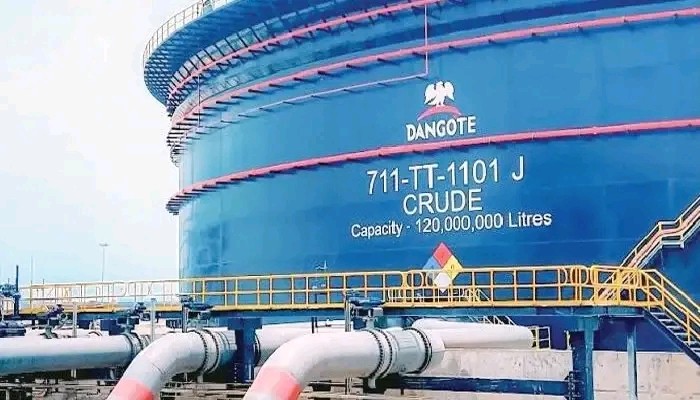
- Major petroleum marketing bodies, including PETROAN and IPMAN, have strongly rejected Dangote Petroleum Refinery’s transition to dollar-denominated pricing for local fuel purchases, warning of severe economic consequences.
- Following the refinery’s policy shift invalidating previous naira transactions, depot loading prices rapidly surged, with petrol prices climbing by up to ₦113 per litre and diesel rising by up to ₦150 per litre in key hubs.
- While some energy economists view the policy as a standard commercial risk-management strategy to offset foreign exchange exposure, legal and regulatory experts argue that domestic transactions must respect the naira as Nigeria’s sole legal tender.
Independent petroleum marketers and energy experts across Nigeria have expressed strong opposition to the Dangote Petroleum Refinery’s decision to introduce United States dollar-denominated pricing for local petroleum product transactions.
Eko Hot Blog reports that stakeholders warned on Tuesday that the sudden policy shift could worsen foreign exchange pressures, drive up retail pump prices, and trigger fresh instability in the domestic downstream sector.
EDITOR’S PICK
- Why Africa Still Cannot Win the FIFA World Cup Despite Its World Class Talent
- Man Allegedly Slits Father’s Throat, Mutilates Body in Anambra
- Lagos Court Convicts Director, Company Over N822.4m Fraudulent Conversion
The controversy erupted after Dangote Refinery formally notified marketers that it was transitioning its pricing template, quoting ex-depot prices for Premium Motor Spirit (PMS), Automotive Gas Oil (AGO), and aviation fuel in US dollars for both coastal and gantry transactions.
The refinery declared all previously issued naira-denominated Proforma Invoices (PFIs) and deal recaps invalid, directing marketers to cease payments against them.
Following the announcement, private depot operators across major hubs in Lagos, Port Harcourt, and Warri quickly adjusted their rates to factor in rising replacement costs.
In Port Harcourt, petrol loading prices at some depots surged by ₦113, jumping from ₦1,137 to ₦1,250 per litre, while diesel prices rose from ₦1,500 to ₦1,650 per litre. In Lagos, petrol loading prices crept up from ₦1,090 to ₦1,120 per litre, with similar upward adjustments recorded in Warri.
Reacting to the development, the National President of the Petroleum Products Retail Outlets Owners Association of Nigeria (PETROAN), Billy Gillis-Harry, warned that the move threatens to dollarize the local economy While acknowledging Dangote’s massive investment, he insisted that a single private player should not implement policies that directly conflict with regulatory efforts to stabilize the national currency.
He noted that forcing local marketers to source scarce foreign exchange from banks to buy domestic fuel would inevitably pass the financial burden onto struggling consumers.
Similarly, the National Publicity Secretary of the Independent Petroleum Marketers Association of Nigeria (IPMAN), Chinedu Ukadike, appealed directly to President Bola Tinubu to intervene.
Ukadike urged the federal government to ensure the continuation of the crude-for-naira initiative, warning that tying domestic fuel sales to the dollar amid global shipping tensions would trigger massive pump price volatility and increase local demand for scarce greenbacks.
Meanwhile, energy experts offered divergent perspectives on the legal and economic implications of the decision.
Professor Emeritus Wumi Iledare, a prominent petroleum economist, urged stakeholders to view the shift through the lens of deregulation and commercial risk management.
He argued that because refinery inputs, including crude feedstock, equipment, and catalyst materials, are priced in dollars, selling the final product in naira exposes the refinery to severe currency mismatch risks.
He emphasized that the role of the Nigerian Midstream and Downstream Petroleum Regulatory Authority (NMDPRA) is to ensure healthy competition rather than to cap prices arbitrarily.
Conversely, Professor Dayo Ayoade of the University of Lagos questioned the propriety of the policy. While acknowledging the refinery’s need to hedge against currency losses, Ayoade pointed out that the Central Bank of Nigeria (CBN) provided significant forex support during the facility’s construction, and the refinery had previously benefited from local naira-denominated crude allocations.
He asserted that because the naira remains Nigeria’s sole legal tender, domestic transactions should be denominated accordingly.
He called on the CBN, NMDPRA, and the Federal Competition and Consumer Protection Commission (FCCPC) to urgently review the financial and legal basis of the decision.