- Cuba does not threaten American security or regional stability
- The Cuban president also accused Washington of increasingly embracing confrontational rhetoric in its foreign policy
Cuban President Miguel Díaz-Canel has accused the United States of attempting to create a justification for possible military action against Cuba amid escalating tensions between both countries over sanctions and regional security issues.
Speaking at an international solidarity gathering in Havana organised to mark the 100th anniversary of late revolutionary leader Fidel Castro, Díaz-Canel criticised Washington’s approach toward the Caribbean nation and rejected claims that Cuba poses any threat to the United States, Eko Hot Blog gathered.
EDITOR’S PICK
- Benue Mortician Arrested for Using Corpse Part as Walking Stick
- Baba Yusuf: Bandits May Reach National Assembly
- PDP Asks INEC To Withdraw Recognition Of Anyanwu As National Secretary
According to reports by TRT World and Anadolu Agency, the Cuban leader alleged that the US government was deliberately portraying Cuba as a danger in order to justify increased pressure and possible aggression against the island.
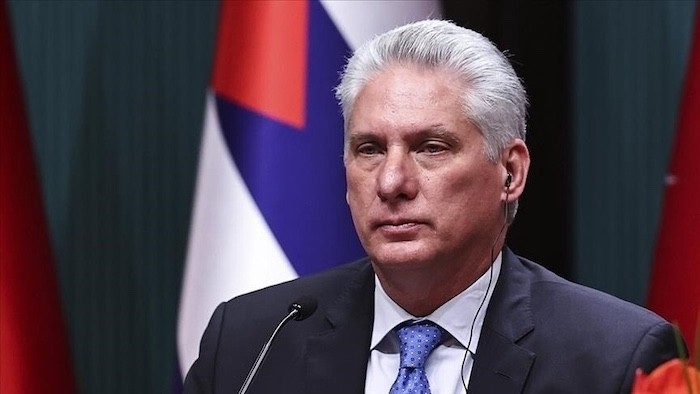
“The US does not define us as an ‘extraordinary and unusual’ threat for itself. We are convinced this is not the sentiment of the American people, but a pretext used by the US government to attack us,” Díaz-Canel said during the event in Havana.
He insisted there was no basis for any form of military intervention, maintaining that Cuba does not threaten American security or regional stability.
The Cuban president also accused Washington of increasingly embracing confrontational rhetoric in its foreign policy and linked current tensions to wider geopolitical disputes involving Venezuela and other governments opposed to US influence in Latin America.
The latest remarks come as relations between Havana and Washington continue to deteriorate following a fresh round of sanctions introduced by the administration of Donald Trump targeting sectors tied to Cuba’s economy and security institutions.
Recent US measures have focused on restricting Cuba’s access to foreign investment and hard currency, with sanctions targeting military-linked businesses and key industries.
Cuban officials say the restrictions have worsened the country’s economic difficulties, including fuel shortages, rising inflation and recurring electricity blackouts across the island.
Cuba’s Foreign Minister, Bruno Rodríguez Parrilla, also condemned what he described as dangerous threats of military action from Washington, warning that such rhetoric could further destabilise the Caribbean region.
Despite the growing tension, Díaz-Canel stated that Cuba remains open to dialogue with the United States, provided discussions are based on mutual respect and non-interference in the country’s internal affairs.
FURTHER READING