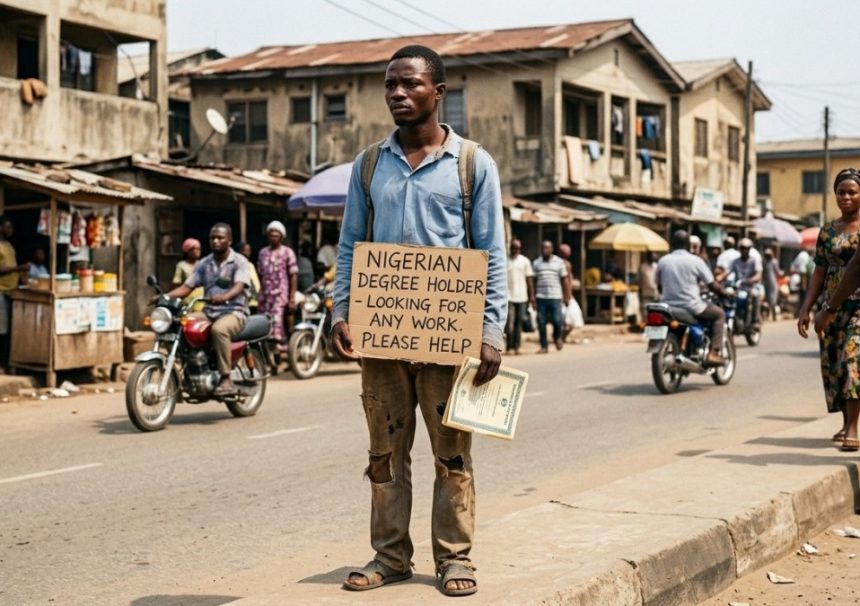
For decades, a university degree in Nigeria was seen as a direct pathway to stability, respect, and economic security. Today, that belief is rapidly fading, across campuses and social conversations, a new narrative has taken hold: what you study in university may not matter in the real world.
This shift is backed by data, experience, and a widening gap between education and economic reality.
Recent findings show that more than 55% of Nigerian graduates work in fields unrelated to their course of study, while nearly 60 percent of employers say graduates are not job-ready.
EDITOR’S PICKS
- FA Introduces New Rules To Limit Heading In Football
- President Tinubu Has Not Endorsed Any APC Candidate for 2027 – Jandor
- Police Arrest 2 Over Trafficking of Nigerian Woman to Côte d’Ivoire
Earlier academic research also revealed that skills mismatch in Nigeria stands at over 60%, exposing the disconnect between what universities teach and what the labour market demands.
At the same time, graduate unemployment has surged dramatically. From less than 1% in the 1970s, unemployment among degree holders rose to about 28.8 percent by 2020, with many others underemployed or working low-income jobs.
The implication is clearer now, higher education no longer guarantees employment.
A large proportion of Nigerian students are concentrated in social sciences and management courses, which account for about half of total university enrolment.
However, the economy is increasingly demanding digital, technical, and vocational skills. Reports indicate that millions of future jobs in Africa will require digital competence, yet many graduates lack these capabilities.
This mismatch creates a cycle where graduates are trained for jobs that either do not exist or are already saturated.
In response, a new survival strategy has emerged among students and graduates: learn a skill, build a side hustle, and depend less on your degree.
From fashion design to coding, photography to forex trading, many students now invest more time in skill acquisition than academic excellence. The phrase “school na scam” has gained traction, showing this growing frustration with the system.
While entrepreneurship is positive, experts warn that this mindset is also making some students less serious about their academic training, which is in turn weakening the value of university education.
Analysts point to several structural problems driving the crisis, University curricula remain outdated and heavily theoretical, offering limited practical exposure to students.
There is also weak industry linkage, as institutions maintain little collaboration with employers, leaving many graduates unprepared for real work environments. In addition, vocational education continues to be neglected, with the system placing greater value on degrees than technical skills despite rising demand for artisans and technicians. At the same time, mass graduate production has intensified the problem, with hundreds of thousands entering the labour market each year while job creation has failed to keep pace.
Beyond statistics, the consequences are personal, many graduates face years of job searching, financial dependence, and frustration. Studies show that youth unemployment and underemployment remain high, contributing to poverty, social unrest, and loss of confidence in education itself.
For many, the dream of university education has turned into a struggle for survival.
Is the Degree Still Worth It?
The answer is complex.
A university degree still matters, but no longer on its own. In today’s Nigeria, employability depends on a combination of: Academic knowledge, Practical skills, Digital competence and Entrepreneurial ability.
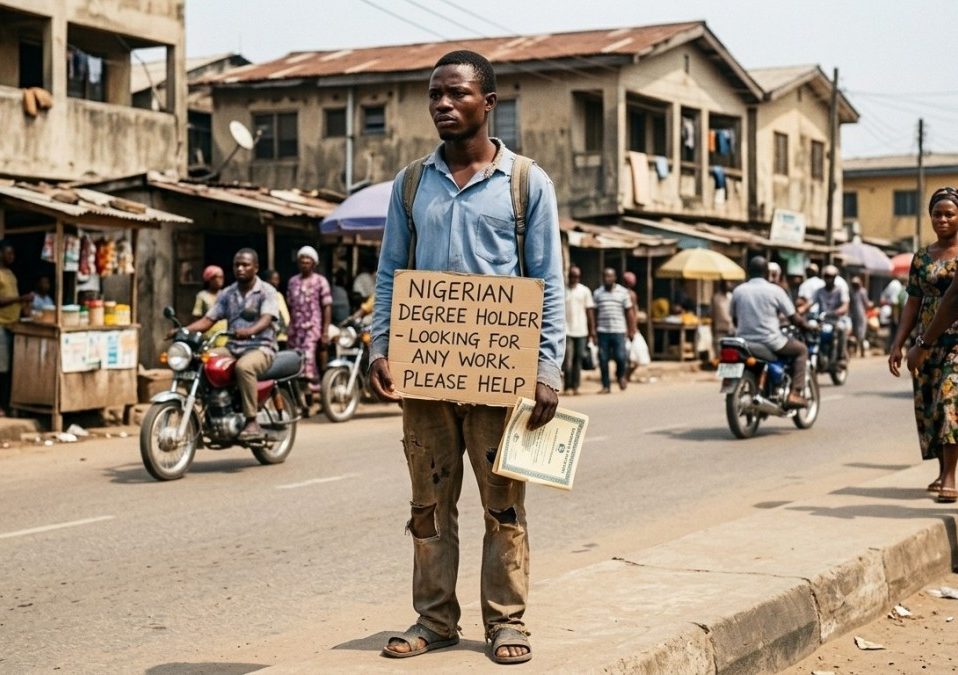
Education is no longer a guarantee, it is now just one part of a larger equation.
FURTHER READING
- Nigerian Fraudster Admits Role in $50 Million Email Scam Network
- FG Begins Review of Agricultural Curricula to Bridge Skills Gap
- Mother Slumps, Dies While Escorting Daughter To UTME Centre In Ondo