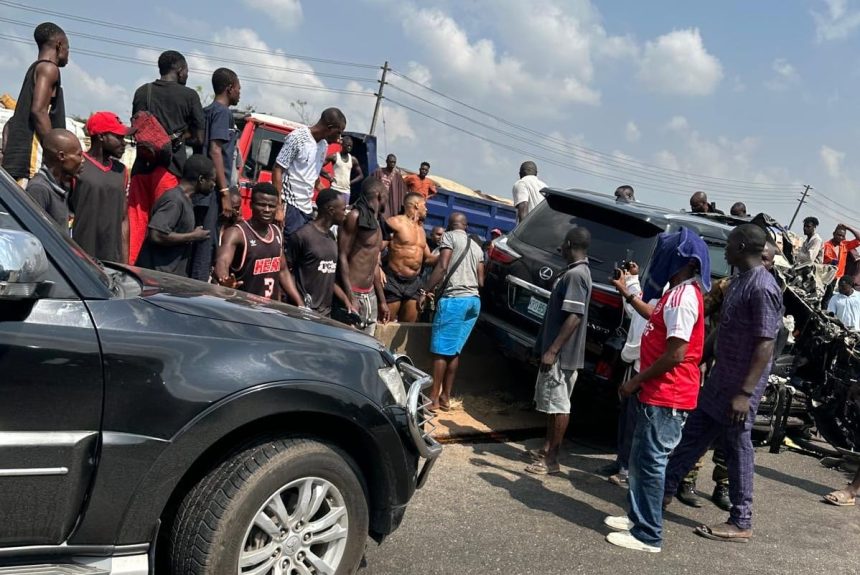
British-Nigerian heavyweight boxing star Anthony Joshua was on Monday involved in a fatal road traffic crash on the Lagos-Ibadan Expressway near the Sagamu axis of Ogun State, an incident that claimed two lives and left the former world champion with minor injuries.
However, shortly after news of the crash broke, claims began circulating on social media that poor road conditions were responsible for the accident, with some users accusing the Ogun State Government of negligence and failure to maintain the expressway.
EDITOR’S PICKS
One widely shared commentary on X, by an account identified as GST, described the crash as evidence of a broader pattern of deadly accidents on “broken roads the government still refuses to fix.”
Anthony Joshua has been involved in a car crash that left two people dead, and was rushed to the hospital not in an ambulance, but in a police van.
This is negligence. Nigeria is witnessing a pattern of fatal crashes on broken roads the government still refuses to fix.… pic.twitter.com/TCpc7hF9Pp
— gst (@wearegst) December 29, 2025
Similar posts suggested that the section of the expressway where the crash occurred was in poor condition and therefore directly responsible for the loss of control that led to the collision.
A review of official statements and preliminary investigative findings by EKO HOT BLOG, however, paints a different picture.
What the FRSC Investigation Says
The Federal Road Safety Corps (FRSC), Nigeria’s statutory agency for road traffic administration and crash investigation, responded to the incident and subsequently released a preliminary report on the circumstances surrounding the crash.
According to the FRSC, the Lexus SUV conveying Joshua was travelling beyond the legally prescribed speed limit on that corridor of the Lagos-Ibadan Expressway at the time of the accident.

The corps stated that the vehicle lost control during an overtaking manoeuvre before crashing into a stationary truck near the Sinoma area of Sagamu. It identified excessive speed and wrongful overtaking as the primary causes of the crash, describing both as serious traffic violations and among the most common contributors to fatal road accidents on Nigerian highways.
The FRSC confirmed that the accident occurred around 12 noon and resulted in the deaths of two occupants of the vehicle. Joshua survived with minor injuries and was treated at a medical facility. The bodies of the deceased were conveyed to the Livewell Morgue in Ajaka, Sagamu, while the Nigeria Police Motor Traffic Division was formally notified to support further investigation.
Notably, the FRSC’s official statement made no reference to potholes, collapsed pavement, road failure, or any form of infrastructural defect as a contributing factor. There was also no indication that the condition of the road surface impeded vehicle control or visibility. Instead, the focus of the findings was on driver behaviour, particularly speed management and overtaking judgment on a high-speed expressway.
Verdict
Based on the preliminary findings released by the FRSC and other sources, there is no evidence to support claims that poor road conditions caused the crash involving Joshua on the Sagamu axis of the Lagos-Ibadan Expressway.
While concerns about road safety and infrastructure remain legitimate in Nigeria’s broader transport discourse, the available facts in this case point to excessive speed and wrongful overtaking as the determining factors.
FURTHER READING
Until further investigations present new or contradictory evidence, assertions that the crash was caused by bad road conditions — or that it resulted from government negligence in road maintenance — remain unsupported by evidence and are MISLEADING.
Philip Ibitoye is a Special Correspondent with EKO HOT BLOG. Click here to find daily analysis and critical insight on trending issues in Lagos and other parts of Nigeria.
Click here to watch the video of the week below: