- EIB, EU, AFD Partner Lagos on Modern Ferry Terminals, Electric Boats
- Sanwo-Olu Praises €550m EIB Commitment to Nigeria
- Sanwo-Olu Says Omi Eko Aligns with THEMES+ Agenda
Lagos State Governor, Babajide Sanwo-Olu, has commended the European Investment Bank (EIB) for supporting the Omi Eko Project, describing the initiative as a transformative investment capable of improving urban mobility, boosting economic productivity and enhancing the quality of life of Lagos residents.
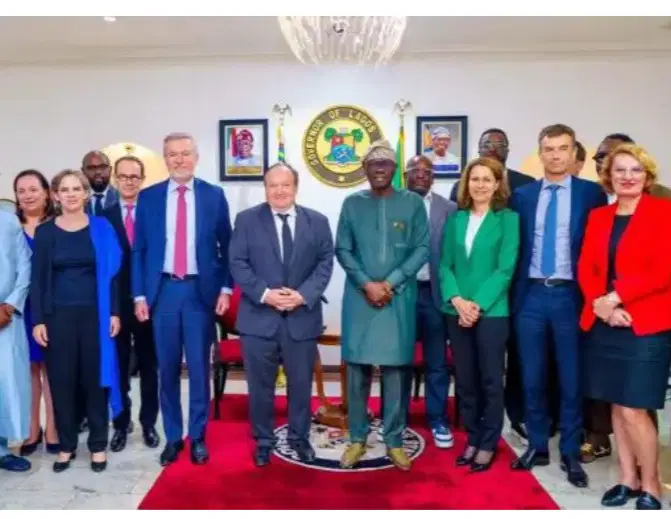
Eko Hot Blog reports that Sanwo-Olu made the remarks on Friday while receiving a delegation from the EIB led by its Vice President, Ambroise Fayolle, during a courtesy visit to Lagos House, Marina.
EDITOR’S PICK
- Phase 2 of Lekki Deep Sea Port to Begin Soon
- If Only God Can End Insecurity, Then What Are We Paying For?
- Lagos Unveils Team for National Robotics Championship After Thrilling State Finals
The governor said the Omi Eko Project aligns with his administration’s THEMES+ Agenda, particularly its transportation and traffic management objectives aimed at developing a more efficient and integrated mobility system for the state.
According to him, Lagos, Nigeria’s commercial nerve centre, is increasingly becoming a preferred destination for investments in technology, finance, innovation and entrepreneurship, making modern transport infrastructure critical to sustaining growth.
Sanwo-Olu explained that the Omi Eko Project is a key component of the state’s strategy to establish an intermodal transportation network that seamlessly integrates road, rail and water transport systems.
He noted that with nearly one-third of Lagos covered by water, the government remains committed to harnessing its waterways as a viable alternative means of transportation.
The governor said the project, whose name translates to “Water of Lagos,” will provide modern and climate-resilient infrastructure, including upgraded ferry terminals, safer navigation routes and improved commuter services.
He added that the initiative is expected to unlock the economic potential of Lagos waterways and significantly reduce travel time for commuters.
“Trips that currently take up to two hours could be reduced to between 40 and 45 minutes, improving productivity and making daily life easier for residents,” he said.
Sanwo-Olu thanked the EIB, the African Development Bank and other development partners for supporting the state’s vision of building a sustainable and efficient transport system.
He also welcomed the EIB’s increasing investments in Nigeria’s small and medium-scale enterprises, describing SMEs as the backbone of economic growth.
The governor referenced the recently concluded Lagos Investment Summit and reiterated his administration’s commitment to translating investment commitments into measurable economic benefits.
Speaking earlier, EIB Vice President Ambroise Fayolle disclosed that Nigeria became the bank’s largest country of operations in Africa in 2025, with lending commitments reaching €550 million.
He said the development reflected the growing partnership between Nigeria, the European Union and the EIB.
Fayolle revealed that the bank recently signed a €200 million facility with the Development Bank of Nigeria to support digital and green investments for micro, small and medium-sized enterprises.
He also announced a financing agreement with Wema Bank aimed at improving access to funding for underserved businesses while promoting environmentally sustainable practices.
Describing Omi Eko as one of the European Union’s flagship projects in Lagos, Fayolle said the initiative is jointly financed by the EIB, the European Union and the French Development Agency (AFD).
He explained that the project will support the construction of modern ferry terminals and the deployment of electric boats to improve water transportation, reduce congestion and provide residents with a cleaner and more efficient means of commuting.