- The Federal Government has announced a landmark defense policy initiative aimed at embedding civilian media practitioners directly within active military formations during internal security and counter-insurgency operations.
- Operational leaders emphasize that modern combat extends beyond traditional kinetic land, air, and maritime operations, requiring a sophisticated and collaborative approach to information management and strategic communication.
- The collaborative initiative seeks to bridge the information gap between national defense bodies and the public while strictly mandating professional compliance to prevent the premature disclosure of sensitive tactical intelligence.
The Federal Government has formally disclosed a comprehensive national security plan to embed professional journalists within operational military units during selected combat and peacekeeping assignments.
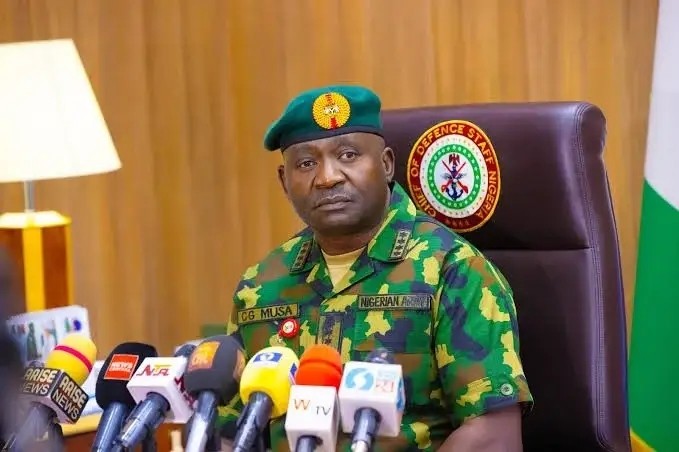
Eko Hot Blog reports that the Minister of Defence, General Christopher Gwabin Musa (rtd.), made the strategic disclosure on Thursday during the National Security Summit in Abuja.
EDITOR’S PICK
- Hamzat Appoints Obanikoro as Campaign DG Ahead of 2027 Lagos Governorship Race
- Tinubu’s State Police Plan Gains Momentum as Amendment Looms
- Residents Raise Alarm After Two Bodies Found in Lagos Waterway
The high-level conference, jointly structured by the Nigeria Union of Journalists (NUJ) and the Department of State Services (DSS), brought together top security chiefs, media executives, policymakers, and academics to establish collaborative solutions to the country’s evolving internal security landscape.
The minister, who was officially represented at the event by his Special Adviser, Rear Admiral Olusanya Bankole (rtd.), framed the media inclusion project as a vital mechanism for driving accurate security reporting, enhancing transparency, and building robust public confidence in the institutional victories achieved by the armed forces.
Expanding on the philosophical foundation of the policy, the defense minister characterized the media as a foundational pillar in contemporary defense management rather than a mere secondary observer.
He noted that contemporary warfare has expanded dramatically past the physical constraints of land, sea, and air, establishing the information space as a critical, high-stakes domain of conflict.
According to the minister, the true index of success in modern counter-insurgency campaigns is no longer calculated solely by battlefield dominance or enemy casualties, but also by the level of public trust, national resilience, and institutional credibility maintained at home.
He asserted that the media function not only as standard informational enablers but as vital constitutional stabilizers capable of preserving national unity and public morale during prolonged security challenges.
The tactical deployment framework is being designed by the Ministry of Defence to offer verified media practitioners direct, firsthand exposure to the realities, risks, and complexities faced by front-line personnel.
By integrating trained correspondents into operational theaters, the state intends to dismantle long-standing communication barriers, eliminate speculative reporting, and suppress the spread of weaponized misinformation and disinformation that frequently undermines military operations.
Despite the progressive nature of the initiative, the minister issued an explicit caution regarding the severe operational hazards of reckless reporting.
He warned that the unverified or premature publication of active troop positions, logistical maneuvers, or pending tactical strategies could severely compromise active assignments, endanger the lives of combat personnel, and inadvertently offer free tactical intelligence to adversarial networks.
In tandem with the defense ministry’s briefing, the broader government apparatus used the summit to advocate for a profound behavioral shift in national media coverage.
Contributing to the policy dialogue, the Minister of Information and National Orientation, Mohammed Idris, made an impassioned appeal to editorial boards across the federation to deny front-page publicity to terrorists, bandits, and saboteurs, arguing that sensationalized media prominence plays directly into the psychological warfare strategies of criminal networks.
Furthermore, the Office of the National Security Adviser (ONSA) revealed that it is actively developing a National Security Strategic Communication Framework to build permanent structural pathways for secure information sharing, source verification, and institutional alliance.
Concluding the session, the National President of the NUJ, Comrade Alhassan Yahaya Abdullahi, welcomed the collaborative blueprint, affirming that safeguarding the territorial integrity and social peace of Nigeria is a shared civic obligation that requires an enduring partnership between the press and the nation’s security agencies.