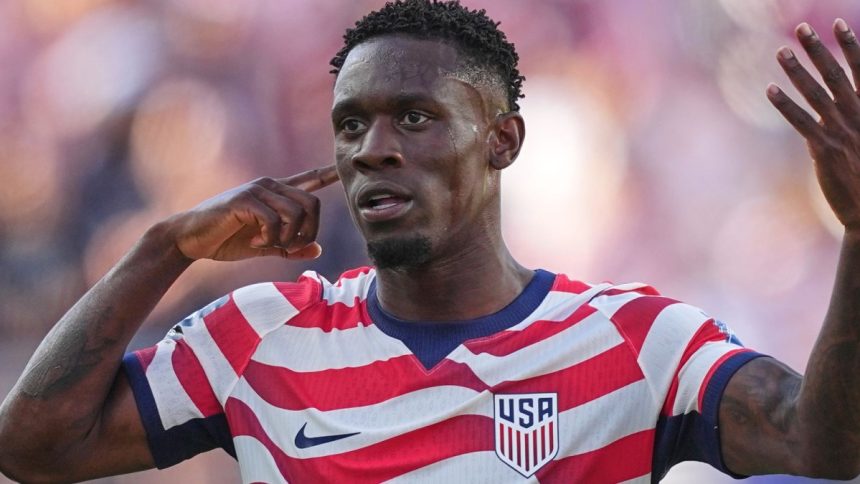
The United States Men’s National Team (USMNT) is targeting its first FIFA World Cup quarterfinals in 24 years, but it is Folarin Balogun’s reinstatement for the Round of 16 clash with Belgium, set for 1:00 am (Nigerian time) on Tuesday, that has dominated the headlines.
The matter has turned a routine disciplinary matter into a test of FIFA’s credibility and left both the American striker and his federation exposed to consequences that may only be settled long after the final whistle in Seattle.
EDITOR’S PICKS
- Can “Waste Police” Fix Lagos’s Trash Epidemic?
- LAWMA Is Clearing Lagos’s Trash. But Who Stops the Next Pile?
From Automatic Ban to Political Flashpoint
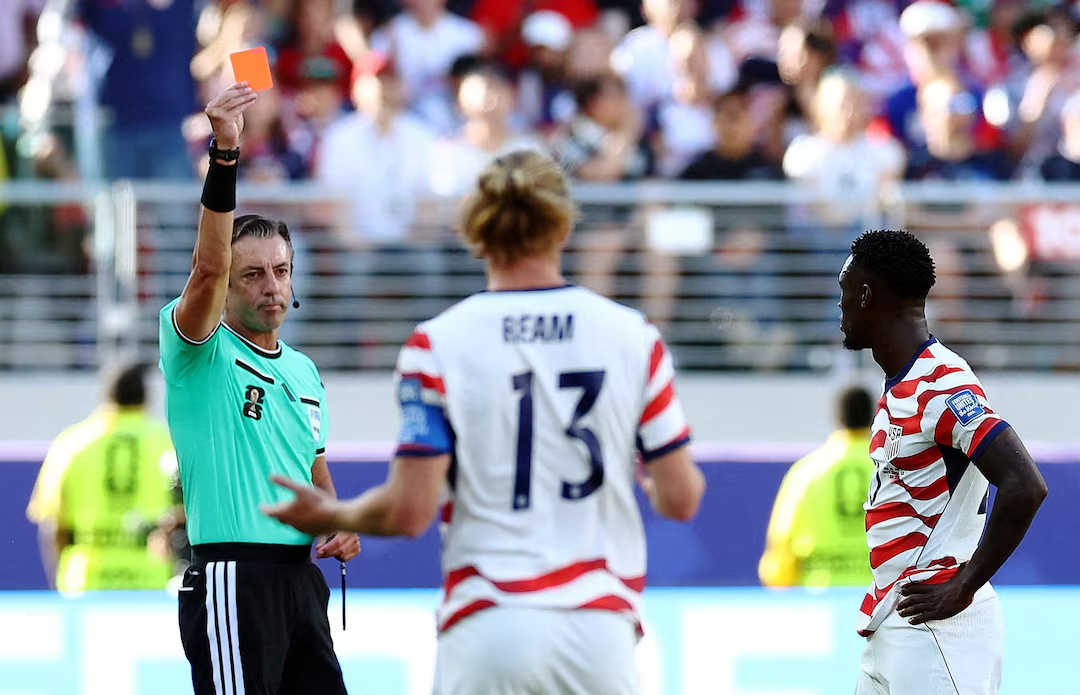
Balogun was sent off in the 64th minute of USA’s 2-0 win over Bosnia and Herzegovina after stepping on the ankle of Tarik Muharemović, a challenge review officials deemed serious enough to warrant a red card.
Under FIFA’s rules, that ordinarily triggers an automatic one-match ban with no right of appeal.
But on the eve of the Belgium fixture, FIFA’s Disciplinary Committee invoked Article 27 of its Disciplinary Code to suspend the ban itself for a one-year probationary period, clearing Balogun to play.
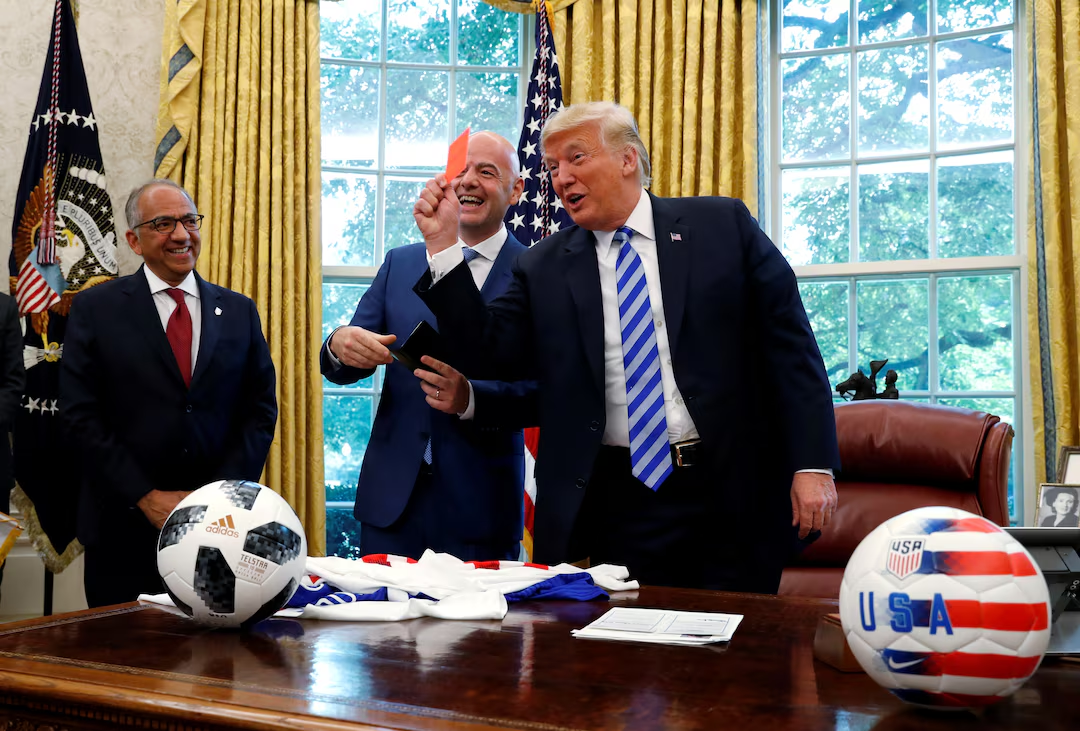
The decision followed a phone call from President Donald Trump to FIFA president Gianni Infantino, in which Trump pressed for a review of what he called an unfair sanction. Infantino has since acknowledged the call but maintains it did not influence a process he says was handled independently by FIFA’s judicial bodies.
Belgium’s Legal Pushback
The Royal Belgian Football Association (RBFA) responded with more than public objection. It formally notified US football federation that it contests Balogun’s eligibility should he appear on the team sheet, explicitly leaving “all further actions open.”
Separately, Belgium sought a copy of FIFA’s reasoned decision and an explanation of the process, only for FIFA to treat that request itself as an appeal, appoint a judge, and give Belgium a matter of hours to respond.
FIFA’s Appeal Committee ultimately dismissed Belgium’s challenge as inadmissible, ruling the federation lacked standing since it was not a party to the original disciplinary case.
UEFA entered the fray with unusually pointed language, describing the reversal as crossing a line that undermines the certainty of football’s rules and warning it sets a precedent that could unravel consistency for the rest of the tournament.
The Dilemma on the Pitch
This is where the dilemma sharpens. Should Balogun start, score, and help eliminate Belgium, the RBFA’s eligibility notice suggests the federation is positioned to escalate its protest, likely toward the Court of Arbitration for Sport (CAS), the body historically responsible for adjudicating World Cup eligibility disputes once FIFA’s internal remedies are exhausted.
In that scenario, the result on the pitch would not end the controversy; it would trigger the next phase of it, with the specter of a contested or even nullified result hanging over the United States’ historic run. That means the US could win the match on the pitch and lose it in court.
However, should Belgium win outright, even with Balogun playing, the practical incentive for RBFA to pursue further legal action diminishes considerably.
A federation that progresses on merit has little appetite, and even less standing, to keep fighting a case it has effectively rendered moot. As one observer close to the situation put it, a Belgian win would largely close the matter.
A Reputational Cost Regardless of Outcome
Whatever unfolds on the scoreline, FIFA’s institutional standing has already absorbed damage.
Coaches, pundits and rules analysts have questioned both the original decision to send Balogun off and the unusual mechanism used to reverse it, with FIFA’s own precedent involving Cristiano Ronaldo’s deferred suspension now cited as evidence the rule exists, but rarely used, and never before under this level of political pressure.
FURTHER READING
- Men’s Health Week: What Nigerian Fathers Must Do To Stay Alive
- Inside the 37 Bills That Could Rewrite How Nigeria Is Governed
For Balogun and the USMNT, the dilemma is layered: play and win, and risk becoming the answer to a question CAS may yet be asked to settle; play and lose, and the entire episode recedes into a footnote. Either way, the American federation now finds itself managing not just a football match, but the fallout of a decision it did not make and cannot fully control.
Philip Ibitoye is a Special Correspondent with EKO HOT BLOG. Click here to find daily analysis and critical insight on trending issues in Lagos and other parts of Nigeria.
Click to watch the video of the week below: