- UEFA, AFC and Concacaf criticized FIFA
- They accused Infantino’s leadership of eroding trust
- The dispute could trigger FIFA boycotts
UEFA, Concacaf and the Asian Football Confederation have intensified their criticism of FIFA president Gianni Infantino, accusing the organisation and its leadership of damaging trust within world football.
The three continental bodies made the accusation in a joint open letter signed by their presidents and general secretaries.
EDITOR’S PICK
- How Lagos Achieved 57.4% Exclusive Breastfeeding Rate
- Shaibu Lists Nigeria’s Biggest Security Challenges
- Vote, Protect Your Mandate, Governor Adeleke Urges Residents Ahead of August 15 Polls
They said the controversy surrounding FIFA’s abandoned Forward Enterprise proposal was much bigger than a disagreement over commercial strategy, describing it as an issue involving the integrity of football and the responsibilities of those elected to lead the sport.
The Forward Enterprise proposal involved plans to establish a company that would manage the commercial and ticketing rights for FIFA competitions, including the World Cup. Under the proposal, a 21 per cent stake in the company would have been sold to a private investment firm.
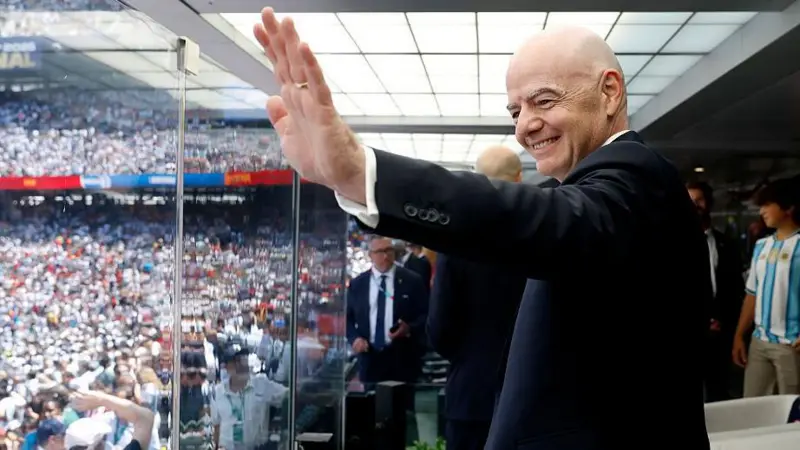
The plan was withdrawn following strong opposition from several FIFA confederations, with UEFA leading the criticism and warning that European football could boycott FIFA competitions if the dispute remains unresolved.
Sources familiar with the situation told BBC Sport that UEFA, Concacaf and the AFC have also held preliminary discussions about the possibility of organising alternative competitions if Infantino remains in office.
Although Infantino was not mentioned by name in the joint letter, its wording was widely interpreted as a direct challenge to his leadership. Sources close to the opposition said the message was effectively a call for the FIFA president to resign and leave office voluntarily rather than seek another term.
The confederations argued that football leadership should be viewed as a responsibility to the sport rather than something to be personally controlled or retained.
The statement came after FIFA strongly rejected what it described as an organised campaign intended to undermine the organisation and Infantino. The three confederations subsequently criticised FIFA’s handling of a meeting in Rabat, Morocco, involving senior officials.
According to the letter, FIFA Council members and representatives of member associations were excluded from the meeting, while senior FIFA employees were invited.
The confederations also rejected FIFA’s response to the controversy over the Forward Enterprise proposal. Although FIFA acknowledged that mistakes had been made during the process, the three bodies said the admission failed to address what they regarded as the fundamental problem with the proposal.
They argued that the attempt to commercialise an interest in the World Cup represented a serious failure of judgement and had damaged confidence between FIFA and the organisations it is supposed to serve.
FIFA has committed to producing a report on the matter for consideration at the next FIFA Council meeting, expected to take place in October. However, the three confederations said such an investigation should be conducted by a completely independent organisation rather than by FIFA itself.
They also reiterated a legal warning that documents connected to the abandoned proposal should not be deleted or destroyed.
The dispute has raised the possibility of a major confrontation within international football, including the creation of alternative competitions. UEFA has maintained that FIFA’s defence of Infantino has not changed its position on a potential boycott.
Concacaf and the AFC, however, have not publicly committed to such a boycott, and support for Infantino remains within both regions.
Mexico recently expressed support for the FIFA president, while eight Asian football associations — the United Arab Emirates, Qatar, Sri Lanka, Lebanon, Kuwait, Mongolia, the Philippines and Bhutan — have publicly backed him.
The immediate test of the growing dispute could come with the FIFA Under-20 Women’s World Cup in Poland. Several European countries, including England, are scheduled to participate, while France has said it still intends to take part.
The three confederations said football’s strength has historically come from its unity and called for that principle to be protected through leadership focused on serving the sport rather than concentrating power.
The growing opposition represents a serious challenge to Infantino as he considers his future at FIFA. Sources close to the campaign against him reportedly want him to resign rather than contest another election in March.
There have also been preliminary discussions about competitions that could bring together teams from the opposing confederations if FIFA tournaments are boycotted.
The AFC is considered particularly important because of its large membership and the potential influence of its voting bloc in any future FIFA leadership contest. Infantino still has significant support in South America and Africa, as well as among some Concacaf members.
However, if UEFA and sections of Concacaf oppose him as a bloc and secure enough support from Asian members, the balance of power could shift considerably.
The latest developments have therefore deepened an increasingly bitter dispute over the direction of world football and placed further pressure on Infantino ahead of the next FIFA presidential election.
FURTHER READING