The last time Nigeria witnessed single-digit inflation was in January 2016 when the headline rate was pegged at 9.62 percent. Since then, the inflation rate has risen to a high of up to 34.8% in December 2024, leaving Nigerians in far worse shape than they were only ten years ago.
In response, the Central Bank of Nigeria (CBN) has revealed a medium-term target of bringing the inflation rate down to a single digit, but the World Bank has cast doubt on the prospects of achieving that in the near term, warning that persistent structural challenges make such optimism unrealistic.
EDITOR’S PICKS
In its latest Africa’s Pulse report released on Tuesday, the Bank projected that Nigeria—alongside Angola, Ethiopia, Ghana, Malawi, Sudan, Zambia, São Tomé and Príncipe, and Zimbabwe—will continue to record double-digit inflation through 2025.
While inflation is receding across much of Sub-Saharan Africa, the report noted that 37 of the region’s 47 economies are on track to maintain single-digit inflation by 2026. The region’s median inflation rate has declined from 9.3 per cent in 2022 to 4.5 per cent in 2024 and is projected to stabilise between 3.9 and 4.0 per cent annually over 2025–26.

By contrast, Nigeria remains an outlier. The Bretton wood institution cited persistent exchange rate depreciation, high food and energy prices, and supply bottlenecks as the major factors fuelling price instability. “Nigeria’s situation remains challenging because of exchange rate pass-through and structural supply bottlenecks,” Andrew Dabalen, the World Bank’s Chief Economist for Africa, said.
CBN Sticks to Its Single-Digit Ambition
Despite the World Bank’s caution, the CBN remains committed to its goal of bringing inflation down to single digits in the medium term. Speaking at the CBN Governor’s Annual Lecture Series at the Lagos Business School last week, Governor Olayemi Cardoso reiterated that ongoing fiscal and monetary reforms, including exchange rate unification, subsidy removal, and tightening measures, would gradually tame inflationary pressures.
“The idea is to ensure that in the medium term we achieve single-digit inflation,” Cardoso told participants, adding that some analysts believe the National Bureau of Statistics (NBS) may be overstating current price levels.
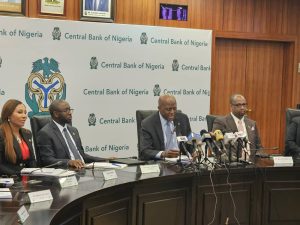
Recent data from the NBS show that Nigeria’s headline inflation eased to 20.12 per cent in August 2025, down from 21.88 per cent in July, with month-on-month inflation at 0.74 per cent and food inflation at 1.65 per cent. Though the decline marks the first significant easing in months, it remains far from the single-digit territory targeted by the apex bank.
Between Ambition and Structural Reality
Analysts say the divergence between the CBN’s optimism and the World Bank’s projections reflects the tension between policy ambition and economic reality. The Bank’s assessment highlights the structural roots of Nigeria’s inflation, ranging from currency volatility and energy costs to insecurity and weak logistics, issues that monetary tightening alone may not resolve.
Economists note that while the CBN’s reforms are essential to stabilising the macroeconomic environment, they may take longer to yield visible results. Inflation’s persistence continues to erode household purchasing power, limit consumer demand, and weaken business confidence.
For now, Nigeria’s inflation outlook remains a delicate balancing act: between the CBN’s medium-term aspiration for single-digit price growth and the World Bank’s projection that double-digit inflation will likely persist well into 2026.
FURTHER READING
Whether monetary and fiscal coordination can narrow that gap will determine the credibility of Nigeria’s disinflation path in the months ahead.
Philip Ibitoye is a Special Correspondent with EKO HOT BLOG. Click here to find daily analysis and critical insight on trending issues in Lagos and other parts of Nigeria.
Click here to watch the video of the week below: