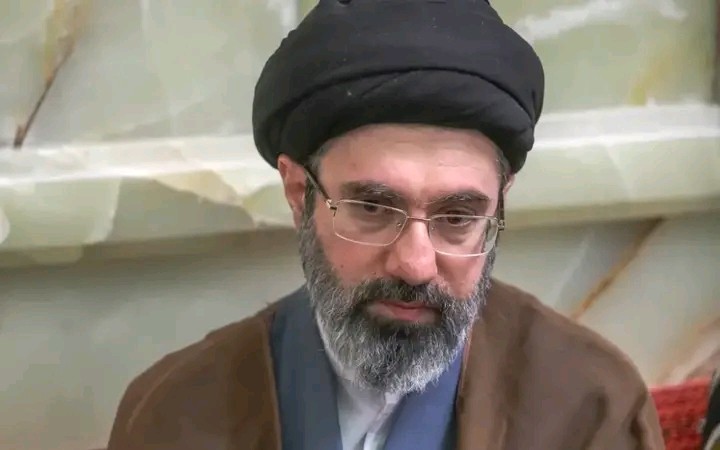
- In his first official written address since his father’s funeral, Iran’s newly consolidated Supreme Leader, Mojtaba Khamenei, swore an unyielding oath of vengeance against the United States and Israel for the military strike that killed his predecessor.
- The top cleric warned that Iran’s retaliatory plans do not depend on the survival of individual leaders, revealing that a definitive hit list of Western and allied targets has already been drawn up by state intelligence.
- The fiery message from Tehran dropped just hours after US President Donald Trump claimed over 1,000 American missiles were “locked and loaded” to completely obliterate the Islamic Republic should any assassination plot target him.
The fragile framework of Middle Eastern diplomacy has fractured completely as Iran’s new Supreme Leader, Mojtaba Khamenei, issued a stark, uncompromising vow of military retribution against the United States and Israel.
Eko Hot Blog reports that breaking his prolonged public absence following the assassination of his father, the late Ali Khamenei, in late February, the younger Khamenei released a powerful written statement declaring that the assassination of the former leader will be met with absolute force, irrespective of the geopolitical consequences or diplomatic interventions.
EDITOR’S PICK
- Hamzat Appoints Obanikoro as Campaign DG Ahead of 2027 Lagos Governorship Race
- Tinubu’s State Police Plan Gains Momentum as Amendment Looms
- Residents Raise Alarm After Two Bodies Found in Lagos Waterway
The state address marks Mojtaba Khamenei’s first official policy projection since his father’s state funeral, which concluded earlier this week.
The Supreme Leader emphasized that the revolutionary state’s resolve to seek vengeance operates completely independently of his own personal survival or that of other top-tier Iranian politicians.
He further revealed that the Islamic Republic’s defense architecture has officially cross-referenced and compiled a detailed list of foreign officials and strategic targets slated for elimination.
The escalating rhetoric directly mirrors the combative stance adopted by Washington.
Hours before the Supreme Leader’s message went live, US President Donald Trump used his social media platform, Truth Social, to map out an explicit counter-warning.
Trump maintained that the United States military holds a standing, one-year authorization window to completely decimate and destroy any region within Iran if the clerical regime executes or attempts an attack against the sitting American president, asserting that over a thousand tactical missiles are actively locked onto Iranian coordinates.
The rapid unraveling of the region’s stability follows an intense exchange of military fire earlier this week, effectively terminating the tentative ceasefire brokered via a memorandum of understanding last month.
According to data provided by the Iranian Ministry of Health, a heavy wave of US retaliatory airstrikes targeting approximately 90 positions across the country left at least 17 people dead and 115 others wounded.
In turn, Iranian forces and regional proxy networks have initiated waves of reprisal attacks striking American military assets and Western-allied Gulf nations hosting foreign bases.
At the heart of the military and economic deadlock is the ongoing blockade of the strategic Strait of Hormuz, a critical global maritime chokepoint which Iran closed to commercial shipping networks at the onset of the war in late February.
Washington has issued a firm weekend ultimatum demanding Tehran halt all hostile actions against commercial tankers and respect the international right of free transit.
However, Iranian Foreign Minister Abbas Araghchi, who recently arrived in Oman for emergency maritime talks, maintained that the pre-war era of unregulated free navigation through the strait is permanently over, stating that Tehran intends to collect toll fees from vessels navigating the waterway.
Despite the severe escalation, back-channel diplomatic missions are working frantically to prevent a slide into total regional warfare.
A high-level mediation team from Qatar traveled directly to Tehran to reinforce Doha’s role as an impartial intermediary, while Pakistani Prime Minister Shehbaz Sharif held emergency phone consultations with Qatari Emir Sheikh Tamim bin Hamad Al Thani and Iranian President Masoud Pezeshkian, begging both sides to preserve the region’s hard-earned peace.
However, Iran’s chief negotiator, Mohammad Bagher Ghalibaf, mirrored his supreme leader’s unyielding posture, warning international observers that while stopping the bloodshed remains a priority, Iran will never accept a peaceful resolution that demands the country’s sovereign surrender.