The Lagos State Government’s partnership with Federal agencies to sensitise public servants on human trafficking and irregular migration could not have come at a more critical time.
Through the Ministry of Special Duties and Intergovernmental Relations (MoSD&IGR), the state has shown that tackling trafficking requires not just enforcement, but consistent education, advocacy, and collaboration.
EDITOR’S PICKS
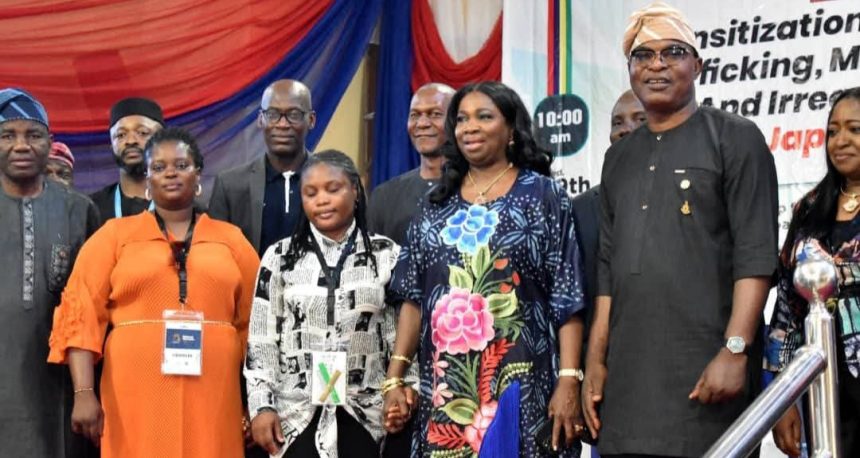
At the sensitisation programme held at the Adeyemi-Bero Auditorium on Wednesday, the Chairman/CEO of the Nigerians in Diaspora Commission (NIDCOM), Abike Dabiri-Erewa, commended Lagos for its proactive leadership, noting that “human trafficking has evolved beyond a local menace to become a global crisis demanding urgent attention.”
She cautioned that traffickers now prey on educated and ambitious young Nigerians, disguising their traps as lucrative job offers abroad.
“Human trafficking is not only a moral crime but a growing global business that feeds on desperation,” Dabiri-Erewa said. “The slang ‘Japa’ may sound harmless, but when aspiration turns into desperation, people become vulnerable, and that vulnerability is what traffickers exploit.”
By framing trafficking within the context of modern aspiration and desperation, Dabiri-Erewa’s remarks highlight why Lagos’s awareness strategy is crucial. The state’s decision to engage public servants, who interact daily with communities, ensures that the anti-trafficking message will cascade down to grassroots levels where vulnerability often begins.
Education as the Strongest Shield
In his keynote address, the Lagos State Commissioner for Special Duties and Intergovernmental Relations, Gbenga Oyerinde, described human trafficking as “a form of modern-day slavery that must be fought with collective resolve.”
He noted that the “Japa syndrome,” the wave of Nigerians seeking opportunities abroad, has been hijacked by deceitful agents: “Many fall victim to traffickers promising non-existent jobs and better lives overseas.” His statement captures the tragedy of countless Nigerians trapped in cycles of exploitation, forced labour, and abuse in foreign countries after being sold false dreams.
Oyerinde’s emphasised on education as key to prevention. This vision aligns with the broader commitment of Governor Babajide Sanwo-Olu’s administration, which established the Lagos State Task Force Against Human Trafficking five years ago, a structure that continues to strengthen prosecutions and raise public awareness in partnership with NAPTIP, the Nigeria Immigration Service, and international bodies.
The Lagos State House of Assembly also lent its voice to the campaign. Representing the Speaker, Rt. Hon. (Dr.) Mudashiru Ajayi Obasa, Hon. Olawale Age-Suleiman described the sensitisation as a “necessary step in strengthening public understanding and institutional response.” He stressed that “human trafficking is a stain on our collective humanity. Every institution of government must play its role in ending it.”
He urged civil servants to take the message beyond the auditorium: “Public servants must become ambassadors of awareness in their communities, ensuring the message of safe migration and self-belief spreads across every part of the State.”
This approach transforms awareness into action. Public servants, once trained, become critical channels for behavioural change. They can educate young people, discourage risky travel decisions, and direct citizens toward lawful migration channels.
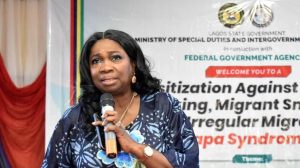
As Dabiri-Erewa reminded the audience, “We are not here to demonise ambition or migration. Nigerians have every right to seek greener pastures, but they must do so through regular and lawful channels. Migration should build lives, not destroy them.”
‘Building a Lagos Where No Dream Is Trafficked’
The active participation of Federal agencies such as the Nigeria Immigration Service and the National Orientation Agency shows that government at all levels can collaborate effectively to prevent exploitation before it happens.
By treating human trafficking and irregular migration as national development issues, Lagos and its partners are doing the right thing, not only rescuing potential victims but also preserving the nation’s most vital resource: its people.
FURTHER READING
If sustained, such efforts will redefine migration from a path of despair to one of dignity.
Philip Ibitoye is a Special Correspondent with EKO HOT BLOG. Click here to find daily analysis and critical insight on trending issues in Lagos and other parts of Nigeria.
Click here to watch the video of the week below: