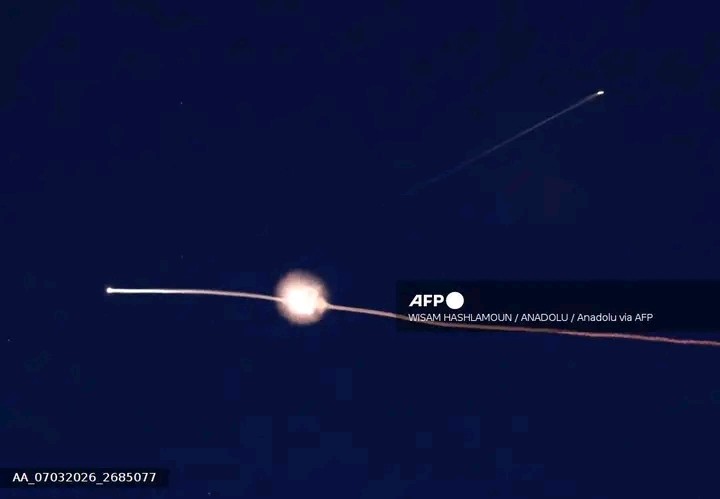
- The Turkish Defence Ministry confirmed on Friday that NATO forces intercepted an Iranian ballistic missile in Turkish airspace, marking the third such incident since the outbreak of the U.S.-Israeli war on Iran.
- Air raid sirens were triggered at the strategically vital Incirlik airbase and in the city of Batman early Friday morning as NATO air and missile defense assets in the eastern Mediterranean neutralized the incoming threat.
- Despite the interception, Iranian President Masoud Pezeshkian has denied that the missiles originated from Iranian soil during a high-level diplomatic phone call with Turkey’s Recep Tayyip Erdogan.
The Middle East conflict has spilled further into NATO territory as Turkey’s southern borders become a frequent flashpoint for ballistic missile activity.
Eko Hot Blog reports that on Friday, March 13, 2026, the Turkish Ministry of Defence announced that a missile launched from Iran had been successfully neutralized over the eastern Mediterranean.
EDITOR’S PICK
- 540 Candidates Cleared as Lagos APC Moves to Elect LGA Executives
- Court Sentences Pastor to Death for Killing UniUyo Student
- Lagos Teacher Questions Lack of Recognition for One-Day Governor Mentors
This latest interception follows similar incidents on March 4 and March 9, highlighting a dangerous pattern of escalation that has placed Turkish cities and NATO military installations under direct threat.
Panic spread through the southern city of Adana around 3:25 am when sirens blared at the Incirlik airbase, a critical hub for U.S. and European forces.
Residents reported seeing a fast-moving, flaming object in the sky, and footage of the interception quickly flooded social media.
Similar alarms were reported in Batman, roughly 600 kilometers to the east, home to a significant military drone base.
The repeated incursions have prompted the U.S. State Department to urge all American citizens to evacuate southeastern Turkey, while the consulate in Adana remains shuttered for safety reasons.
The diplomatic friction between Ankara and Tehran is reaching a boiling point. While Iranian President Masoud Pezeshkian has officially denied responsibility for the launches, the presence of the Kurecik early-warning radar system in Malatya remains a major grievance for Iran.
This U.S.-manned radar is a “key element” of NATO’s missile shield, capable of detecting launches deep within Iranian territory.
Tehran has long alleged that this data is shared with Israel, a claim Turkey categorically denies, though the deployment of additional Patriot missile batteries to Malatya this week suggests that Turkey is bracing for further hostilities.
Since the joint U.S.-Israeli operations against Iran began on February 28, the region has been trapped in a cycle of retaliatory strikes.
The conflict has already impacted global oil markets, with prices surging past $100 per barrel as Iran threatens to block the Strait of Hormuz.
For Turkey, a country that has tried to maintain a delicate diplomatic balance, the physical entry of ballistic munitions into its airspace is a significant provocation that could force a more direct NATO involvement in the conflict.
As NATO moves to strengthen its “alliance-wide ballistic missile defence posture,” the situation in southern Turkey remains precarious.
With thousands of casualties already reported across the region and vital infrastructure increasingly targeted, the successful interception of this third missile has provided a temporary reprieve, but the prospect of a wider regional war continues to loom over the Mediterranean.