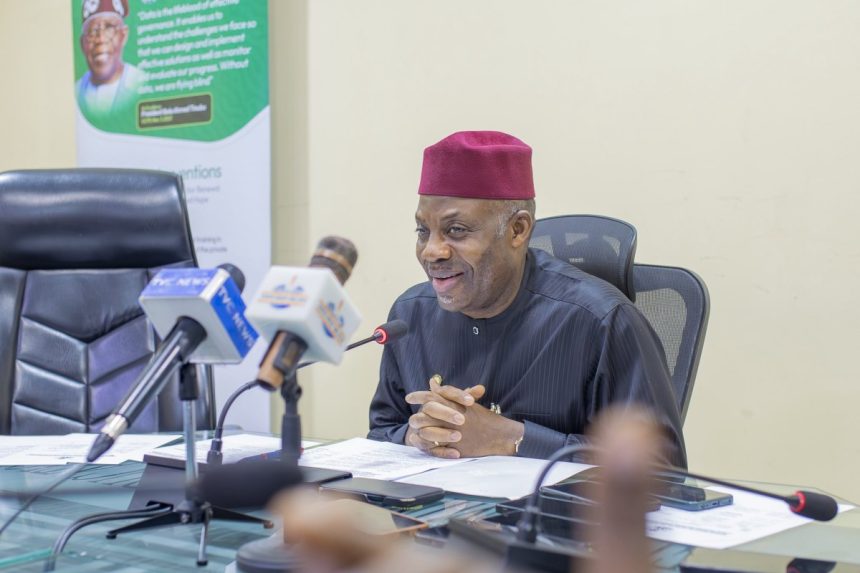
Nigeria does not have 15 to 17 million out-of-school children, the Minister of Education, Dr Tunji Alausa, has said, promising fresh data to prove the widely used figure wrong.
Alausa said his position is backed by early results from Kaduna and Kano states, where household surveys returned far lower numbers than the long-quoted estimates.
EDITOR’S PICKS
The out-of-school figure has shifted often over the years. UNICEF put it at 7 million in 1999, before it rose to 10.5 million by 2013 and roughly 18.3 million in more recent reporting. The Federal Government’s own current campaign, built around returning 15 million children to school, already sits below that UNICEF estimate, showing that even government agencies have not been working from the same number.
Alausa argues most of these figures rest on projections rather than direct counts. He drew a distinction between two methods he considers reliable: a full census, the gold standard, and a General Household Survey on the Grid, which he says comes close to it. This gap in method, he said, explains why the real numbers in Kaduna and Kano came in so much lower.
The Kaduna and Kano numbers that dispute the estimates
Alausa said Kaduna State had long been estimated to have about 585,000 out-of-school children. But when the state carried out a General Household Survey on the Grid, covering over 90 percent of households, the number dropped to under 190,000, a difference of more than 350,000.
Watch the minister speak below:
Tinubu’s Education Sector Reforms: Dr Alausa Correects Nigeria’s Out-of-School Figure With Data, Lauds Tinubu’s NESRI Agenda #Nigeria #News #Education #fyp pic.twitter.com/SzdPguoGBR
— drtunjialausa-news (@tunjialausanews) August 14, 2026
He gave a similar example for Kano State, which had been estimated to have 1.2 million out-of-school children. A household survey there put the real number at under 900,000, also a drop of more than 300,000.
The minister explained that a full census is the most accurate way to count out-of-school children, followed closely by the household survey method used in both states.
A nationwide count is coming
Alausa said the ministry has commissioned the National Bureau of Statistics (NBS) to carry out the same household survey across all 36 states and the Federal Capital Territory. He expects results within 8 to 12 months and predicts they will show a significant nationwide drop in the out-of-school figure.
He stressed, though, that a lower number would not reduce the urgency of the problem.
“Any child out of school is still too many,” he said, adding that the government has moved to tackle the issue and is already seeing results.
Where the disputed figures come from
The 15 to 17 million range Alausa is challenging has been used by the Federal Government itself in recent years, including in its push to return 15 million children to school.
But it sits below other widely cited estimates.
UNICEF has continued to put Nigeria’s out-of-school population at around 18.3 million, made up of 10.2 million children of primary school age and 8.1 million of secondary school age, a figure also used by UNESCO’s Global Education Monitoring Report and the Universal Basic Education Commission (UBEC).
Older UNICEF estimates put the number lower, at about 10.5 million children aged 5 to 14, rising from 7 million in 1999. The figures have moved in different directions across different reports over the years, reflecting how out-of-school numbers in Nigeria have long depended on which survey method and age range is used. This is part of why Alausa’s push for a fresh, uniform household survey across all states matters: it would give the government one verified number to work with, instead of competing estimates from different agencies.
What NESRI is doing about it
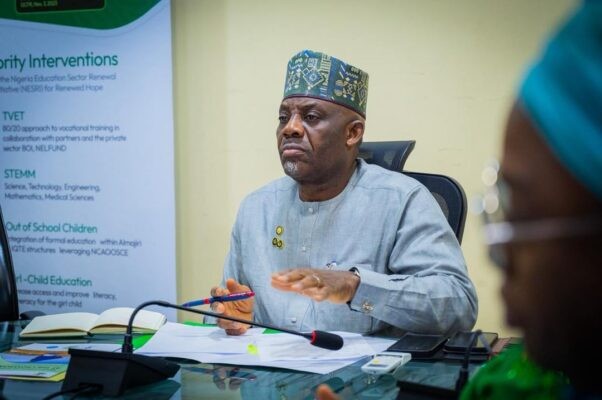
Alausa’s push on the numbers is tied to the Nigeria Education Sector Renewal Initiative (NESRI), a six-pillar reform programme he launched to overhaul the education sector. The out-of-school children challenge is one of NESRI’s stated priority areas, alongside technical and vocational education, science and technology education, girl-child education, quality assurance, and data management and digitalisation.
Under the programme, the government says it has mapped nearly one million out-of-school children for reintegration into formal or alternative learning. Between January 2025 and January 2026, states drew over N106 billion in UBEC matching grants for basic education, while N22 billion went into training about 978,000 teachers. More than 10,000 classrooms have been renovated and 7.8 million textbooks distributed.
The government has also rolled out digital tools, including free, zero-rated online lessons from Primary 1 to SS3, and moved teacher training online. Alausa said the 2026 Annual School Census has made significant progress through the digitisation of the Nigerian Education Management Information System, which he says will support more reliable data going forward.
FURTHER READING
Alausa reviews NESRI’s progress every six months. At the last review, held in Abuja last Friday, August 7, he warned officials against declaring reforms complete when they have only been started, saying the test of the ministry’s performance is the improvement Nigerians actually see in schools, not the number of programmes launched.
Philip Ibitoye is a Special Correspondent with EKO HOT BLOG. Click here to find daily analysis and critical insight on trending issues in Lagos and other parts of Nigeria.
Click to watch the video of the week below: