- Atiku Abubakar’s aide, Demola Olarewaju, says the disagreement between Atiku and Olusegun Obasanjo is political rather than personal
- Olarewaju alleges that Obasanjo does not want Atiku to become Nigeria’s president
- He insists that Atiku’s supporters remain committed to his political campaign despite Obasanjo’s opposition
A Senior Political Assistant to former Vice President Atiku Abubakar, Demola Olarewaju, has described the long-running disagreement between Atiku and former President Olusegun Obasanjo as a political dispute rather than a personal feud.
Eko Hot Blog reports that Olarewaju made the remarks on Monday during an appearance on Frontline, a current affairs programme on Eagle 102.5 FM in Ilese-Ijebu, Ogun State. He appeared on the programme alongside Ayodeji Ologun, Executive Director of the Centre for Responsive Governance.
His comments came amid renewed exchanges between the two former political allies after Obasanjo recently described his decision to select Atiku as his running mate in the 1999 presidential election as the “biggest mistake” of his political career.
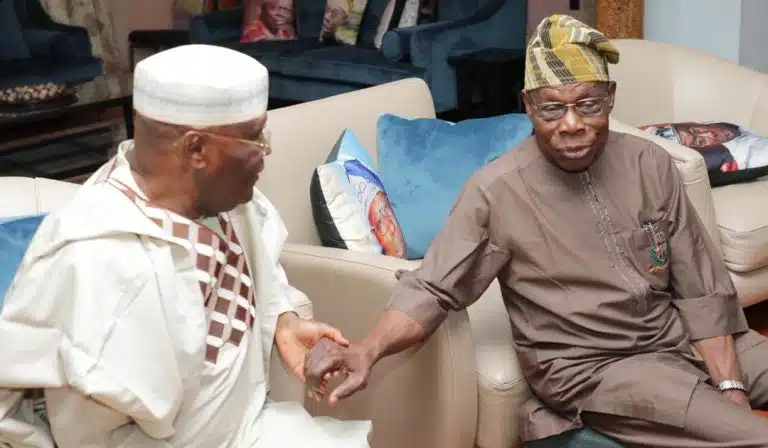
Obasanjo also alleged that Atiku was involved in an attempt to remove him from office in 2003, claiming that the former vice president paid ₦5 million to then Speaker of the House of Representatives, Ghali Umar Na’Abba, to initiate impeachment proceedings.
Atiku rejected the allegation through his media team, accusing the former president of engaging in what it described as a pattern of falsehoods and distortion of historical events.
The former vice president also linked Obasanjo’s continued criticism of him to his refusal to support the former president’s controversial attempt to extend his tenure beyond the constitutionally permitted two terms.
According to Atiku, his decision at the time was based on his commitment to the Constitution and Nigeria’s democratic system rather than personal loyalty.
Olarewaju said Atiku still regarded Obasanjo with respect despite the political differences between them.
“The relationship between the former President Obasanjo and Atiku, in my view as a Nigerian who witnessed the administration and the post-administration, is the fact that they do not seem to have a personal issue,” he said.
He argued that the major disagreement between the two men was rooted in politics, particularly Obasanjo’s opposition to Atiku becoming president.
“The issue between them is political and, for reasons best known to Obasanjo, it is very clear and obvious that he does not want Atiku Abubakar to ever be President of the Federal Republic,” Olarewaju said.
The aide also questioned what he described as Obasanjo’s belief that no other Nigerian leader could match his record in government or administer the country better than he did.
He described Obasanjo’s activities since leaving office in 2007 as part of what he called a “journey of redemption,” arguing that the former president had subsequently sought to rebuild his relationship with the Yoruba people.
Olarewaju linked that process partly to Obasanjo’s role during the Nigerian Civil War and his later involvement in political affairs across the South-West.
He further compared Obasanjo’s relationship with successive Nigerian administrations, claiming that the former president had been more openly critical of the governments of Goodluck Jonathan and Muhammadu Buhari than he has been of the current administration of President Bola Tinubu.
The Atiku aide also played down Obasanjo’s ability to influence voting patterns in the South-West, particularly his capacity to determine the outcome of elections in the region.
Despite the former president’s opposition to Atiku’s presidential ambition, Olarewaju said supporters of the former vice president would remain committed to his political campaign.
“We are determined that this opposition won’t affect Atiku’s campaign,” he said.
Also speaking during the programme, Ologun argued that Obasanjo’s position on Atiku had changed significantly over the years.
He recalled that the former president spoke favourably about Atiku during the build-up to the 2019 presidential election, including praising his understanding of governance.
Ologun said the working relationship between Obasanjo and Atiku while they were in government also demonstrated the level of trust that existed between them at the time.
“In 2019, Obasanjo spoke well about Atiku, saying that he knows well about running the affairs of the country,” Ologun said.
He noted that Atiku served as vice president throughout Obasanjo’s eight-year presidency and played a significant role in the administration.
Ologun said the change in Obasanjo’s position became particularly noticeable when he opposed Atiku’s presidential bid in 2023 and continued to criticise his political ambitions.
He maintained that the disagreement should be viewed largely through a political lens rather than as the result of a personal dispute.
The renewed exchange between the two former leaders comes as Nigeria’s political landscape begins to take shape ahead of the 2027 general elections, with Atiku among opposition figures seeking to challenge the ruling political establishment.