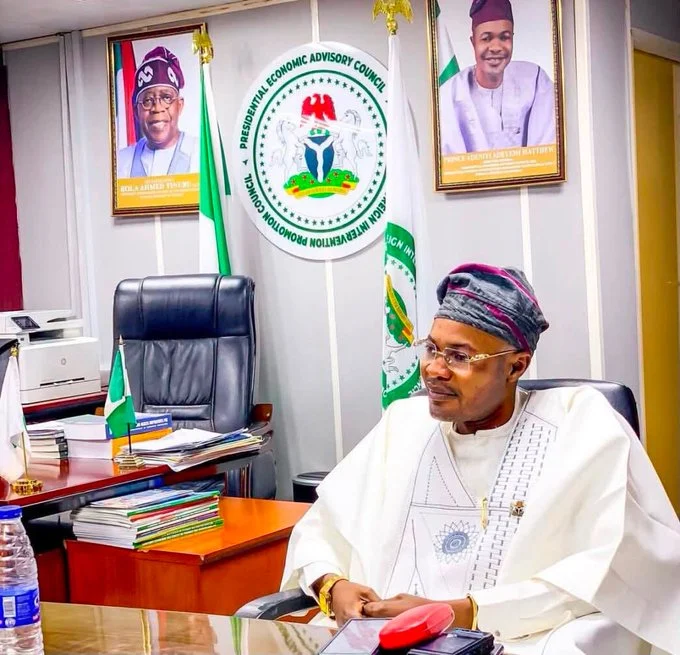
President Bola Tinubu, on Tuesday, ordered the Independent Corrupt Practices and Other Related Offences Commission (ICPC) to launch a full investigation into the fictitious “Presidential Foreign Intervention Promotion Council” (PFIPC) and the man behind it, Prince Adeniyi Adeyemi Matthew, with a report due back to the President within 30 days.
The directive was announced in a statement issued by Bayo Onanuga, Special Adviser to the President on Information and Strategy.
EDITOR’S PICKS
It follows weeks of controversy over Adeyemi’s operation of the PFIPC, an agency the Presidency insists “was never established by the Federal Government of Nigeria and has no basis in any law, presidential instrument, executive approval, or other lawful act of Government.”
The order comes just a day after Chief of Staff Femi Gbajabiamila’s lawyers issued a ₦10 billion defamation ultimatum against Adeyemi, and marks the first time the Presidency has formally directed an anti-graft agency to probe the matter, rather than simply denying the agency’s existence in public statements.
The Forged Documents
At the centre of the ICPC’s mandate is the question of forged appointment letters and other official government documents. Adeyemi had presented himself as the PFIPC’s Director-General on the strength of a claimed presidential appointment, a claim the Presidency says is false.
The ICPC has been asked to trace the “provenance” of these documents: who produced them, how they were made to resemble authentic government paperwork, and who else may have helped create or circulate them.
Diplomatic And Official Recognition
The statement says President Tinubu asked the ICPC to investigate the false claim of presidential appointment being allegedly used to “seek or obtain official recognition and diplomatic support, including visa facilitation.”
This suggests Adeyemi’s alleged activities may have extended beyond domestic fraud into engagement with foreign missions or international partners, potentially exposing gaps in how diplomatic credentials are verified.
The Bank Accounts And Money Trail
ICPC has also been directed to examine the opening of multiple bank accounts under the names of purported government agencies, reportedly using forged documents.
Investigators are expected to trace the source and movement of any funds involved, a detail that speaks directly to earlier reports that Adeyemi operated dozens of accounts, some under fictitious agency names.
Who Else Was Involved
Tinubu’s directive is notably broad on culpability. The ICPC is to investigate not just Adeyemi himself but “other collaborators” and the “wider circumstances” that allowed a fictitious body to acquire an appearance of legitimacy. This includes examining the role of “any public officer, private individual, financial institution, intermediary or other person or entity” that may have facilitated the scheme — language that leaves room for the probe to reach beyond Adeyemi alone.
Institutional Weaknesses
Beyond individual culpability, the President wants the ICPC to identify weaknesses in government and institutional procedures that made the scheme possible, and to recommend measures to prevent a recurrence. This positions the investigation as partly a systems review, looking at how a self-declared agency was able to secure office space at the Federal Secretariat and engage with officials and diplomats without early detection.
Cooperation Directive
All federal ministries, departments and agencies have been ordered to give the ICPC full cooperation, including access to records and information upon request, to help meet the 30-day deadline.
The directive effectively shifts the PFIPC saga from a war of words between Adeyemi and the Presidency into a formal state investigation, with the ICPC’s findings expected to determine what action, including potential prosecutions beyond Adeyemi’s existing forgery trial, is taken next. Adeyemi remains due back in court on July 27.
FURTHER READING
- 2% of GDP ‘Missing’ or Just Unreported? Inside the IMF Controversy
- Nigeria’s Biggest Fiscal Challenge: Low Revenue or Excessive Debt?
“The President directed that all persons found culpable be treated strictly in accordance with applicable law,” Onanuga added.
Philip Ibitoye is a Special Correspondent with EKO HOT BLOG. Click here to find daily analysis and critical insight on trending issues in Lagos and other parts of Nigeria.
Click to watch the video of the week below: