- Spain’s Ministry of Health has confirmed that a second Spanish national evacuated from the cruise ship MV Hondius has tested positive for hantavirus while undergoing mandatory isolation at a Madrid hospital.
- The patient, identified as a close contact during active epidemiological monitoring, has been transferred to the High-Level Isolation Unit (UATAN) at the Gómez Ulla Central Defense Hospital.
- Health officials emphasized that because the case was detected within an existing quarantine framework established on May 10, the development does not increase the threat level for the general population.
A Spanish national who was evacuated from the cruise ship MV Hondius and is isolating at a hospital in Madrid has tested positive for hantavirus, Spain’s Ministry of Health said Monday.
Tracking the clinical data on May 25, 2026, Eko Hot Blog reports that the patient is noted to be one of 14 Spanish citizens who were placed in strict quarantine at the Gómez Ulla Central Defense Hospital in Madrid immediately after returning to their home country.
EDITOR’S PICK
- Fresh Details Emerge on Death of Odomola Monarch, Oba Adebowale Adeshina
- Sanwo-Olu Applauds LASU’s Academic Excellence After JAMB Ranking
- NRC Moves 176,820 Tonnes Of Cargo Through Lagos Ports In Q1
Authorities stated that the patient is a close contact identified through the epidemiological monitoring activated after the initial detection of the outbreak on the cruise ship.
Following the laboratory confirmation, the individual was immediately moved to the facility’s specialized High-Level Isolation Unit (UATAN) to ensure round-the-clock medical monitoring.
The newly confirmed case marks the second Spaniard from the vessel to contract the disease, which triggered global public health alarms earlier this month.
Seeking to prevent public panic, the Spanish health ministry released a statement reassuring the public that the infection was caught entirely within the pre-existing isolation and control system.
Consequently, regional health boards maintain that the development does not alter the current risk assessment for the wider public, nor does it necessitate a shift in the ongoing epidemiological response and containment strategy.
International health agencies have been working in a race against time to trace, log, and isolate all passengers linked to the MV Hondius itinerary after three passengers tragically died from the infection following the ship’s initial departure from Argentina in April.
The management of the vessel saw dozens of international travelers disembark at the remote South Atlantic island of Saint Helena in late April, while the remaining tourist contingents left the ship at Spain’s Canary Islands in early May before being flown to their respective home countries under medical observation.
The remaining skeletal crew eventually brought the ship to dock in Rotterdam, the Netherlands, where they entered a mandatory quarantine.
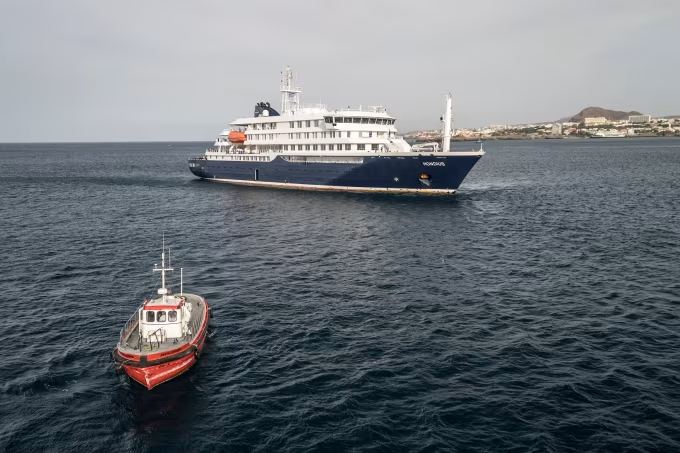
Infectious disease specialists and epidemiologists have warned that additional positive cases are highly probable over the coming days due to the exceptionally long incubation timeline of the pathogen.
Medical research shows that the average incubation period for this specific strain, identified by the World Health Organization as the Andes hantavirus, is roughly three weeks, though symptoms can take up to 42 days to physically manifest.
While standard strains of hantavirus are contracted through direct contact with infected rodent secretions, international researchers are carefully studying evidence of rare human-to-human transmission inside the close quarters of the cruise liner.