
- The President Bola Ahmed Tinubu Media Centre has shared an AI-generated image of First Lady Senator Oluremi Tinubu as a roadside bean-cake vendor, pushing a brewing macro-economic policy debate into a full-blown digital public relations crisis.
- The controversial post follows recent public assertions by the First Lady regarding low-capital micro-enterprises and a playful acknowledgment by President Tinubu during the Presidential Press Corps Dinner in Abuja.
- While administration loyalists have defended the creative asset as a witty response to online memes, critics have fiercely condemned the media strategy, accusing the presidency of trivializing severe economic hardships and rising food inflation.
The strategic communication framework of Nigeria’s executive branch is facing intense scrutiny as the official digital media channels of the Presidency published an artificial intelligence-generated image depicting First Lady Senator Oluremi Tinubu operating a roadside bean-cake (akara) stand.
Eko Hot Blog reports that the graphic asset features the First Lady dressed in a customized local trading apron bearing the phrase, “Iya Alakara, fueling the nation with love.”
EDITOR’S PICK
- Hamzat Appoints Obanikoro as Campaign DG Ahead of 2027 Lagos Governorship Race
- Tinubu’s State Police Plan Gains Momentum as Amendment Looms
- Residents Raise Alarm After Two Bodies Found in Lagos Waterway
The unconventional post, released on Friday, July 3, 2026, has ignited furious debate across major digital ecosystems, transforming raw policy feedback into a highly polarized national conversation regarding presidential PR etiquette.
The underlying controversy originally stems from an executive interview granted by the First Lady, during which she defended the administration’s strategy of deploying direct financial grants rather than institutional credit facilities to micro-entrepreneurs.
Senator Tinubu remarked that starting small-scale trades like frying akara, roasting corn, or producing local snacks like kuli kuli does not require heavy initial capital expenditure, noting that the state aimed to give immediate hope to grassroots merchants.
While structural economic analysts acknowledged her focus on accessible commercial ventures, the choice of examples drew immediate social media pushback from citizens navigating high operational costs.
“We’re trying to give hope, and to start akara business doesn’t take a lot of money. To start roasting corn, or somebody even said kuli kuli doesn’t take much. We didn’t give them a loan; we gave it to them as a grant.”
First Lady, Senator Oluremi Tinubu
The controversy moved directly into the political mainstream during the annual Presidential Press Corps Dinner at the State House in Abuja.
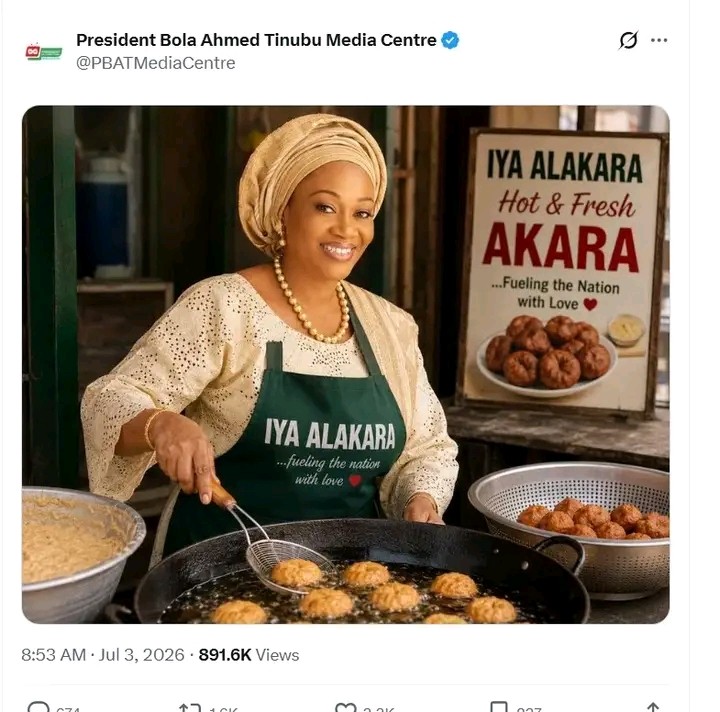
While delivering his official address to media executives, President Bola Ahmed Tinubu playfully adjusted protocol to refer to his spouse as “Iya Alakara” (Mama Akara Seller), drawing smiles from the attending dignitaries.
However, the decision by the administration’s media handlers to institutionalize the joke by distributing a stylized AI-generated image has severely backfired among structural commentators.
Critics maintain that utilizing public communication platforms to circulate satirical content during an active cycle of soaring food prices, expensive cooking gas, and diminished consumer purchasing power indicates a deep disconnect within the Aso Rock media unit.
Public reactions on platforms like X (formerly Twitter) remain highly fragmented. Several media strategists have actively called for the dismissal of the account handlers, arguing that transforming severe macroeconomic discourse into a “national meme” degrades the global prestige of the presidency.
Conversely, strong defenders of the administration argue that since the general public initially weaponized the First Lady’s programmatic statements into digital skits, the government’s lighthearted counter-response is fair game.
As the digital asset continues to gather thousands of impressions, the incident highlights the complex challenges modern political communications face when attempting to navigate citizen fatigue through digital satire.