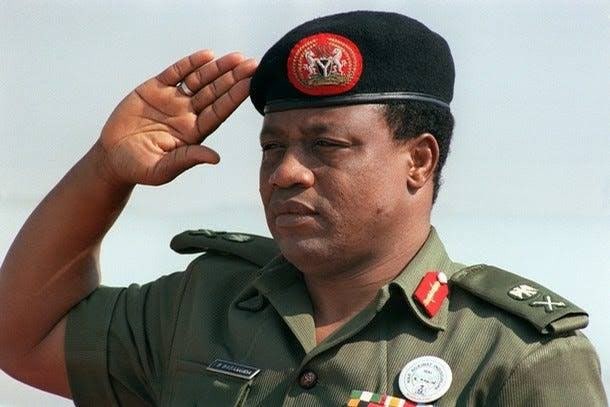
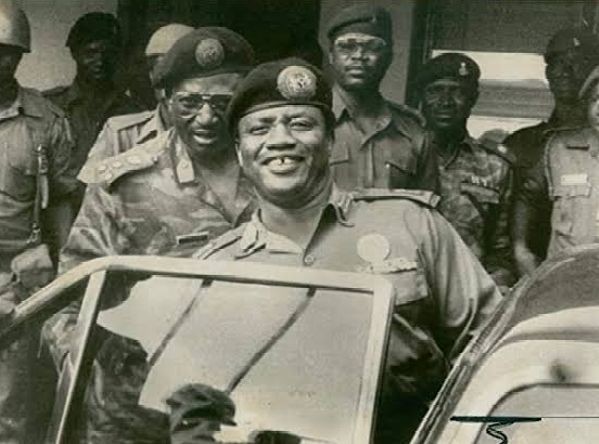
In a few days, it will be another 27th August forty-one years after then Major-General Ibrahim Badamasi Babangida led the coup d’etat that toppled the Major-General Muhammadu Buhari/Major-General Tunde Idiagbon military government. He was the Chief of Army Staff. His age was forty-four years.
As for me, I was aged forty-one and very much an idealistic young man. I am now eight-two years old. If the IBB coup had failed, I would have been part of the collateral damage. I would have been roped in. The penalty and price would almost certainly have been premature death for all those who were in any way connected with Babangida.
His Royal Majesty Oba Adedotun Aremu Gbadebo the Alake and Paramount Ruler of Egbaland was then Colonel Dotun Gbadebo, Principal Staff Officer to Major-General Tunde Idiagbon. He did not mince words when he and his entourage sat at the table next to the King’s college versus St Gregory’s College table at the Lagos Motor Boat Club, last Friday.
When Babangida struck on 27th August 1985, it was a palace coup code-named “Operation Midnight March”. The Buhari/Idiagbon’s regime was generally perceived as being too rigid, draconian and intolerant of dissent. It also coincided with economic hardship due to IMF/World Bank recommended austerity measures. Added to these were detentions without trial and clamp down on the press through the instrumentality of Decree 4 and censorship.
There was also internal dissatisfaction within the military top hierarchy. General Ibrahim Babangida announced himself as President and Commander-In-Chief. The nomenclature was no longer Head of State full stop. He promised a transition to civilian rule and a “more humane” government. He later set up “the Armed Forces Ruling Council” with Commodore Ebitu Ukiwe as the Chief of Staff, Supreme Headquarters–effectively the number two in the hierarchy.
It bears repetition that it was Brigadier Olaseinde Ishola Willaims (ex-King’s College, Lagos) who was in charge of TRADOC (Training and Doctrine) based in Minna, Niger state who called me to convey the invitation from his boss Major-General Ibrahim Babamgida, Chief of Army Staff. I was to deliver an address at the Chief of Army Staff Conference in Minna. Actually, I was out of the country. I had just arrived in London en route to the United States of America. Ishola would not take no for an answer. We were at the same Primary School – Lagos Government School, Okesuna.
The Training and Doctrine Command, TRADOC, is the Nigerian Army’s think tank and training headquarters. Headquartered in Minna, Niger State, it was established in 1981 under Major General Geoffrey Ejiga to serve as the intellectual and instructional center of the Army.
EDITOR’S PICK
- Dabiri-Erewa Celebrates ‘London Bus Aunty’ Over London Transport Honour
- 2027: Tinubu Charges APC Campaign Council to Showcase Achievements, Defeat Opposition
- Lagos Explains Delay in Replacing BRT Buses Destroyed During #EndSARS
TRADOC was modeled after the US Army Training and Doctrine Command. Its job is to shape how the Army fights, trains, and thinks. It develops doctrine, designs training curricula, evaluates force structures, and supervises all 18 Nigerian Army schools, depots, and the Command College. Before the Nigerian Army Resource Centre was created in 2015, TRADOC also acted as the Army’s senior liaison with universities and research institutions.
Beyond training, TRADOC is the custodian of Army doctrine. It studies past operations, from counter-insurgency in the North East to peacekeeping abroad, and turns those lessons into new manuals and tactics. It also runs key military exercises like Exercise Mugun Bugu and conducts the Senior Staff Course Qualifying Examination that determines which officers attend higher staff colleges.
Though some officers jokingly call postings to Minna “Siberia,” TRADOC has produced some of the Army’s top leaders. Both General Lucky Irabor and General Ibrahim Attahiru served there as Commander and Deputy Commander before becoming Chief of Defence Staff and Chief of Army Staff respectively. If the Army is the body, TRADOC is the brain and the classroom. It ensures the Nigerian Army doesn’t just fight today’s wars, but learns, adapts, and prepares for tomorrow’s.
On 27th August 2026, those of us who were around during the military era will converge at RH England at Aynho Park, Aynho, Banbury, Oxfordshire OX17 3BQ Oxford, England to reflect on what we witnessed and preview my book: “GENIUS VERSUS UNFORCED ERRORS”.
Nigeria, and indeed Africa, is blessed with extraordinary talent. From boardrooms to barracks, classrooms to marketplaces, we have men and women who deserve the title: “genius” — breakthrough ideas, bold leadership, and solutions that can change the trajectory of a nation. Yet, too often, progress is derailed not by lack of ideas or capacity, but by avoidable mistakes. In sports these are called unforced errors — points lost not because the opponent was better, but because we fumbled. Bashorun J.K. Randle, in
_Genius vs Unforced Errors_, argues that Nigeria’s greatest constraint is not a deficit of genius. It is our tolerance for unforced errors in governance, business, institutions, and personal conduct.
The book draws a distinction between two forces shaping our national destiny:
- Genius: The capacity to innovate, lead, build, and solve complex problems. It is seen in our entrepreneurs, scientists, artists, and public servants who deliver results against all odds.
- Unforced Errors: Self-inflicted setbacks. Policy somersaults, corruption, indiscipline, poor succession planning, ego-driven leadership, and the failure to execute simple things well.
The thesis is simple: We do not need more genius to develop. We need fewer unforced errors to allow the genius we already have to thrive.
The book aims to:
- Diagnose: Identify the recurring “unforced errors” in Nigeria’s public and private
- Celebrate: Highlight examples of Nigerian “genius” that have succeeded despite the system.
- Prescribe: Propose a culture of discipline, consistency, and institutional memory to minimize errors.
- Inspire: Challenge leaders to move from heroic, one-off brilliance to systems that make excellence routine.
Key Themes to be Explored
- Leadership: The difference between charismatic genius and institutional leadership.
- Governance: How policy inconsistency and lack of continuity waste national
- Business: Why Nigerian companies and individuals scale abroad but struggle at home — the error of environment.
- Military/Public Service: Lessons from TRADOC, and other institutions on doctrine vs. indiscipline.
- Personal Conduct: The unforced errors of pride, short-termism, and failure to mentor the next generation.
Policymakers, business leaders, military and civil service leadership, academics, and young professionals. The goal is to spark a national conversation about execution, not just ideas.
Genius vs Unforced Errors will serve as both a mirror and a manual. A mirror to show us where we are sabotaging ourselves. A manual to remind us that nations are not built on genius alone, but on the boring, daily work of avoiding stupid mistakes.
As Bashorun J.K. Randle puts it: “We have enough light. What we lack is the discipline not to keep blowing out the candle.”
My grandfather Dr J.K. Randle has this to his credit: “As far back as 1898, Dr John Kehinde Randle; Dr. Akinwande Savage; and Joseph Ephraim Casely Hayford (of the Gold Coast) the founders of the National Congress of British West Africa had begun to agitate for the Independence of Nigeria and the rest of West Africa.” They had in mind a Business Model whereby throughout West Africa, each village would have only three officials – a doctor to look after the health clinic; a teacher to run the local school and an engineer to supervise the road to the next village (or town). Politics would be strictly for only those who genuinely wanted to serve. However, the Nigerian economy is a totally different model. It is a mystery. A mystery of a country which has been subjected to plunder and pillage yet we expect it to prosper and be at peace. It is both a mystery and an enigma. We are in a forever war with poverty.
Here is where Professor Paul Collier of Oxford University comes in. He is a development economist, former Director of the Centre for the Study of African Economies at Oxford, and author of “The Bottom Billion”. For over 20 years he has studied why some countries stay trapped in poverty, conflict, and bad governance while others break out.
Collier’s central argument is simple and brutal: poverty is not an accident. Countries get stuck in what he calls “traps” — the conflict trap, the natural resources trap, the landlocked with bad neighbors trap, and the trap of bad governance.
Nigeria fits his diagnosis almost too perfectly. We are a country blessed with genius, resources, and human capital, yet we are caught in a cycle of plunder. We extract without building. We spend without saving. We fight over the spoils instead of growing the pie.
Collier would call this the classic case of a resource-rich country making _unforced errors_. The oil that should have been a bridge to prosperity became a curse because institutions were weak and accountability was missing. The wars we fight are not just with insurgents or with each other. We are in a forever war with poverty.
But Collier is not just a diagnostician. He is also an optimist about policy. He argues that escape is possible through 3 things:
- Good governance — rules that constrain the predatory state
- Regional integration — because no poor country develops alone
- Post-conflict strategies — deliberate choices made in the 10 years after a crisis
Many years ago, I came across an old copy of Harvard Business Review which featured an article written by two professors who postulated that if there was no government in Canada, the economy would grow by 7 percent annually.
The new generation is entitled to take my generation to task over the current state of our nation. Truly, Nigeria has always had an abundance of geniuses (human) and natural resources. However, we either neglected them or mismanaged them. Frustration all round. We now have to live (or die) with the consequences.
FURTHER READING
- ‘Irregular Migration Is Voluntary Suicide’ – Dabiri-Erewa Warns Nigerians
- ‘Kill Him!’ Disu Reveals Shocking Request From Retired Soldier Over Son
- Sanwo-Olu Presents Staff of Office to New Onise of Ise Kingdom
Those of us who have served in one capacity or the other genuinely believe that we owed our nation a duty – to serve. To quote from the school song of King’s College, Lagos: “When the call is sounded, we must answer “Here” !!”
Under General Babangida, we had the Presidential Advisory Committee (PAC) which was headed by Professor Ojetunji Aboyade. The other members were as follows: Dr Michael Omolayole, Professor Ikenna Nzimiro, Professor Akin Mabogunje, Dr. Chu Okongwu, Chief Olu Falae, Dr. Kalu Idika Kalu. The secretary was Chief Rex Akpofure (ex-King’s College and Oxford University). Chief Akpofure was also a former Principal (Headmaster) of King’s College. PAC had an office within Dodan Barracks which was the Headquarters of the Military Government.
The group to which I belonged was tagged “F9” and the Chairman was Chief Ernest Adegunle Oladeinde Shonekan, Chairman of what was then the largest multinational (conglomerate) company in Nigeria – UAC of Nigeria Plc. Our meetings were on Sunday evenings at the home of our Chairman at 1, Lugard Avenue, Ikoyi.
The other members were as follows:
- Alhaji A.O.G. Otiti (Deputy Governor Central Bank of Nigeria)
- Chief Olusegun Oshunkeye (ex-King’sCollege), Chief Executive of Nestle Nigeria Plc
- Senator (Mrs) Kofo Akerele-Bucknor
- Captain Wole Bucknor (Nigerian Navy)
- Chief Maan Lababidi (Chairman, Crown Flour Mills Limited)
- Chief K. Randle (Partner, KPMG)
- Our Secretary was Mr. Joe Obuseh who was a verysenior officer in this security
We gave advice on a wide range of issues based on our knowledge of the economy and financial market as well as international affairs/global politics. On account of our international network, we had access to global data and trends. For example, Singapore and South Korea which were at par with Nigeria in 1960 when we obtained Independence had already leapfrogged us in terms of economic performance and financial stability. We were not paid for our services. Neither were we rewarded with contracts; appointment as ambassadors; Chairmen of parastatals/Government-owned Companies. None of us was allocated oil blocks or banking licenses. Ditto: import licensees or mining rights.
Anyway, my book captures my engagements with various Heads of State and top government officials. Never did I accept any reward from them. Late General Murtala Mohammed is no longer with us. Thankfully, General Olusegun Obasanjo; General T.Y. Danjuma; and General Ibrahim Badamasi Babangida are alive and well. They would readily confirm that I never lobbied them for any appointments or reward.