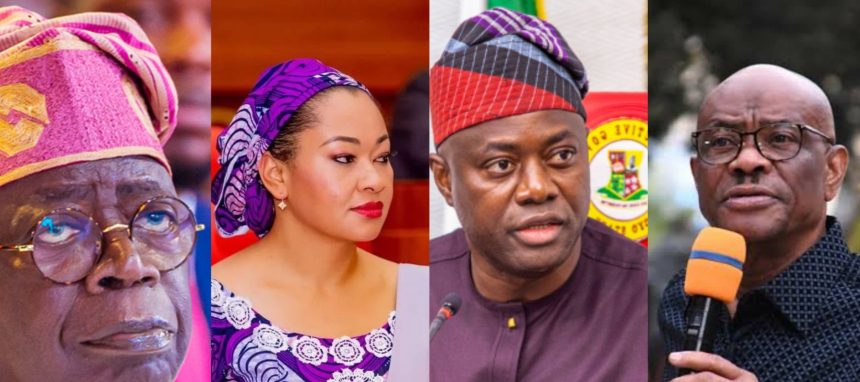
The year 2025 will be remembered as one in which Nigeria’s political system was repeatedly pushed to its constitutional and moral limits.
- EDITOR’S PICKS
- Emergency Rule in Rivers State
- Senator Natasha Akpoti-Uduaghan vs Senate President Akpabio
- Nigeria–Trump Tensions and the Sokoto Christmas Day Strike
- Mass School Abductions
- Alleged Alterations in Gazetted Tax Laws
- Nnamdi Kanu’s Imprisonment
- Tinubu’s Presidential Pardons
- Wave of Political Defections
- Criminal Allegations Against Abubakar Malami
- The Deepening PDP Crisis and Fears of a One-Party State
- FURTHER READING
Rather than a single defining crisis, the year unfolded as a series of high-stakes confrontations involving executive power, judicial authority, national security, and the credibility of democratic institutions.
EDITOR’S PICKS
Each controversy, while distinct, fed into a broader national debate about accountability and the rule of law.
From the controversial declaration of emergency rule in Rivers State to presidential pardons, political power in 2025 was frequently exercised under intense scrutiny. The presidency tested the boundaries of constitutional authority, the legislature struggled with internal legitimacy, and the judiciary found itself entangled in disputes that exposed inconsistencies. Insecurity, long Nigeria’s most persistent challenge, continued to shape political decisions, sometimes with grave consequences.
Foreign relations also intruded forcefully into domestic politics. Nigeria’s sovereignty was tested by sharp rhetoric from the United States (U.S.) and a controversial Christmas Day military strike that raised uncomfortable questions about consent and coordination. At the same time, mass school abductions highlighted the limits of state capacity, even as official assurances of improved security rang hollow in affected communities.
Meanwhile, political parties fractured and defectors flooded the ruling party. Taken together, these episodes defined 2025 not merely as a turbulent political year, but as a revealing one — exposing both the strengths and vulnerabilities of Nigeria’s democratic experiment.
Below, EKO HOT BLOG looks back at the top 10 defining political controversies of 2025:
-
Emergency Rule in Rivers State
President Bola Tinubu’s declaration of a state of emergency in Rivers State in 2025 marked one of the most consequential constitutional interventions of the year, bringing federal power, partisan rivalry, and judicial authority into direct conflict. The crisis followed prolonged political paralysis in the state, driven largely by the bitter fallout between Governor Siminalayi Fubara and his predecessor, Nyesom Wike, whose continued influence over the state’s political machinery destabilised governance and crippled the House of Assembly.
Wike, by then a minister in Tinubu’s cabinet, was widely accused by critics of orchestrating legislative obstruction and factional warfare to weaken Fubara’s administration. The breakdown of lawmaking, competing claims of legitimacy within the Assembly, and escalating security concerns provided the backdrop for Tinubu’s decision to invoke Section 305 of the Constitution, suspend the elected government, and appoint a sole administrator — a move that immediately polarised the country.
The legality of the action was swiftly challenged, culminating in a landmark Supreme Court judgment later in December. In its ruling, the apex court upheld the declaration of emergency rule, affirming the president’s constitutional powers to intervene where governance had effectively collapsed, but also cautioned against the politicisation of such powers.
-
Senator Natasha Akpoti-Uduaghan vs Senate President Akpabio
The Senate was plunged into crisis when Senator Natasha Akpoti-Uduaghan accused Senate President Godswill Akpabio of sexual harassment and intimidation. The allegation, unprecedented in its directness and the level of leadership involved, immediately dominated national discourse and exposed fault lines within the National Assembly.
Rather than establishing an independent probe, the Senate suspended Akpoti for alleged misconduct, a move widely criticised as punitive. Civil society groups, women’s rights advocates, and legal experts questioned the chamber’s handling of the matter, while the Senate insisted it acted within its rules. The controversy deepened concerns about internal accountability and gender dynamics in Nigerian politics.
-
Nigeria–Trump Tensions and the Sokoto Christmas Day Strike
Political controversy spilled beyond Nigeria’s borders after U.S. President Donald Trump accused the Nigerian government of failing to protect Christians and threatened unilateral military action. Nigerian officials rejected the characterisation, insisting insecurity in the country was not religiously driven.
Tensions reached a climax on December 25, Christmas Day, when a U.S. airstrike hit terrorist targets in Sokoto State. While the U.S. Africa Command (AFRICOM) suggested coordination with Nigerian authorities, the federal government stopped short of confirming that it had requested the strike. The episode triggered a national debate about sovereignty, transparency, and the limits of foreign military cooperation.
-
Mass School Abductions
Despite repeated assurances of improved security, 2025 saw a resurgence of mass school abductions, particularly in Niger and Kebbi States. Armed groups attacked schools in coordinated night raids, abducting students and staff and reigniting public fear reminiscent of earlier kidnapping waves.
The incidents prompted emergency security meetings, school closures, and rescue operations combining military pressure with negotiation. Although many abductees were eventually released, the attacks exposed persistent vulnerabilities and raised questions about intelligence failures and the sustainability of Nigeria’s non-kinetic approach to dealing with armed groups.
-
Alleged Alterations in Gazetted Tax Laws
A major legislative controversy erupted after discrepancies were discovered between tax bills passed by the National Assembly and the versions later gazetted and signed into law. Critics alleged that key provisions were altered without parliamentary approval, raising concerns about the integrity of the lawmaking process.
The controversy deepened when the National Assembly last Friday, December 26, ordered a re-gazetting of the laws — an action many constitutional lawyers argued it had no power to undertake. While the federal government continues to deny wrongdoing and insist that the laws will take effect as intended on January 1, 2026, the episode has shaken public confidence in the process with many influential voices, including former Vice President Atiku Abubakar, calling for a suspension of the tax laws’ implementation.
-
Nnamdi Kanu’s Imprisonment
The long-running legal saga surrounding the leader of separatist group, the Indigenous People of Biafra (IPOB), Nnamdi Kanu, reached a decisive turning point in 2025 with his conviction on terrorism-related charges and subsequent imprisonment. After years of legal disputes, adjournments, and jurisdictional arguments following his extraordinary rendition to Nigeria, the Federal Government secured a conviction that it described as a landmark victory against separatist violence.
The federal government argued that Kanu’s broadcasts and leadership of IPOB directly incited violence, disrupted public order, and contributed to deadly attacks on security personnel and public infrastructure in the South-East. The conviction was framed by the government as proof that no individual, regardless of political symbolism, was above the law.
However, the outcome did not bring closure. Supporters continued to question the broader implications of the case, particularly concerns over due process and the political roots of separatist agitation.
-
Tinubu’s Presidential Pardons
President Bola Tinubu’s exercise of presidential pardon powers in 2025 became one of the most morally charged political controversies of the year, sparking national debate over justice, mercy, and elite privilege. No pardon generated more outrage than that of Maryam Sanda, who had been convicted and sentenced to death for the murder of her husband, Bilyaminu Bello, in a case that had gripped the nation for years. News of her inclusion in the pardon list triggered widespread public backlash, particularly on social media, where many Nigerians viewed the decision as an insult to victims of domestic violence and a dangerous signal about accountability for violent crime.
Amid mounting pressure, the presidency moved swiftly to clarify and effectively scale back the decision, announcing that Sanda had not received a full pardon but a commutation of sentence, reducing her punishment rather than absolving her of guilt. The retreat was widely interpreted as an attempt to contain political damage, even as questions persisted about how her name made the initial list.
-
Wave of Political Defections
As preparations for the 2027 elections began, 2025 witnessed a wave of defections, largely into the ruling All Progressives Congress (APC). Lawmakers and governors cited internal party crises and ideological realignment, though critics pointed to political pressure and access to federal power.
The defections weakened opposition parties, particularly the Peoples Democratic Party (PDP), and raised concerns about Nigeria’s increasingly fluid party system.
-
Criminal Allegations Against Abubakar Malami
Immediate past Attorney-General of the Federation Abubakar Malami, SAN, found himself at the centre of one of 2025’s most explosive political controversies when the Economic and Financial Crimes Commission (EFCC) charged him, his son, and wife with multiple fraud and money-laundering offences involving billions of naira allegedly accumulated during and after his tenure as Nigeria’s chief law officer. The 16-count charge sheet, filed in the Federal High Court in Abuja, accuses Malami and his co-defendants of conspiring to conceal illegal funds and disguise their origin through corporate fronts and complex transactions, including allegedly laundering over ₦8.7 billion and disguising the sources of funds lodged in bank accounts and used for luxury property acquisitions.
In parallel with the criminal charges, investigators have traced as many as 41 properties across the Federal Capital Territory (FCT), Kebbi and Kano allegedly linked to Malami and his network, with an overall estimated value of around ₦212.89 billion. These include hotels, schools, factories, lands, residential estates and commercial buildings reportedly acquired through proxies and companies such as Rahamaniyya Properties Ltd, Metropolitan Auto Tech Ltd, and Meethaq Hotels Ltd.
Malami has denied any wrongdoing, but he has been remanded in Kuje Correctional Centre pending trial and has been arraigned before a Federal High Court judge.
-
The Deepening PDP Crisis and Fears of a One-Party State
The internal crisis within the PDP deepened significantly in 2025, reaching a critical point at its November national convention, which was meant to signal renewal but instead exposed the party’s profound disarray. Rather than producing unity, the convention amplified internal divisions, with parallel camps trading accusations of manipulation, sabotage, and betrayal.
The crisis escalated last Tuesday, December 23, when Oyo State Governor Seyi Makinde openly accused Wike of “holding down” the PDP for the benefit of President Tinubu in the 2027 election, an accusation the FCT minister denies. Makinde warned that sustained internal sabotage was paving the way for the emergence of a de facto one-party state.
FURTHER READING
The PDP has remained deeply fractured, with leadership disputes unresolved and the fate of the party unknown as it continued to be unable to present candidates for political offices.
Philip Ibitoye is a Special Correspondent with EKO HOT BLOG. Click here to find daily analysis and critical insight on trending issues in Lagos and other parts of Nigeria.
Click here to watch the video of the week below: