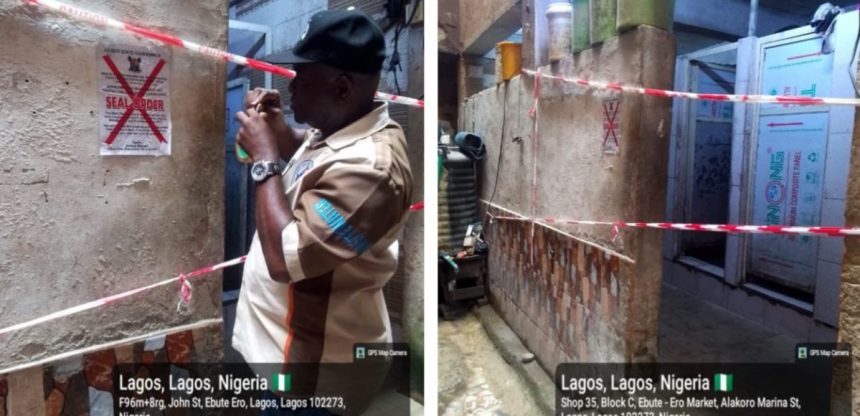
On Tuesday morning, the Lagos State Wastewater Management Office (LSWMO) sealed a public toilet on Offin Road, off Apongbon, after officials found its sewage chamber had been piped directly into a public drain.
The same day, COSJANE Mall along Festac Link Road in Amuwo Odofin was shut down, not for the first time, and not without warning.
EDITOR’S PICKS
The Commissioner for Environment and Water Resources, Tokunbo Wahab, confirmed both actions, describing them as responses to deliberate acts of environmental pollution that had caused offensive odour, sewage flow in communities, and serious risks to public health.
Today, the Lagos State Wastewater Management Office (LSWMO) sealed off a public toilet located on Offin road off Apongbon for the deliberate discharge of raw sewage into the public drain by channeling their chamber directly into the drain resulting into offensive odour and sewage… pic.twitter.com/lBaRSqCIGe
— Tokunbo Wahab (@tokunbo_wahab) March 3, 2026
The two cases are not isolated. Checks by EKO HOT BLOG reveal that, since 2024, the LSWMO and the Lagos State Environmental Protection Agency (LASEPA) have sealed restaurants, hotels, residential estates, markets and public toilets from Lekki to Idi-Araba for pumping raw sewage or untreated wastewater into the city’s drainage network.
The pattern is wide and stubborn. The question that is now hard to avoid is whether sealing a property is doing enough.
A Long List of Offenders
The scale of the problem stretches across Lagos. In August 2025, six public toilets in Idi-Araba were shut for routinely discharging raw sewage into drains, alongside residential apartments in Lekki.
In September 2025, two estates in Ikota GRA — EMCEL Court Phase I and Well Stock Apartments — were sealed for releasing untreated wastewater into public drains. Ejanla Restaurant in Lekki was found to have installed a pumping system specifically designed to divert wastewater into the drainage network.
In September 2024, Cravings & More restaurant on Egbeda-Idimu Road was shut after kitchen waste clogged drains and produced maggots. Major markets including Mile 12, Ladipo and Oyingbo were temporarily closed for the same class of offences.
What stands out is that many of these sites had been warned before enforcement action was taken. COSJANE Mall, shut again today, is a case in point. The repeat nature of the problem — across upscale Lekki and densely populated Apongbon alike — suggests that the current penalty is not changing behaviour fast enough.
What Sealings Can and Cannot Do
Sealing a property is disruptive and visible. It sends a public signal and temporarily halts operations.
For a small roadside toilet, that may be significant. For a shopping mall or a restaurant, it is a financial inconvenience, but it ends the moment the seal is lifted, often with no further consequence. There are no published records of prosecutions, fines or criminal charges arising from these enforcement actions in Lagos. The offenders are inconvenienced. They are not punished.
Discharging raw sewage into public drains is not a victimless act. It contaminates water sources, breeds disease, blocks drainage channels that then flood communities during rain, and degrades the environment for everyone nearby.
In many countries, it attracts criminal liability, not just an administrative closure. Nigeria’s National Environmental Standards and Regulations Enforcement Agency (NESREA) Act provides for fines and imprisonment for environmental violations, but that framework is rarely invoked at the state level.
The Case for Stiffer Consequences
The argument for harsher penalties is not about being punitive for its own sake. It is about deterrence. When COSJANE Mall can be sealed, reopened and then sealed again, the enforcement cycle has become predictable and therefore manageable for the offender. A meaningful financial penalty — one proportionate to the size and revenue of the establishment — would change the calculation. For repeat offenders, revocation of operating licences would change it further.
There is also a structural side to this. Some property owners discharge sewage into drains because connecting to proper sewage infrastructure is expensive, inaccessible or poorly regulated. Lagos has a sewage coverage problem that enforcement alone cannot fix. But that reality does not excuse deliberate, repeated violations, particularly from commercial properties that have the resources to comply.
FURTHER READING
Wahab’s office is doing the visible work. The sealings are necessary. But unless they are backed by fines, prosecutions and licence revocations for the worst offenders, Lagos risks running an enforcement machine that inconveniences polluters without truly stopping them.
Philip Ibitoye is a Special Correspondent with EKO HOT BLOG. Click here to find daily analysis and critical insight on trending issues in Lagos and other parts of Nigeria.
Click to watch the video of the week below: