- Labour Party clarifies that Julius Abure was elected in March 2024 for a term ending in 2028.
- The leadership describes claims of a tenure expiration as fallacious and mischievous.
- The party emphasizes that leadership matters are internal affairs beyond court jurisdiction.
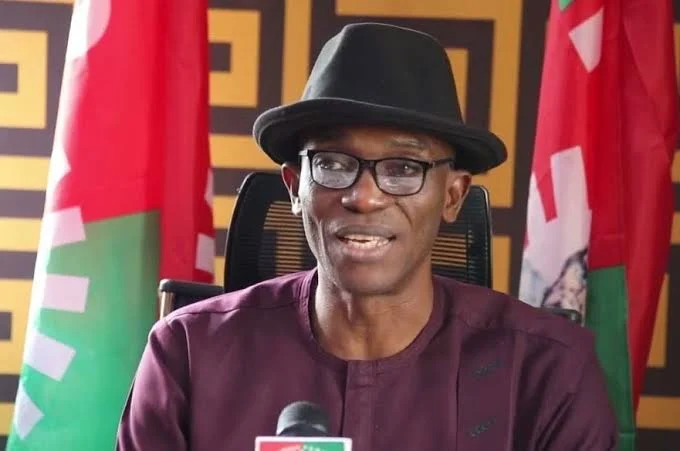
The internal leadership crisis within the Labour Party took a definitive turn on Tuesday as the Julius Abure led faction reaffirmed his position as the National Chairman.
Eko Hot Blog reports that in a statement issued by Aju Elumelu James, Special Adviser on Media and Strategic Communications to Abure, the party declared that his current tenure is constitutionally valid until 2028.
EDITOR’S PICK
- 540 Candidates Cleared as Lagos APC Moves to Elect LGA Executives
- Court Sentences Pastor to Death for Killing UniUyo Student
- Lagos Teacher Questions Lack of Recognition for One-Day Governor Mentors
This clarification was aimed at countering what the party described as a flurry of conflicting narratives and misinformation intended to distort verifiable facts regarding the leadership structure of the organization.
The statement provided a detailed chronological account of Abure’s rise to the chairmanship, beginning with the vacancy created by the death of Alhaji Abdulkadir Abdulsalam in December 2020.
Following a brief interim period under Maria Lebeke, Abure was unanimously elected on March 29, 2021, to complete the remainder of the late chairman’s term.
The party further noted that a National Executive Council meeting in Asaba in April 2023 extended that tenure by one year, eventually leading to the National Convention held on March 27, 2024, in Nnewi, where the current leadership was officially elected for a full four year term.
Addressing the ongoing legal battles, the Abure led faction maintained that the judicial process should not be used as a tool for political distortion.
The statement specifically referenced the Supreme Court’s stance, clarifying that the apex court did not invalidate the Nnewi convention.
Instead, the court held that leadership disputes are internal affairs of a political party, over which courts generally lack jurisdiction.
This legal interpretation is being used by the Abure camp to assert that only the party’s recognized organs—the National Working Committee, the NEC, and the National Convention—have the authority to determine who leads the party.
The timing of this statement is critical, as it follows a January Federal High Court ruling that purported to sack Abure and recognized a caretaker committee led by Senator Nenadi Usman.
Tensions escalated last week following accusations from the Usman led committee that Abure’s supporters had allegedly invaded the party’s national secretariat.
By releasing this constitutional timeline, the Abure faction is attempting to solidify its legitimacy in the eyes of the public and party members, dismissing the caretaker committee’s claims as legally unfounded.
The Labour Party leadership urged its members and the general public to disregard the “mischievous” suggestions that Abure’s time in office has expired.
They insisted that the 2024 convention remains the legitimate authority for the current administrative cycle.
As the matter remains before the Court of Appeal, the party’s internal divide continues to create a complex political landscape, with both factions claiming the legal and moral high ground in a struggle that will likely define the party’s trajectory toward the next general elections.