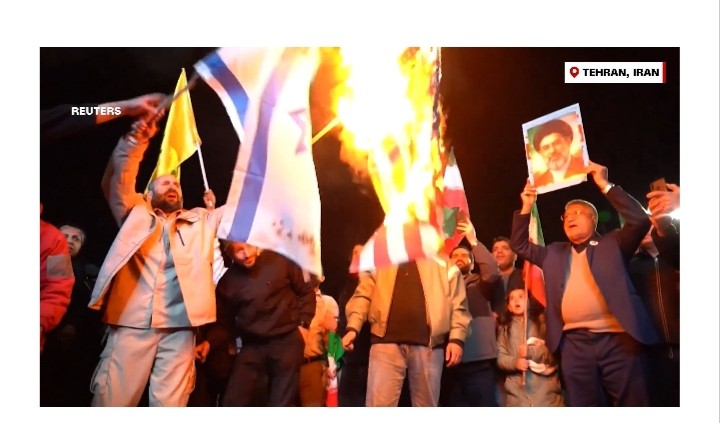
- Iranians took to the streets of Tehran in the early hours of Wednesday to protest the newly announced ceasefire, with some demonstrators burning American and Israeli flags.
- Many citizens and regime supporters expressed deep skepticism, arguing that the United States is using the truce as a tactical maneuver to allow Israel to regroup and “buy time.”
- Questions have been raised by protesters regarding the reopening of the strategic Strait of Hormuz and the wisdom of negotiating with Western powers after previous military escalations.
In the pre-dawn darkness of Wednesday, the streets of Tehran became a theater of political defiance as Iranians gathered to react to the announcement of a ceasefire.
Eko Hot Blog reports that depite the cessation of active hostilities, the mood was far from celebratory. Videos emerging from the scene captured demonstrators setting fire to American and Israeli flags, a symbolic gesture synonymous with pro-regime rallies.
EDITOR’S PICKS
- Judge Frees 37 Inmates Over Prolonged Detention in Akwa Ibom
- Trump Threatens Iran Over Energy Attacks
- Tinubu Excludes Kemi Badenoch from UK State Visit Itinerary
Supporters also waved national flags and displayed portraits of the Iranian Supreme Leader, Mojtaba Khamenei, alongside his late father, Ayatollah Ali Khamenei, signaling a strong alignment with the hardline stance of the leadership.
The sentiment on the ground, as reported by Reuters, was dominated by a profound lack of trust in the diplomatic process.
One woman at the protest emphasized that the United States has repeatedly proven itself unreliable, suggesting that Washington’s primary goal in brokering the agreement was to “re-power” its military presence and provide a strategic breather for Israel.
“I have no idea why they have accepted… like always, they want to buy time for Israel,” she noted, echoing a common refrain among the skeptical crowd who view the ceasefire as a temporary pause rather than a path to lasting peace.
Beyond general distrust, specific strategic decisions were called into question by the protesters.
Some questioned the rationale behind reopening the Strait of Hormuz, a vital maritime chokepoint that Iran has historically used as a point of leverage in international disputes.
The reluctance to trust Washington is rooted in recent history; senior Iranian officials have pointed out that the country was targeted during negotiations both at the start of the current war and during the brief, intense 12-day conflict that erupted last year.
This internal pressure and public display of skepticism highlight the delicate position of the Iranian government. While the ceasefire brings an end to the immediate exchange of fire, the “nature of America” remains a core concern for the Iranian public.
For many in Tehran, the scars of previous conflicts and the perception of biased mediation mean that this truce is viewed not as a diplomatic victory, but as a period of heightened vigilance.
As the situation unfolds, the global community will be watching to see if this fragile agreement can withstand the deep-seated animosity and strategic doubts expressed on the streets of the capital.