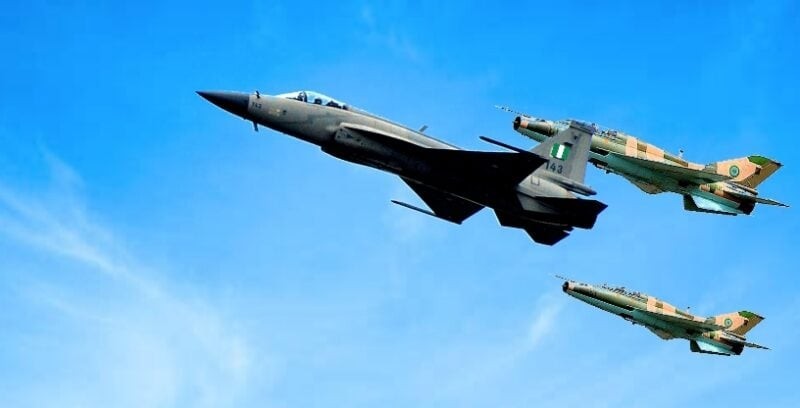
On Sunday, Nigerian military jets struck two separate locations in Northern Nigeria within hours of each other. In Zamfara State, an airstrike hit Tumfa market in Zurmi Local Government Area during active trading hours.
AFP, citing a community leader, reported that at least 72 people were killed, their bodies scattered across a market where, as Garba Ibrahim Mashema put it, “everybody — residents and bandits — goes.”
EDITOR’S PICKS
Amnesty International put the toll above 100, adding that one affected village buried 80 victims in a single ceremony. Among the dead, a local source told AFP, were young girls selling millet porridge and tofu. On the same day, a separate Nigerian Air Force operation targeting bandits in Niger State killed 13 civilians.
Defence Headquarters spokesperson Michael Onoja told AFP that reports of civilian casualties in Zamfara were “not true.” The military similarly denied that innocent people died in Niger State, though it said the incident would be investigated. Two denials, two strikes, one day.
Those denials came barely a month after jets struck Jilli market in Gubio Local Government Area of Borno State on April 11, killing what eyewitnesses told Daily Trust were at least 56 people.
Amnesty International put that figure above 100. A UN conflict monitoring report seen by AFP said the combined dead and injured numbered around 200. The Nigerian Air Force announced an investigation, details of which remain unreleased. For those tracking this issue, the sequence — strike, outrage, investigation, silence — was recognisable. It has played out at least a dozen times since 2014. What is different now is the frequency, the scale, and the growing difficulty of making the numbers disappear.
The Pattern
Since 2014, the Nigerian military has carried out at least 14 documented airstrikes that killed civilians, according to a review of reports from human rights organisations, wire services, and Nigerian newspapers. AP tallied at least 500 civilian deaths from such strikes since 2017 alone.
The incidents span both the northeast and northwest — Borno, Yobe, Zamfara, Katsina, Kaduna, Nasarawa, Sokoto — and the targets have included IDP camps, livestock markets, farming communities, religious gatherings, and weekly trade markets. What they share, almost without exception, is a familiar ending: denial or qualification from the military, a promised investigation, and silence.
The January 2017 Rann IDP camp strike, which killed 112 people including Red Cross and MSF volunteers, was the first time the military publicly admitted to a mistake of this kind.
The December 2023 Tudun Biri drone strike in Kaduna, which killed between 85 and 120 people at a religious gathering, resulted in two officers being referred for court martial. No verdict has been made public. Victims’ families are still waiting for compensation.
The Military’s Shrinking Room
What is changing is the evidentiary environment. AFP, Reuters, and Amnesty International now reach affected communities faster. Survivors speak on record. UN monitors file reports. The Jilli strike produced named survivors who directly contradicted the military’s claim that the market had been officially closed for five years. One tailor told AFP he had no idea about any closure order. He was simply there, working, before the bombing knocked him unconscious.
The military and its political allies have responded by hardening their language. After Jilli, the Federal Government described the strike as “deliberate and intelligence-led.”
Borno Governor Babagana Zulum warned residents against harbouring insurgents. After Tumfa, the military simply said the casualty reports were untrue — without offering an alternative account of events at a market AFP sources described as full of civilians buying and selling food.
The Cost of Silence
Human rights organisations have repeatedly called for independent investigations with published findings and reparations for victims. None has materialised in any meaningful form. What exists instead is a system in which the burden of proof falls entirely on the dead.
“The authorities must investigate these deadly strikes and put an end to reckless attacks on civilians,” Amnesty International said after Tumfa.
FURTHER READING
It is not the first time the organisation has said this. It will likely not be the last, unless something structurally changes in how the Nigerian military plans, executes, and accounts for its air operations.
Philip Ibitoye is a Special Correspondent with EKO HOT BLOG. Click here to find daily analysis and critical insight on trending issues in Lagos and other parts of Nigeria.
Click to watch the video of the week below: