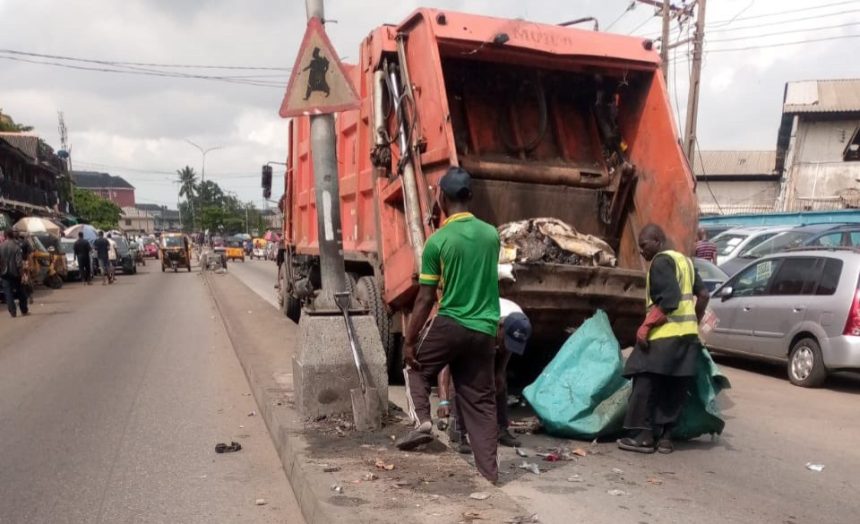
For the better part of the past two weeks, Lagos looked like a city that had given up on itself. Heaps of uncollected refuse lined road medians, clogged drainage channels and spilled onto pavements across the state, from Mushin to Egbeda, from Surulere to the Island.
Residents have posted photos and videos, complained on social media, and demanded answers. The images have been damning.
Snapshot from Lagos today…
1. Idi-Araba
2. Ikeja( state command street)
3 &4. Munshine
Eko oni baje o https://t.co/A9hZZ63ai5 pic.twitter.com/GhqDYJW9Ve
— Oluwanifise (@Oluwanifise13) June 18, 2026
There's a whole regulation body for sanitation in Nigeria. In fact, I grew up knowing there was sanitation every Thursday.
How did we regress so badly? What exactly does this government do for us?
There's a whole sitting minister of health and Lagos stinks badly. https://t.co/ipR0s8h74d pic.twitter.com/XBs0KlrCUe
— Moyomss🍒 (@moyomss) June 15, 2026
EDITOR’S PICKS
Then, following sustained public outrage, the Lagos State Waste Management Authority (LAWMA) moved. Trucks returned to the streets. The heaps began to disappear. The crisis, at least visually, appears to be receding.
The Lagos Waste Management Authority (LAWMA) Intervention Team has successfully cleared heaps of illegally dumped waste from the median of the Egbeda–Idimu Road and Lawanson, Surulere corridor.
The Authority used the opportunity to reiterate its warning to residents, traders,… pic.twitter.com/3JgCTh1J9p
— Tokunbo Wahab (@tokunbo_wahab) June 16, 2026
Yesterday, while passing through Fadeyi Road, I saw someone dumping refuse illegally and had to stop to document it. I also raised concerns about the growing heap of waste at the location.
Today, I passed by again and was pleased to see LAWMA already clearing the site. Kudos to… https://t.co/yGmolpV7ph pic.twitter.com/mDmCKER1b6
— Amb. MOYOSORE BADEJO (@MJAY_MOG) June 17, 2026
But a question lingers: what happens next time?
How Did It Get This Bad?
The immediate cause of the crisis was a breakdown in LAWMA’s waste collection schedule.
Several residents reported that collection agents, whether LAWMA-operated or private PSP operators contracted by the agency, had not visited their areas in over two weeks. With nowhere to put accumulating household waste, residents did what Lagosians have long done: they found the nearest road median or junction and dumped it there.
The behaviour is not new. What was new this time was the scale and the speed with which it attracted public attention. But the underlying conditions — irregular collection, absent street bins, zero enforcement of waste disposal laws — have existed for years.
Does Cleaning It Up Send the Wrong Signal?
Here lies the uncomfortable question at the heart of this crisis. When the government clears refuse that residents dumped illegally on road medians, is it not, in effect, rewarding that behaviour? If the consequence of dumping on the road is simply that the government eventually cleans it up, what deters the next round of dumping?
This is not an argument against clearing the trash, the public health risk alone makes that non-negotiable. But cleaning up without accountability is an incomplete response. It addresses the symptom while leaving the conditions that produced it entirely intact.
What Needs to Change
Three things must happen for this crisis not to repeat itself.
First, LAWMA must restore and maintain a reliable, publicised collection schedule. Residents who dispose of their waste responsibly through designated drums or PSP operators should never find themselves sitting on two weeks of uncollected refuse. Where private operators are failing, the agency must step in or replace them. The system cannot collapse quietly and then expect residents not to improvise.
Second, the state and local governments must invest in street-level infrastructure. Lagos has almost no public waste bins on its roads and walkways. When a resident finishing a bottle of water on the street has nowhere to put it, the road becomes the default bin. That is a structural failure, not merely a moral one.
Third, and most critically, there must be enforcement. Lagos has laws against indiscriminate waste disposal. They are almost never applied. A serious government response to this crisis would include visible, consistent prosecution of illegal dumping, not just a clean-up exercise that will be forgotten by the next collection breakdown.
The Culture Question
None of this fully removes individual responsibility. As Japanese World Cup fans demonstrated last week in the United States — cleaning stadiums with bags they brought themselves, without being asked — civic culture is not always a product of government action. It can be chosen.
The reason Japan fans clean the stadium after each game. Respect. 🤝🇯🇵 pic.twitter.com/o9qJUOLefY
— FIFA (@FIFAcom) June 15, 2026
But culture is also shaped by environment and consequence. When people dump refuse on Lagos roads and face no penalty, and when the government eventually clears it anyway, the lesson learned is that the behaviour is acceptable. It is not.
FURTHER READING
LAWMA cleaning up Lagos is necessary, but it is not sufficient. Without structural reform and real enforcement, the only question is not whether this crisis will repeat itself, but when.
Philip Ibitoye is a Special Correspondent with EKO HOT BLOG. Click here to find daily analysis and critical insight on trending issues in Lagos and other parts of Nigeria.
Click to watch the video of the week below: