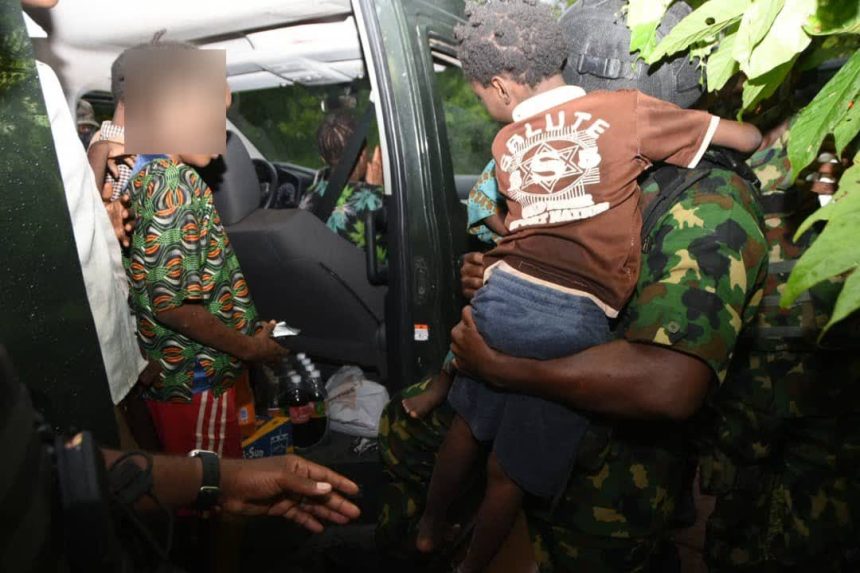
In recent years, when security agencies announced the rescue of kidnap victims, they were often met with a skeptical public because those operations often came without any mention of arrests or killings of the kidnappers. The question is usually simple: how did you secure the release of captives without a single casualty or arrest on the side of the kidnappers?
For example, last November, when 38 worshippers abducted from a branch of the Christ Apostolic Church at Oke Isegun and Eruku community in Kwara State were released, presidential spokesperson Bayo Onanuga claimed that security forces deployed a non-kinetic approach to secure their freedom.
EDITOR’S PICKS
- What Tinubu Wants ICPC To Uncover About PFIPC, Adeyemi
- 2% of GDP ‘Missing’ or Just Unreported? Inside the IMF Controversy
“The security agencies have a way of contacting these people. They (bandits) know the consequences of not acquiescing to government demands. They know they could be pummelled,” Onanuga said in an interview.
Such opaque contacts with terrorists have often led to the perception of the government secretly paying ransom, effectively empowering them to carry out future attacks.
But on Friday, there seemed to be a shift with the rescue of 44 pupils and teachers seized by terrorists from schools in Oriire Local Government Area of Oyo State on May 15, 2026. In a statement, Onanuga said eight of the kidnappers were arrested and are now in the custody of the Department of State Services, while some were killed during the encounter.
“There was no quid pro quo in the rescue, as one of the terrorists, a kingpin whose release the kidnappers demanded, is being prosecuted for his atrocities,” the president’s spokesperson added.
Updated: in the course of the rescue operation, eight of the kidnappers were arrested and are now in DSS custody, while some of them were neutralised. There was no quid pro quo in the rescue as one of the terrorists, a kingpin, that the kidnappers demanded his release, is being… pic.twitter.com/26q9himKyo
— Bayo Onanuga, OON, CON (@aonanuga1956) July 10, 2026
The Nigerian Army also revealed there was a shootout between security operatives and the kidnappers, leading to casualties on the side of the security forces.
A Departure From the Established Pattern
This marks a notable break from the pattern Nigerians have grown used to.
For a government frequently criticised for handling insurgency and banditry with an information vacuum, naming arrests, a prosecution and casualties among attackers signals an attempt at greater transparency.

The Army’s statement went further, detailing a month-long operation involving the 2 Division, the National Counter Terrorism Center, Special Forces from the three services, DSS, NIA, NSCDC and local vigilante groups, and describing efforts to dismantle the kidnappers’ networks, informants and hideouts within the Old Oyo National Park Forest.
For families of victims and a public long weary of ransom speculation, this level of detail could reasonably be read as a good-faith effort to show that the state, not the criminals, dictated the terms of the children’s freedom.
Notably, unlike previous operations where agencies have released photographs of arrested suspects or those killed as evidence, no such images have accompanied this account so far. That may simply reflect an ongoing investigation, but it is a detail some Nigerians expecting visual proof may notice.
What It Could Mean for Future Rescues
If the arrests and casualties disclosed this time hold up under scrutiny, the Oriire operation could become something of a template for how government communicates future rescues.
For years, the standard script has been rescue first, silence on consequences after, an approach that left room for speculation about backroom deals. A model where agencies name arrests, confirm prosecutions and account for casualties on both sides gives the public something more concrete to measure future claims against.
This matters because public confidence in security operations rarely rests on a single announcement; it accumulates, or erodes, over a series of them.
Nigerians comparing this rescue to November’s Kwara release will notice the shift in language: where that earlier explanation leaned on persuasion and unspecified consequences, this one points to arrests in DSS custody and a kingpin facing prosecution.
Whether the public reads that as decisive action or a one-off show of force may depend on what follows, including whether the suspects face trial and whether the “further operations” the Army promised materialise visibly.
A Cautiously Positive Signal
There is a risk worth naming softly, too. Once agencies attach numbers, arrests and casualties to a rescue, they set a new bar for themselves; a return to vague reassurance in future operations could work against the government rather than for it.
FURTHER READING
For now, the safe return of the Oriire pupils and teachers, paired with a security establishment naming its wins in specific terms, represents a meaningfully different posture from past rescues, one that, if sustained, could gradually rebuild public trust in how captives come home.
Philip Ibitoye is a Special Correspondent with EKO HOT BLOG. Click here to find daily analysis and critical insight on trending issues in Lagos and other parts of Nigeria.
Click to watch the video of the week below: