
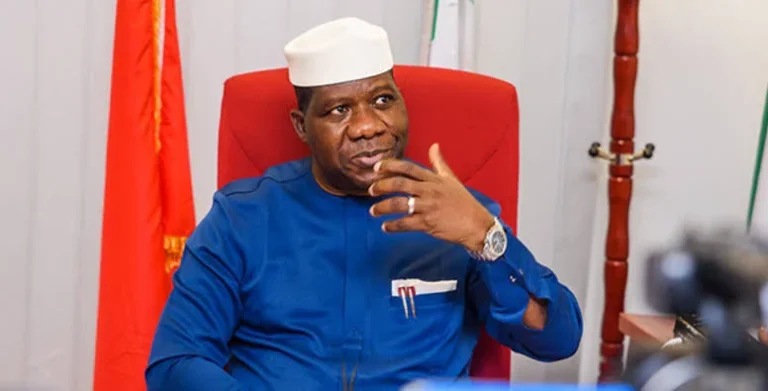
The Senate Leader, Opeyemi Bamidele, on Wednesday, disclosed that the National Assembly is proposing constitutional guarantees for the financial autonomy of state police, as part of the ongoing amendment of the 1999 Constitution.
Bamidele, who is also Vice Chairman of the Senate Committee on the Review of the 1999 Constitution, said funding for the proposed state police services should be placed on a first-line charge, a status currently reserved for bodies like the judiciary.
EDITOR’S PICKS
The Speaker of the House of Representatives, Abbas Tajudeen, gave a similar assurance at a National Security Roundtable, saying the Executive Bill before the National Assembly contains safeguards to stop governors or political actors from hijacking state-controlled security outfits.
Learning From History
Bamidele said many of the fears around state police are rooted in Nigeria’s experience during the First Republic.
Under the 1960 and 1963 Constitutions, regional governments controlled their own police forces, and this led to claims of abuse and political persecution. He said those memories explain why Nigerians are cautious about handing state governors control over policing today, and described the concerns as legitimate rather than baseless.
To address this, lawmakers are working on what Bamidele called a multi-layered framework built around institutional independence, fiscal autonomy and operational discipline.
The idea is that a state police service tied too closely to a governor’s discretion, especially for its budget, could be pressured or weakened whenever there is a disagreement between police leadership and the state government.
The Judiciary Model
The centrepiece of this framework is the first-line charge proposal. This would mean state police funding is deducted directly from a state’s revenue before it reaches the governor’s office, the same way judiciary funds are protected from being caught up in yearly budget battles. Bamidele argued that leaving state police funding entirely at the discretion of governors could undermine the force’s effectiveness and independence.
His reasoning is straightforward: whoever controls the money controls the institution.
As the top senator put it, funding shapes behaviour, and a poorly funded state police service risks becoming, in his words, “a highway to nowhere.”
Without guaranteed financing, Bamidele warned, decentralised policing would struggle to meet its constitutional responsibilities, no matter how well the law is written on paper.
Beyond Political Abuse
Bamidele also broadened the conversation beyond the usual fear of governors misusing state police. He cautioned that a cash-strapped police service is vulnerable to more than just political interference. Wealthy individuals, organised business interests, and criminal networks could all step in to fill funding gaps, and in doing so, gain influence over how the police operate in a state. This is why he insists that fiscal autonomy is not just about protecting state police from governors, but about protecting it from any actor with deep pockets and something to gain.
This is the core argument tying the whole proposal together. Structural safeguards on paper, such as rules on appointments, oversight boards, or operational guidelines, mean little if the police service still has to go cap in hand to anyone for its basic funding.
Money determines loyalty in practice, even when the law says otherwise. That is why the judiciary comparison is key: courts are considered independent partly because their funding is insulated from yearly political horse-trading. Bamidele and Tajudeen are betting that the same insulation, extended to state police, is what will determine whether decentralised policing succeeds or becomes another failed reform.
FURTHER READING
For Nigerians watching the constitutional amendment process, the practical question is whether lawmakers will actually write first-line charge protection into the final document, and whether states will have the revenue base to make that guarantee meaningful. A promise of fiscal autonomy is only as strong as the funding behind it.
Philip Ibitoye is a Special Correspondent with EKO HOT BLOG. Click here to find daily analysis and critical insight on trending issues in Lagos and other parts of Nigeria.
Click to watch the video of the week below: