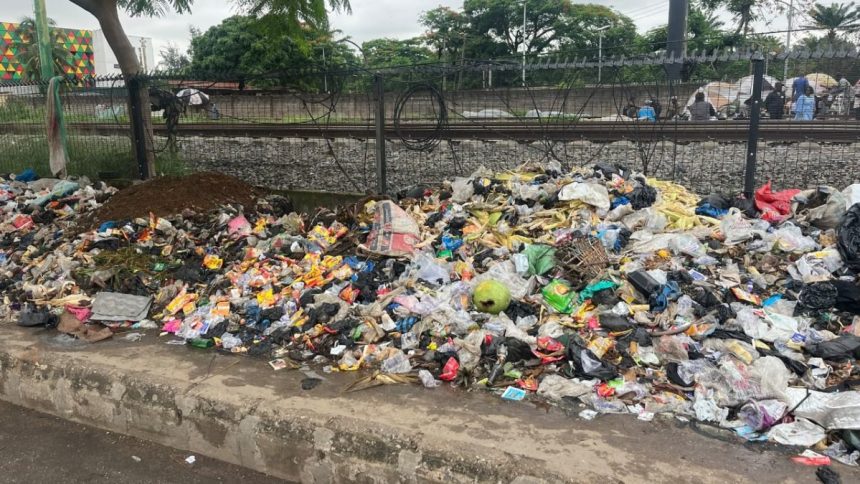
Lagos State Deputy Governor, Obafemi Hamzat, has blamed the state’s worsening waste crisis on higher-than-expected refuse volumes, a shortage of working trucks, and struggling private waste operators.
Speaking on Nigerian Info 99.3FM on Tuesday, Hamzat said the state government had estimated Lagos generates about 13,000 tonnes of waste daily, only to discover the real figure is closer to 17,000 tonnes.
EDITOR’S PICKS
He said this gap, combined with a truck shortage among the roughly 420 private firms that collect waste under contract with the Lagos Waste Management Authority (LAWMA), has made planning difficult. New trucks ordered to fill the gap, he said, will now arrive in September instead of July.
It is a candid admission. But candour does not fix the waste piling up on Lagos streets, and much of what Hamzat described points to problems the state has had every opportunity to solve.
🗣️ "We thought Lagos was generating 13,000 tonnes of waste daily. It turns out it's about 17,000."
🗣️"How do you plan for what you cannot measure?"
Lagos Deputy Governor, Dr. Obafemi Hamzat (@drobafemihamzat ), says the state underestimated the true volume of waste being… pic.twitter.com/GPslrIyOAj
— Nigeria Info FM 99.3 (@NigeriainfoFM) August 11, 2026
A Data Problem Lagos Should Have Solved Years Ago
The most striking part of Hamzat’s explanation is that the state is only now discovering how much waste it actually generates. Lagos has run a dedicated waste authority since 1977 and rebuilt it multiple times, most recently in 2007. Nearly two decades after LAWMA’s last major overhaul, and after years of private sector participation in collection, getting an accurate daily tonnage figure should not still be a mystery.
Waste volume is not exotic data. It can be tracked at landfills, weighbridges, and transfer stations, all of which LAWMA operates or supervises.
If the state has been under-measuring its own waste by roughly 30 percent, that points less to an unpredictable population and more to years of weak monitoring.

Hamzat’s comparison to Accra, Lome, and Freetown may be accurate, but citing regional disorganisation does not explain why Lagos, Nigeria’s wealthiest state and its commercial capital, has not built the basic measurement systems its own waste agency needs to plan.
One Agency, One Impossible Job
The deeper issue is structural, and Hamzat’s own account illustrates it. LAWMA is a single state agency asked to coordinate waste management for a megacity of over 20 million people spread across 57 local governments and LCDAs, each with different population densities, street trading patterns, and informal settlements.
Hamzat said he would not “throw LAWMA under the bus” because the agency was simply not built for a job of this scale. That is precisely the point. Lagos keeps assigning an ever-growing burden to one centralised authority without changing the model that created the burden.
This is not a new pattern. LAWMA has been restructured before, private operators were brought in specifically to ease its load, and the state still ended up here: one authority absorbing the shock of underestimated volumes, ageing trucks, and delayed procurement, all at once.
Devolve the Work, Devolve the Blame
If the problem is that one agency cannot manage refuse across a city this large, the obvious question is why local governments and LCDAs are not directly responsible for collection in their own areas.
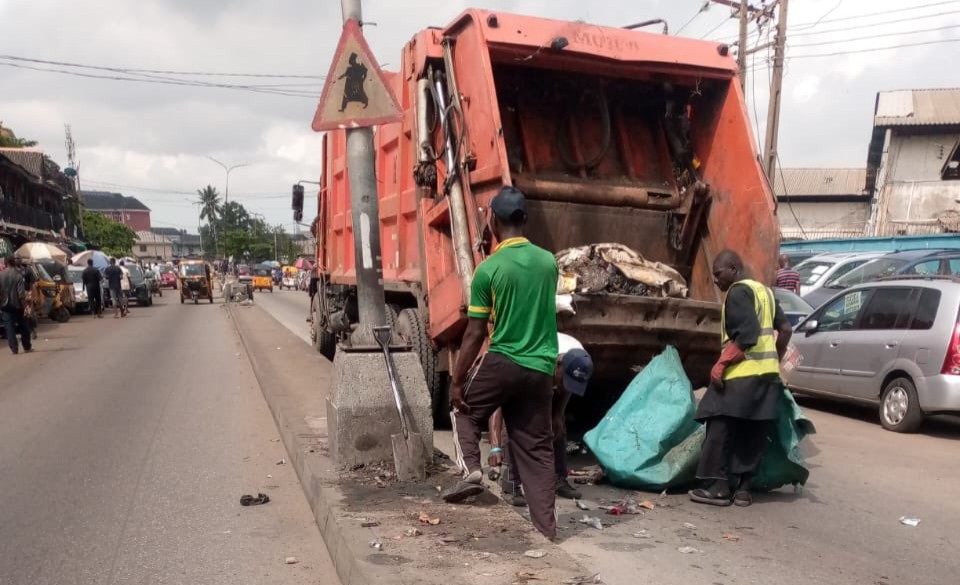
Each of Lagos’s 57 councils already has local knowledge of its streets, markets, and informal waste generators, the very “people who sleep on the street” and “young boys that scrape the street” that Hamzat says are hard for LAWMA to plan for from a central office. A council-level system would put waste management decisions closer to the waste itself.
This would not eliminate LAWMA’s role. The agency could still set standards, manage landfills, and coordinate across councils.
But routine collection, truck deployment, and contracting with private operators could sit with local governments, spreading both the workload and the accountability. It would also make truck shortages and diesel cost pressures a local, trackable problem rather than a single point of failure for the whole state.
The Real Test
Lagos has now ordered new trucks, promised financial support to operators, and admitted its own data was wrong. Those are short-term fixes. The state’s long-term problem is that it keeps loading more responsibility onto the same centralised model that has struggled for decades.
FURTHER READING
Until Lagos is willing to change how waste management is structured, not just how much money or how many trucks it throws at LAWMA, the crisis Hamzat described today will resurface again.
Philip Ibitoye is a Special Correspondent with EKO HOT BLOG. Click here to find daily analysis and critical insight on trending issues in Lagos and other parts of Nigeria.
Click to watch the video of the week below: